Editor's note: When the Thomas J. Pappas School was founded nearly two decades ago, it served just eight homeless children in Phoenix. Since then, Pappas has grown to three schools in Tempe and Phoenix and has taught thousands of elementary and middle school students. But after recent controversies over financial problems and students' test scores, according to media reports, the Maricopa County Board of Supervisors, the county treasurer and a court-appointed school board reached a settlement earlier this month to close the schools in June. While still expected to be appealed, Pappas students will likely be mainstreamed into other public schools. Below, SPM writer Dan O'Connor, who spent months getting to know the school and writing this story, speaks to the students and faculty who have shaped Pappas as they prepare to say goodbye.
"I wanna be a cop or a waiter."
Eight-year-old Duray Walker's eyes beam with confidence as he speaks. "I wanna be a waiter 'cause I sold lemonade by my house one day and made $75, and this guy told me I should be a waiter. But I think I wanna be a cop because I want to get all the bad guys like shooters and stop drive-bys off the street." Walker was a second grader at Thomas J. Pappas School For Homeless Children in Phoenix last year. He recently moved from a shelter into a house with his grandmother off of 30th Street and Roosevelt Street. Things are better now that his mom and dad aren't fighting. There's no need to hide anymore, he says.
Walker was considered a fortunate kid at Pappas. The school deemed him ready to be integrated into the public school system this year, but he says he would have liked another year at Pappas. He was among friends at Pappas, and there was no telling how other kids might treat him at a public school. But this year Walker faced his fears and now attends a public school.
All Pappas kids will be forced to make the same transition that Walker did this year. Pappas schools are closing. The media has speculated that ASU downtown campus housing or office complexes for the UA-ASU biomedical campus might go in place of Pappas' downtown Phoenix location, but city officials haven't said what will happen with the property, Principal Gina Gerdon says. She had to hear the news from an article in The Arizona Republic.
No one came to talk to the kids or offer the staff advice about how to handle the transition, she says. Public schools aren't equipped with the resources to handle all the needs of homeless children, which may cause many to drop out, she added.
But she's going to be especially strong in the school's final year — for the kids' sake.
"Until June 30th, we're going to get the kids here every day and make this the best year of their lives," she says. "Today they need us. Tomorrow they need us. I will ... I have to be here for them."
Life is different at Pappas
Most kids aren't as lucky as Walker. Many don't have an address. The shelters, hotels, cars or parks they call home aren't permanent. Neither is their stay at Pappas, but almost all of the kids say they like being there, among friends, feeling safe, special and cared for, opposed to being at "home."
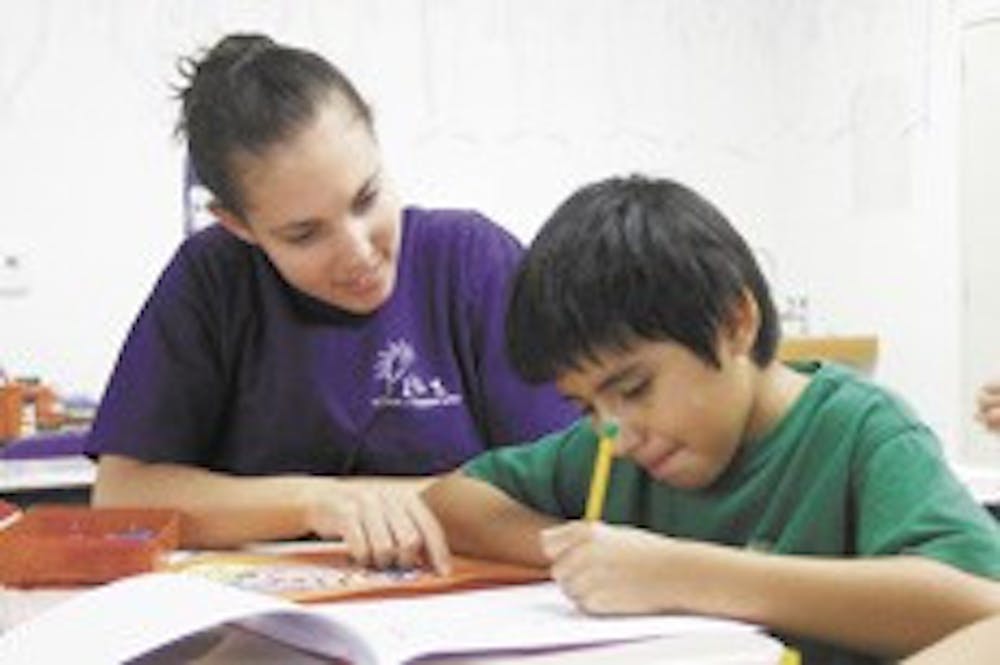
Vanessa Bond is a second grade teacher at Pappas. To the kids, she's known as Ms. Bond and is a magnet for hugs and love from all of her students.
"This is what my class looked like in January," says Bond, a 2004 primary education ASU graduate, as she points to a photo of an overcrowded classroom of 38 children. "Now look. We're down to 23."
Pappas students in Bond's class face challenges getting to school that many other elementary school students never face. The school spends extra attention tracking down the kids each day, making sure they get to school. Buses drive hundreds of miles on a daily basis to accommodate the kids' needs.
"The population at Pappas is transient in nature," Bond says, as her class writes to an old friend that suddenly disappeared in January. Their friend was forced to leave Pappas and move to Apache Junction with foster care because her mom was in jail, accused of murdering the girl's brother.
Life is fragile at Pappas
Most kids who attend Pappas depend on it for much more than just an education. The school provides them with needs many kids take for granted: two meals a day, a shower, clothing, free medical attention and love.
Phoebe Thomas, the donations manager at Pappas, is in charge of making sure each student receives a hygienic kit three times a week filled with toothpaste, deodorant, soap and a washcloth, among other amenities. The kids are also invited to visit "The Gap" with her, which is actually a room in the back of the school consisting of community-donated clothes. Placing a name brand on the room allows the kids to experience a surreal adventure when sifting through hand-me-downs, Thomas says.
"I give them a shopping bag with the [hygiene] kit and a week's supply of underwear and socks and take 'em over to The Gap," she says with a wide grin.
"Oooh, they get so excited!"
Thomas says she loves knowing that she makes a positive difference in 480 kids' lives.
"In the morning, I'll see a kid that has been sleeping all night in a car, and I can tell they're not happy," she says, shaking her head. "But honey, if I get 'em all dressed up and into the nurse's office and showered up, it's like nothin' ever happened. We make 'em feel different here. … When you smell better and look better, you'll think better."
Thomas says that every kid shops at "The Gap. They are all in need, and the makeshift store provides them with the confidence they require to get their days started on a positive note. Pappas kids share a common bond in their needs. She says no kids are ashamed to come see her.
Differences are embraced at Pappas
Even though it may be easy to keep a watchful eye on the kids while they are at school, it's hard to predict what will happen when they leave. It was social worker Erin Angelini's job to keep in contact with the kids outside of the school and make house calls when needed.
"Sometimes kids will be missing for three days at a time and it's my job to go out and find them," she said in an April interview. "Maybe they're sick, but we tell the kids, 'Come to school when you're sick. We'll help you.' That's what our pediatrician is here for."
Angelini said it's tough keeping track of the kids because of the transient tendencies of their parents. Sometimes they wander the streets for days at a time.
"My biggest goal is gaining [parents'] trust so they can tell me their problems," she said. "The more I know, the more I can help."
Pappas lost Angelini earlier this school year after she suffered a fatal heart attack. Her shoes are ones that are not easily filled by Pappas' staff this year, but they're trying to manage, Gerdon says.
But next year, the public schools taking on the task of accommodating Pappas' kids will be in for an even bigger challenge. Pappas provides homeless children the necessities they need to get a proper education, and public schools won't stand a chance, Gerdon says. The most the Pappas staff can do now is ensure the time they have remaining with the kids is cherished, she says.
"Helping [Pappas' kids and parents] has meant the world to me in my life," Angelini said. "I can see that what I'm doing here makes a difference."
Reach the reporter: daniel.oconnor@asu.edu.