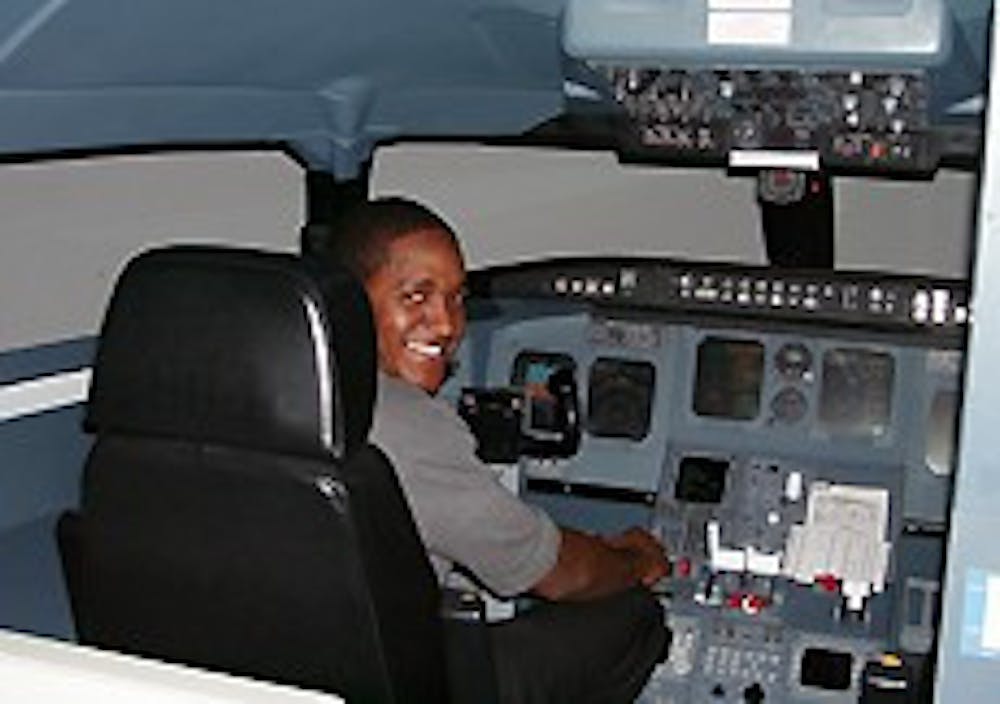
ASU Polytechnic alumnus Carleton McQueen is flying high.
McQueen, a 23-year-old graduate from the Aeronautical Management Technology program, earned captain status this month at Mesa Airlines less than a year and a half after graduating.
"That's the shortest time one of our graduates has been selected for captain by Mesa Airlines," said Jim Anderson, a lecturer for the AMT program.
McQueen was in transit and unavailable for comment on this article.
Pilots from ASU's program usually become captains two to three years after graduation, Anderson said.
The AMT program at the Polytechnic campus is more accelerated than programs at other schools, where students usually don't become pilots until they've flown for at least five years, said Rick Charles, chair of the AMT department.
"[McQueen] apparently did a hell of a job," he added.
Students of the professional pilot program begin flying their first semester of college, said Charles. They train both in actual airplanes as well as in comprehensive flight simulators.
"[The program is] the only one in the country that graduates students directly into airline flying," he said.
Students in the aeronautical field have the opportunity at the Polytechnic campus to practice flying in the same flight simulators as the pilots of Mesa Airlines, Anderson added.
The program shares various simulators with the airline, varying from desktop computer simulators to a $19 million simulator that is balanced on hydraulics.
The simulator is used by Mesa Airlines to train their pilots. It replicates the inside of a cockpit and pilots training in it are put into various emergency situations — such as simulated thunderstorms and engine failures — by their instructor.
The simulator imitates visuals from Phoenix Sky Harbor Airport and is so advanced that the pilots are able to receive their licenses solely through the use of the simulator, Charles said.
The first time they fly the actual plane for Mesa Airlines, actual passengers are on board, added Charles.
AMT students move through the program quickly and are able to become flight instructors by the middle of their junior year, Charles added.
Graduating students are guaranteed an interview with Mesa Airlines, which has a 98 percent rate of hiring AMT graduates.
Hired pilots begin as first class officers, sitting at the captain's right hand. After logging 1,500 hours of flight time, or about 62 24-hour days in the air, pilots are able to apply to be captains.
Acquiring 1,500 hours of flight time is not an easy task, Charles said.
Students accrue only half an hour's worth per hour when they are second in command, and earn a full hour-per-hour as a pilot in command of the aircraft or simulator.
David Steele, a senior at Polytechnic and friend of McQueen's, said McQueen has been an inspiration. As a flight instructor at Polytechnic, McQueen was always there for his students, Steele said.
"He'd always go that extra step that other instructors wouldn't," he said.
Steele is also a flight instructor and said McQueen shows what students of the AMT program are able to achieve.
"[As a flight instructor], it's a joy to give back to the program that's given a lot to me," he said.
Reach the reporter at indra.ekmanis@asu.edu.