In January 2010, Polaroid plans to discontinue their iconic, instant-developing photo cameras, so the Scottsdale Museum of Contemporary Art decided to use the endangered camera as part of their latest project.
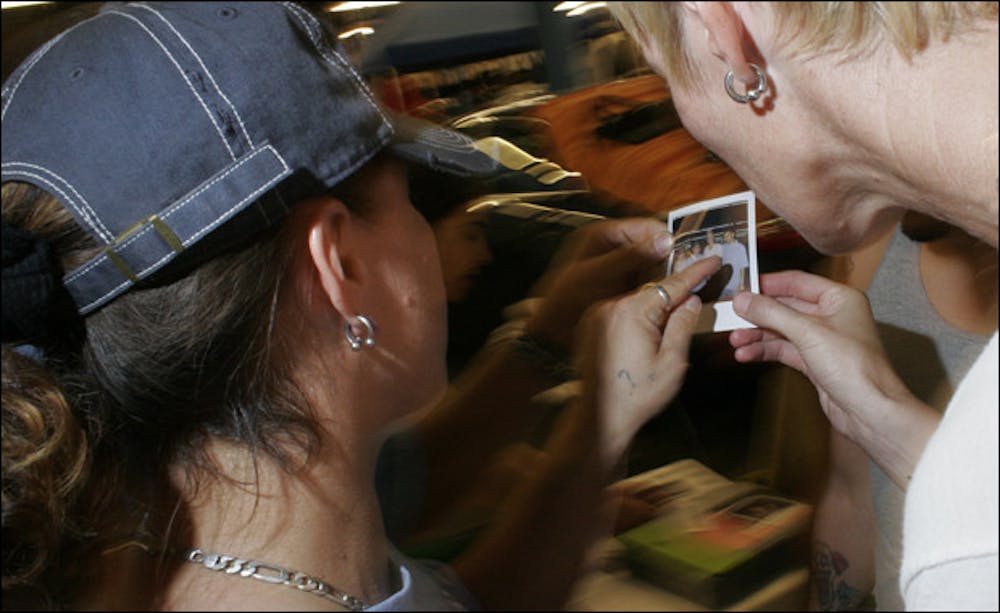
Part of their Scottsdale Museum of Contemporary Art in the Community series, the museum attracted both vintage camera connoisseurs and passing posers to their Polaroid Project at the Phoenix Park ‘n Swap on Wednesday night.
Nestled between stalling selling a candy stand and discounted purses, the museum booth doesn’t resemble a museum.
A clown making balloon animals circled the booth like a more colorful museum curator and, in the background, the sound of mariachi music blended with the theme from Super Mario World. Every so often the man pushed a cart stocked with popcorn and shouted, “¡Palomitas!”
Museum staff invited people to pose in photos, either to keep or to donate to the museum and have scanned onto the event blog, www.smocaprojects.blogspot.com.
After most photos, the participants shook their pictures wildly, a tribute to OutKast’s “Hey Ya!”
The inspiration behind the event came from Pedro Meyer’s “Heresies,” an exhibit showing at the museum starting Oct. 5.
“Heresies” will open in more than 60 museums internationally next week, from Croatia to Belgium to Scottsdale. The Scottsdale Museum of Contemporary Art is the only participating venue in the Southwest.
Meyer, a Mexican photographer, has worked to explore and expand the medium for over 40 years. In the 1990s, he was one of the first to use digital photography and amassed hundreds of thousands of photographs over his career.
Recently, Meyer hired curators worldwide to organize his work into subject categories and put together an exhibit.
Lara Taubman curates the Scottsdale exhibit and said she felt the Polaroid Project was ideal for promoting Meyer’s exhibit.
Surrounded by the noise and crowd of the Park ‘n Swap, Taubman said the atmosphere paid tribute to Meyer’s work, which features many pictures of people on the street.
“Pedro’s work deals with international context and community,” she said. “It’s very much about engaging the world in its local communities everywhere.”
Taubman personally chose the exhibit’s photographs from Meyer’s archives, selecting portraits of women; people and the urban environment of Mexico City; student protests of 1968; the Nicaraguan civil war of the 1980s and Cuba in the 1980s. The photos will become part of the museum’s permanent collection.
Taubman said she selected 40 to 50 photos she felt best embodied the Southwest.
She said Polaroid Project promoted Meyer’s idea of mass information distribution through photography.
“I felt very strongly that the programming needed to be as unusual as the exhibit,” she said.
Sociocultural anthropology graduate student April Bojorquez worked as a guest curator at the exhibit and coordinated Polaroid Project.
“I thought it would be interesting to put the museum in a new context,” Bojorquez said. “Who knows what’s going to happen with Polaroid? It could be worth saving.”
Reach the reporter at channing.turner@asu.edu.