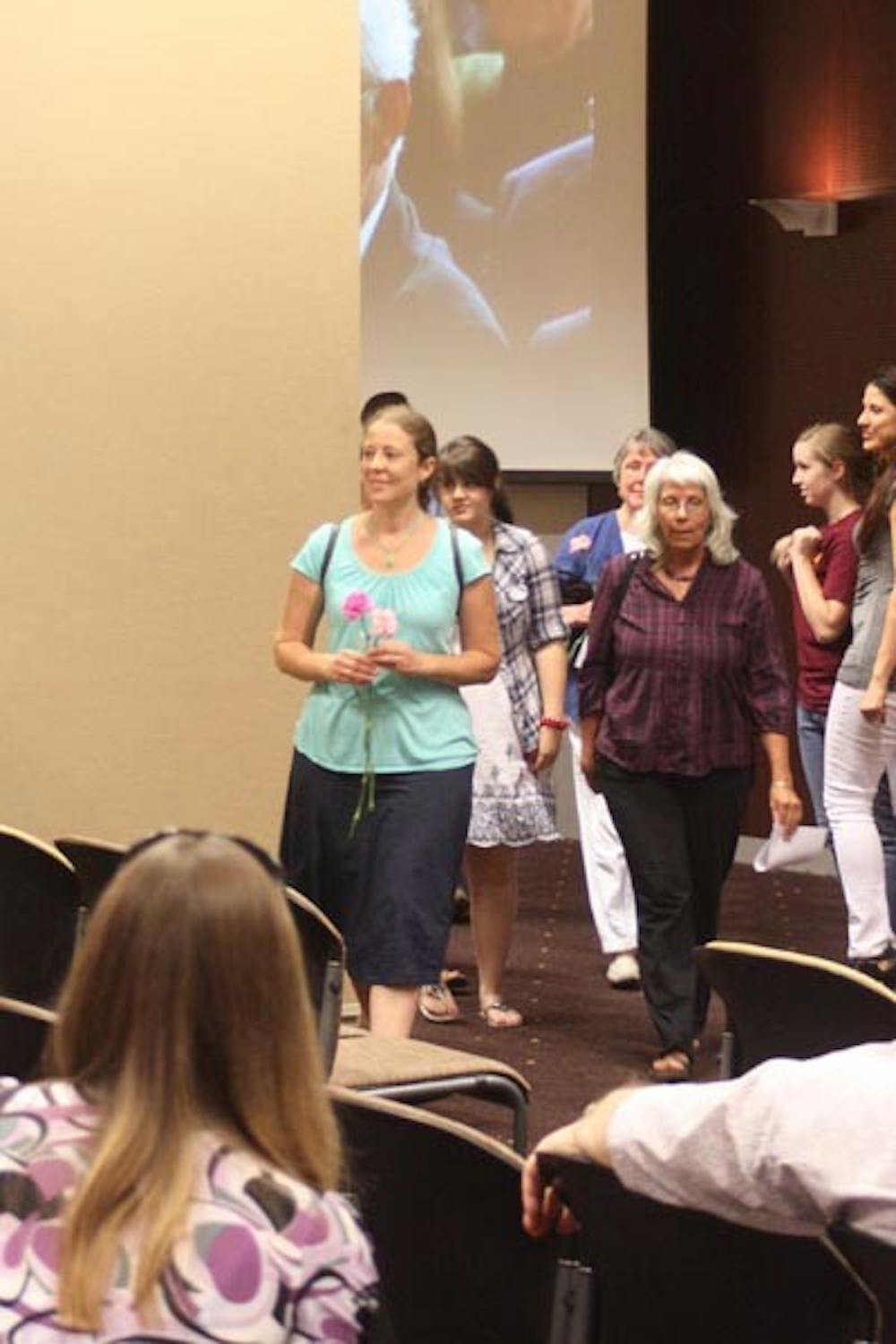

Friends and family members were forced apart Sunday as they entered a simulation of a once-divided Germany.
A floor-to-ceiling partition divided the Ventana Room in the Memorial Union on the Tempe campus, and students dressed as German border police — known as stasi — interrogated, reprimanded and confiscated participants’ belongings on the communist east side of the wall.
The event was intended to give participants an idea of what it was like to be in a divided Germany, said Shana Bell, a German lecturer within ASU’s School of International Letters and Cultures. Sunday marked the 20th anniversary of the official fall of the Berlin Wall on Oct. 3, 1990.
“We wanted to give the people a sensation of the division between the two portions of Germany,” Bell said.
History sophomore Emily Foree had her laptop and purse confiscated by ASU students dressed up as the stasi, and said the event was a symbolic representation of what happened in Germany during that time.
“I had no idea it was going to be like this,” Foree said, referring to the guards and the wall that spanned the length of the room.
Germany was broken up among the Allies after World War II ended, with East Germany under the control of the Soviet Union.
The wall was built in 1961 as people who didn’t want to live in a communist country began to leave East Berlin for the western portion, said Colleen O’Donnell Pierce, a member of the board of directors for the Arizona Center for Germanic Cultures.
“[The Russians] thought it would be a good thing to have a communist country because everyone would have a home [and] food,” O’Donnell Pierce said. “But you just weren’t free.”
She helped coordinate the event, sponsored by the Arizona Center for Germanic Cultures in cooperation with ASU’s German section at SILC.
As part of the event, O’Donnell Pierce gave a personal account of her 10 days spent in divided Germany in 1986 during her junior year of college.
“As we were crossing the border [into East Germany], you see miles and miles of wall,” she said. “We got to the border crossing and police came onto the bus and they were carrying high-powered machine guns.”
The officers checked the passports of all the people on the bus against a list of people who had been approved to enter, she said. Once inside Germany, the students stayed in a youth hostel.
“Everything was gray and black,” O’Donnell Pierce said. “It was like going back in time.”
The residents of the youth hostel spoke to O’Donnell Pierce and fellow students she traveled with about the constant fear that came with being watched.
“They didn’t know who among their friends or family were among the stasi,” she said. “[The stasi] wanted to see who was thinking of leaving, escaping.”
Stasi would often work undercover and relay information to the government, O’Donnell Pierce said.
The families of those who managed to escape were interrogated by the German police, O’Donnell Pierce said. People were afraid that “even if I get out, they’re going to make it hell for my family and friends,” she said.
“In the beginning, [the East German government] had all these high-flying ideas,” O’Donnell Pierce said. “But they became evil in their methods.”
The wall was built in 1961 and began to fall on Nov. 9, 1989. Treaties were signed on Oct. 3, 1990, officially uniting Germany.
Anthropology junior Michelle Nicholas was reprimanded during the event for eating too much food, which was rigidly rationed in communist East Germany.
“It was a unique experience to see the wall come down,” Nicholas said.
Dieter Bollmann, president of the Arizona Center for Germanic Cultures and a German-American, went to Germany in the summer of 1990 and chipped away at the wall.
“Today there were a lot of celebrations all over the globe,” Bollmann said to the crowd, while also noting that there was still a long way to go.
“This reunification is not complete,” he said. He pointed to a study conducted by the German government that noted only 20 percent of Germans thought there had been progress in the last 20 years.
“People had thought Germany had come together as one people,” Bollmann said. “But there is a lot of work that needs to be done.” Reach the reporter at ymgonzal@asu.edu