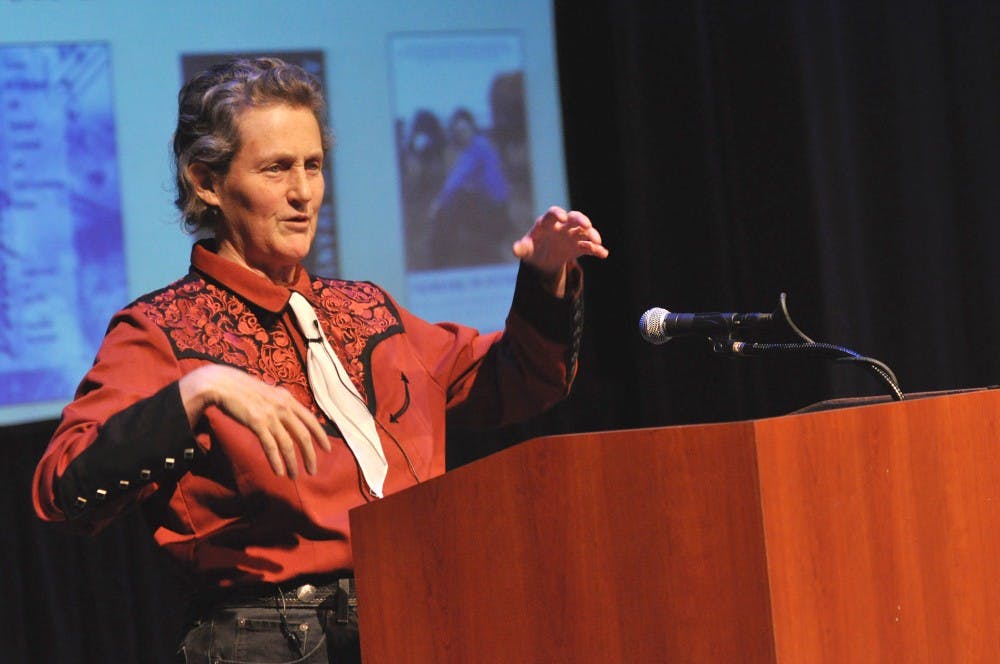

Temple Grandin, autism awareness advocate and animal scientist, spoke to a full audience at ASU’s Galvin Playhouse Tuesday night, sharing her expertise on autism, animals and sensory-based thinking.
Hosted by ASU’s Institute for Humanities Research, Grandin is one of several distinguished lecturers that will speak at ASU in 2011 about humanities.
The ongoing event called Project Humanities “celebrates the range, excellence and impact of humanity’s work,” CLAS Dean of Humanities Neal Lester said.
Grandin obtained her master’s degree in animal science at ASU in 1975. She is currently a professor of animal science at Colorado State University.
Grandin has penned eight books about living with autism and working with animals, including “Animals in Translation” and “Thinking in Pictures,” the autobiography that was made into an award-winning movie starring Claire Danes.
In her lecture, Grandin said she didn’t always know she was different from other children growing up.
“I realized my thinking was different when I asked people about church steeples,” she said. “Most people see a generic steeple, I see specific ones. There is no generalized steeple image to me.”
Grandin said instead of seeing one image of an object, like a shoe, she sees multiple shoes that she has worn throughout her life when the object is brought up in conversation.
With every seat in the theater reserved a month in advance, about 495 ASU students and community members filled the venue.
Education graduate student Courtney Bruno has two children on the autism spectrum and came to the event to gather insight from Grandin’s personal experiences.
“The way she sees the world in pictures helps me visualize how my children see things,” she said.
Grandin said she is a visual thinker, which allows her to pick up on miniscule details, whereas “neurotypical” thinkers screen out details.
This attention to detail has allowed Grandin to work well with livestock.
She designed cattle corrals and chutes for meatpacking plants that ease the cattle into motion by using a series of turns that are more natural to them than straight pathways.
Picking up on seemingly frivolous deterrents for cattle, such hanging chains or patches of light that serve as barriers on a run or corral, allows Grandin to help the animals feel more comfortable.
“Our relationship with farm animals has to be symbiotic,” she said. “Every animal deserves the respect of their human handlers.”
Director of the Institute of Humanities Research Sally Kitch said Grandin’s autism flourished in the arenas of science and technology, as it was nurtured by her science teacher and mentor early on.
“Temple pushes us to examine, and even blur, the lines between humans and animals,” Kitch said.
As an advocate for providing an outlet where children with autism and Asperger’s syndrome can excel, Grandin spoke animatedly about her frustrations with the lack of funding for education, something that leads to less hands-on classes and a shortage of science teachers.
“Some people with brilliant minds are being labeled as handicapped,” she said.
Along with her anger toward the lack of intervention for children with signs of autism, Grandin said she disagrees with giving prescription drugs to children who may just need a change of diet or more mental stimulation.
“I’m appalled at the amount of drugs given out to kids like candy,” she said.
However, she said low doses of antidepressants have improved her quality of life and the lives of other high-functioning autistic people.
Grandin said she was mercilessly teased at her all-girls high school.
“Carpentry and horses saved me in high school,” she said, adding that communicating with teenagers was never comfortable for her and still isn’t.
She is currently promoting her most recent book, “The Way I See It,” in which she discusses how and why people with autism think differently. She also includes a discussion about the benefit of early intervention programs for autistic children.
“If I could snap my fingers and get rid of my autism, I wouldn’t,” she said. “My science is first and autism is secondary.”
As a member of the National Cowgirl Hall of Fame, Grandin typically wears rancher-style shirts to events. She wore a bright red one Tuesday night. One audience member asked where she gets her unique shirts.
“I can’t tell you all my secrets,” she said as the audience broke out in laughter and a standing ovation.
Reach the reporter at tafergu1@asu.edu