There will be only one executive ticket when Tempe students vote for their Undergraduate Student Government candidates Tuesday and Wednesday, but three other candidates said they were disqualified for “illegitimate reasons.”
Finance and computer information systems sophomore Mark Naufel is running unopposed for USG president, with accounting sophomore Rob Wiley as vice president of services and interdisciplinary studies sophomore Brianna Pantilione as vice president of policy.
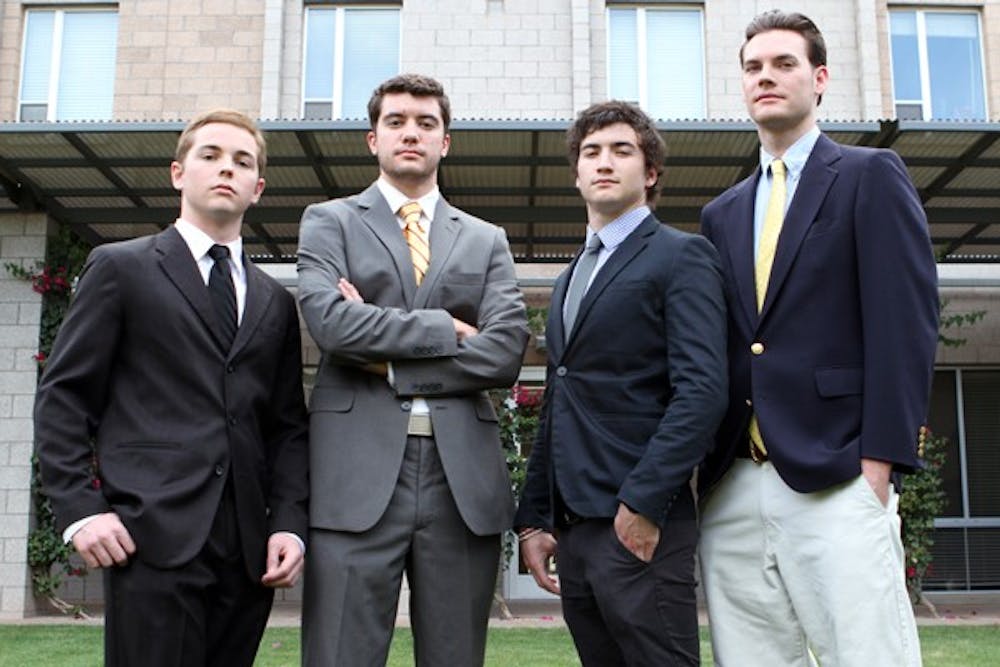
Economics juniors Ryan Henderson and Brandon Good and political science junior Edward Griffin were poised to challenge the other ticket but found themselves disqualified March 7.
“With every instance, every step of this process, there’s been a road block,” Henderson said. “It comes across as they would like to see us disqualified rather than on the ballot.”
Henderson said these issues began when they submitted their elections documents. The documents were due March 5 at 5 p.m., and candidates were told to deposit packets at the Associated Students of Arizona State University business office on the 3rd floor of the Memorial Union.
Angela William, who manned the front desk in the office, was to stamp each packet and place it in a folder for review from the elections director.
Henderson said he dropped these complete documents off at 4:15 p.m. and returned later that night to talk to USG Elections Director Derrik Hester.
He did not see Hester, but noticed that the wallet-sized photos of himself and his vice-presidential candidates, one of the required components of their elections packet, were lying on a table in the USG lounge area.
“That’s a huge indication to me that they’re going to move our pictures and then they’re going to disqualify us for not having our pictures,” Henderson said.
The USG elections code stipulates, “All forms included in the Candidate Packet as well as all other forms must be received by the date and time set by the Elections Department.”
Henderson sent Hester an email that night regarding the pictures, and he received an email back explaining that Hester would look through all of the documents over the next few days.
In later correspondence, Hester said Henderson and his running mates could turn in their pictures any weekday, but an email detailing their ineligibility cited that part of the election code.
Hester said the decision to rule them ineligible in no way contradicted his earlier directions to turn the photos in later that week.
“I said they could turn in the photos at any time, but that didn’t mean their applications were complete,” Hester said.
Following this disqualification notice, the ticket filed a petition with the ASASU Supreme Court March 9. According to the USG Elections Code, a decision must be reached within 72 hours.
However, the Supreme Court, which is made up of three USG-confirmed representatives and two from the Graduate and Professional Student Association, did not have enough justices at that point.
Two of the five justices were confirmed by GPSA during an assembly meeting March 16.
On March 23, the Friday of spring break, the justices met to decide two appealed disqualifications, including the Henderson ticket.
Political science senior Christopher Chesny, an advisor for the Henderson campaign, said this delay hurt the potential campaign.
“They delayed,” Chesny said. “That’s at least four days of stonewalling, four days of valuable preparation time, but not for this campaign. So that’s flagrant abuse number one.”
Although Henderson, Good and Griffin had indicated they wanted an open hearing, they were not invited to the Supreme Court hearing.
Henderson said this was unfair to his ticket, and because they believed they would have the chance to argue before the court, they submitted an abbreviated version of their arguments.
“So, even if, and I’m not saying they did, the Supreme Court used the right procedure to make their decision, our full case wasn’t even represented because of that fact of us anticipating an open hearing,” Henderson said.
Hester said he believed the Supreme Court met during break because they wanted to have each case decided before the ballots were drawn up March 26.
Griffin, the disqualified vice president of services candidate, said the unclear rules had plagued their campaign from the start.
“We were set up to fail in the first place,” Griffin said.
Reach the reporter at julia.shumway@asu.edu or follow @JMShumway on Twitter.
Like The State Press on Facebook and follow @statepress on Twitter.