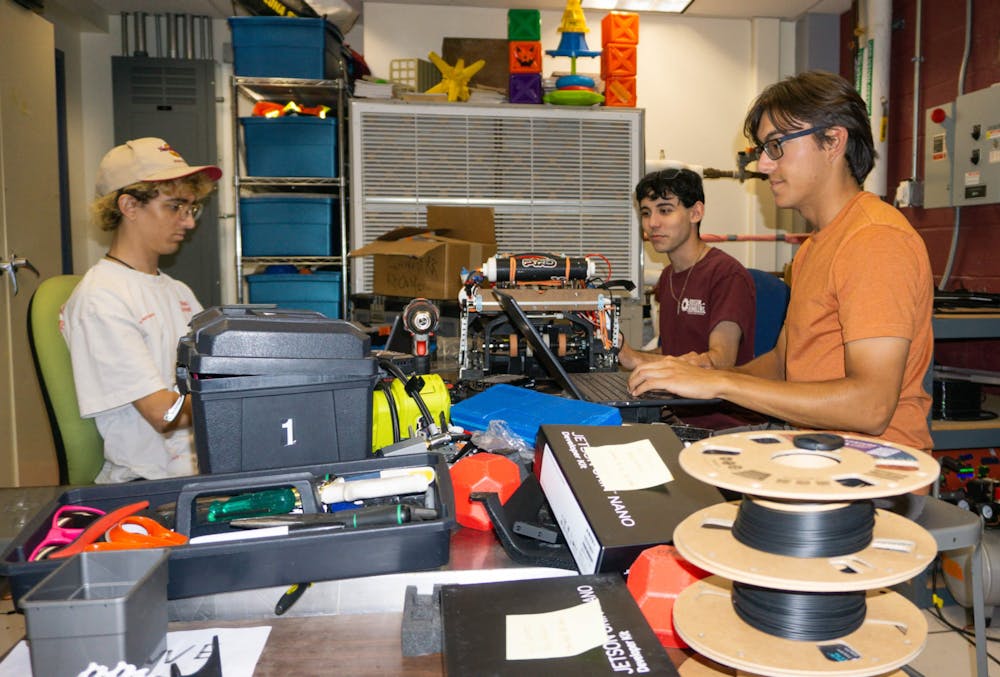
A student-led engineering club on the Polytechnic campus will travel to St. Louis, Missouri, in late April to compete in the 2026 VEX Robotics World Championship.
The Rossum Rumblers Robotics Club works to create robots for various competitions, including VEX. Alessandro Marcolini, a club member and sophomore studying engineering robotics, said the VEX team is working hard to refine its software and develop its robot for the competition.
"Right now is crunch time for us," he said. "We have about a month until world championships, so we're working on refining what we have, trying to implement new software strategies, hardware strategies, getting practice in."
Building the robots
The VEX division of the club builds robots that compete in changing competitions each year, forcing teams to reimagine and redesign their robots from scratch.
Enzo Muggler, the club president and a junior studying engineering robotics, said the team's new season starts immediately after the championships end in April every year.
The process starts by reading and understanding the rules and themes for each year's competitions, as set by VEX's governing body, then building a strategy around them. The team will map out the entire year to account for designing, programming, manufacturing and developing driving skills.
READ MORE: Meet the ASU club designing robots built for destruction
The team usually dedicates three to five hours a week during the regular season, but as competitions approach, members may work for up to 12 hours a week, Muggler said.
Marcolini primarily works on the design and programming aspect of the robots, and said the current system consists of around 30 custom parts 3D printed or laser-cut on campus. The team designs, redevelops and tests the robot until it can meet its objectives.
"We keep going that way, through the whole year, basically, until we end up with something that works," Marcolini said.
The competitions
To qualify for the world championships, the team must score points in VEX competitions or volunteer at high school competitions and run their robots through a skills challenge.
There are two components to the challenge: an autonomous run, where the robot tries to earn maximum points entirely through its programming, and a driver skill run, where a human operates the robot to score points.
"Driver skill is super important in VEX, sometimes more important than build quality," Muggler said.
This year's game is called Pushback, and teams must develop a robot to go head-to-head with another robot to collect and sort balls in a 12-by-12-foot field.
READ MORE: ASU's AAIR Lab increases autonomous robot reasoning
The team qualified for the world championship by running the skills challenge at a high school competition before spring break, scoring points in both autonomous and driver skill runs.
There are only four VEX University teams in Arizona, according to Muggler. He added that the club also received the "Excellence Award," the highest judged award at VEX competitions, while competing against other university teams.
Community engagement
Reinert Webb, the club's vice president and a sophomore studying robotics engineering, said Rossum Rumbler Robotics hosts a high school and middle school VEX competition at the Polytechnic campus every year and invites many students to the University, and also volunteers at other local school events.
He said the team's work at an elementary school's STEM festival was particularly impactful in getting kids interested in science.
"We just showed up there and let the kids play with the robot (and they) saw how the printing works," Webb said. "Just something that (puts) a spark in their mind."
The members volunteer as judges, referees and scorers in various competitions and also use the opportunity to learn and take inspiration from the teams and to instill curiosity among the students.
The club has even started hosting standalone events for students. The club hosted an event where students could build a Tamagotchi-style handheld device and learn about soldering and hardware design.
Beyond the VEX competitions, both Muggler and Webb want the club to grow into the size the organization was before the COVID-19 pandemic.
The club previously held regular meetings with industry partners, which served as a valuable channel for students to connect with engineers, and maintained a strong presence on campus. Muggler said he hopes to bring back those networking opportunities as the club continues to expand.
"Having a program like that exist within our club would be amazing for us," he said. "That would be my definition of we're back to being a successful club."
Edited by Kate Gore, Henry Smardo and Pippa Fung.
Reach the reporter at ngmohta@asu.edu.
Like The State Press on Facebook and follow @statepress on X.
Nikhil Mohta is a sophomore studying B.S. in Finance and is currently a Business Community Leader for the W.P. Carey School of business. He is also an active member in various clubs on campus like PIERA.