
For someone who preaches “crushing the box,” it’s ironic that Will Curran got his start as a DJ from inside of a box.
A DJ-in-a-box kit, to be precise.
The $400 kit purchased by Curran as a freshman in high school not only helped him earn his first gig at a friend’s backyard party, but was the spark that lit his idea to create Arizona Pro DJs, his teen entertainment company.
Now a senior at Arizona State University, Curran, 22, has received $20,000 in grants over the past two years through his involvement in ASU’s Edson Student Entrepreneur Initiative.
The financial backing helped Arizona Pro DJs post a 300 percent growth in revenue since last year.
“ASU’s really great because they really believe that entrepreneurship is huge,” Curran says. “It’s really cool to be a part of a school that actually believes in something you want to do.”

In founding Arizona Pro DJs, Curran’s goal was to bring concert elements to high schools as a “one-night-only club.” Their “bigger and better” mindset includes a video component that Curran and the company’s other DJs integrate into the music they’re playing.
“A lot of people in our industry, they deal with lackluster events,” Curran says. “Our big thing is we want to make it so our clients are putting on better events. ... If you focus everything on putting on a great service, everything else kind of falls into place.”
Arizona Pro DJs is in its second year in the Edson Initiative and is currently one of its most successful companies. The Edson Initiative looks for creativity and innovation from the ASU student body and awards selected students with funding, office space and training.
Curran hopes to be accepted for a third year, which has only been done once before in the accelerator program’s six-year history.
“Will Curran ... has a very global mindset and really wants to expand and he’s already spread across Arizona where he started this in a small area,” says Alix Parker, Marketing Specialist for the Edson Initiative. “We really can see that drive and passion in him and you can tell that he’s also very dedicated to what he does.”
Dedication goes a long way in creating a company from scratch.
While attending Bourgade Catholic High School, Curran was asked to DJ some school parties and figured out that what he needed to grow his company was a name, website and business card. With no formal business training, he worked from instinct, gaining advice from only his dad and audiobooks he listened to.
“Eventually I came to ASU and I realized I wanted to do something more, something bigger,” says Curran, who is working toward his Bachelor of Interdisciplinary Studies in Business and Special Event Management.
For now, Arizona Pro DJs continues Curran’s initial focus on the teen entertainment market because he admitted it felt natural, and he remains only a couple years removed from the age group.
“We kill it right now in teens (demographics),” Curran says. “We understand exactly what they’re looking for. We know how to really entertain them.”
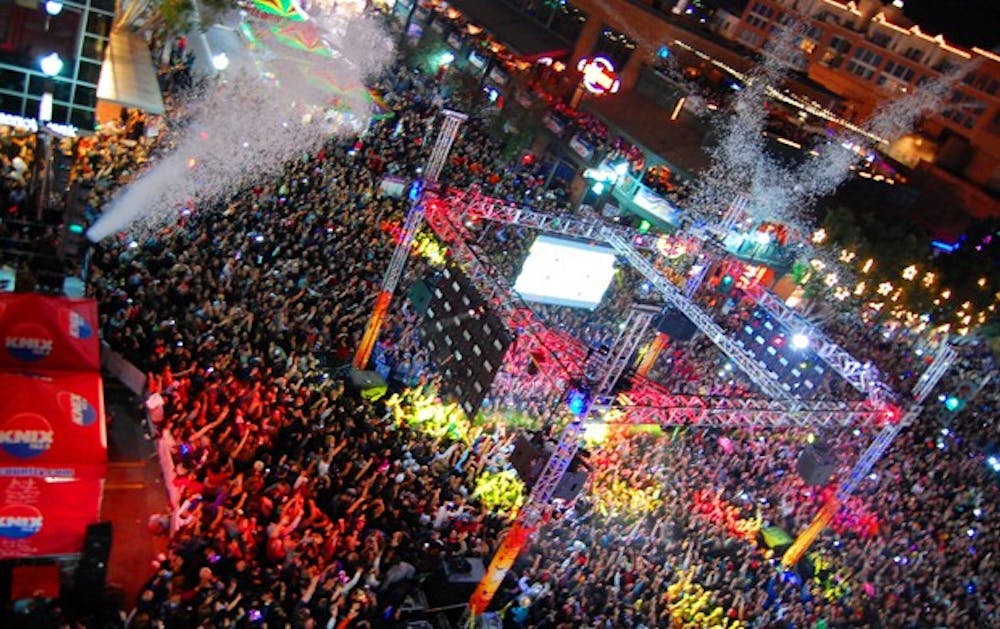
Arizona Pro DJs’ two marquee events were the Fiesta Bowl Block Party this past New Year’s Eve and ASU’s 2011 Undie Run.
“Will’s entire team is passionate and enthusiastic and enjoy providing entertainment,” says Sean Leoni, ASU senior and the 2011 Undie Run President. “Will also does a great job of managing the people he lets assist him and also has several connections with the surrounding community.”
Curran says the Block Party, which was held in Tempe at 5th and Mill avenues, was the highlight of his DJing career so far.
“I actually headlined right at midnight (so) I was dropping my video edits and actually had a huge countdown that transitioned into ‘Party Rock Anthem,’” Curran says. “Doing that and just hitting ‘go’ and hearing thousands of people scream on New Year’s was one of the most exhilarating moments I’ve had.”

With the DJ industry mostly split between teen events and private events, such as weddings and corporate functions, Curran’s competitors believe he could be pigeonholing himself.
“Once you say you’re a teen (company), you’re kind of saying that’s the only thing you do,” says Luke Bishop, co-owner of Phoenix- and Tucson-based Satyr Entertainment. “From a business standpoint if I’m a big corporate client that wants to rock and dance for their clients, they’re kind of going to steer away from a teen company.”
While Bishop acknowledged Satyr’s prices are a little more upscale comparatively, he believes their work in both event types, as well as a theater-based presentation, gives them an edge most don’t have.
Despite that, Bishop says he understood why Curran would focus on teen entertainment in the first place.
“As a matter of fact, the market in Arizona for that kind of stuff is getting really saturated because I think people figured out that it’s a good market and there’s money to be made there,” Bishop says.
As for the expansion possibility the Edson Initiative saw in the business plan for Arizona Pro DJs, Curran says it’s only about five months away.
First and foremost, a name change will allow for the company to expand outside of Arizona into nearby markets, such as Nevada, Colorado or New Mexico.
“We’ll be changing our name to something a little less ‘Arizona’ and a little bit less ‘DJs,’” Curran says. “A lot of people when they hear about Arizona Pro DJs, they think (of) the backyard party thing I did when I first started.”
In an effort to prove that Arizona Pro DJs can move away from their sole focus on teen events, Curran is open to expansion into private and corporate events.
“When you start talking about moving into other markets, it’s as simple as just creating a new company and saying, ‘We do corporate events,’” Curran says, “and you can take exactly what you do at teen events and bring it to a corporate event. Adults like to fist pump just as much as kids.”
Like most start-up companies, Curran admits to still getting a feel for solving their two biggest issues: capital to pay for all the equipment and age discrimination by potential clients.
For example, the video screens Arizona Pro DJs uses during their events require about 24 2-by-2 LED screen panels, which cost about $2,400 each. Regarding the age discrimination, Curran proves he knows what he’s talking about by using the technical jargon that potential clients don’t believe he’s familiar with.
“I like to say right now our big thing is just a time game,” Curran said. “We’re just chugging along, building systems. Before you know it, it’ll be huge.”
Contact the reporter at cjcole3@asu.edu