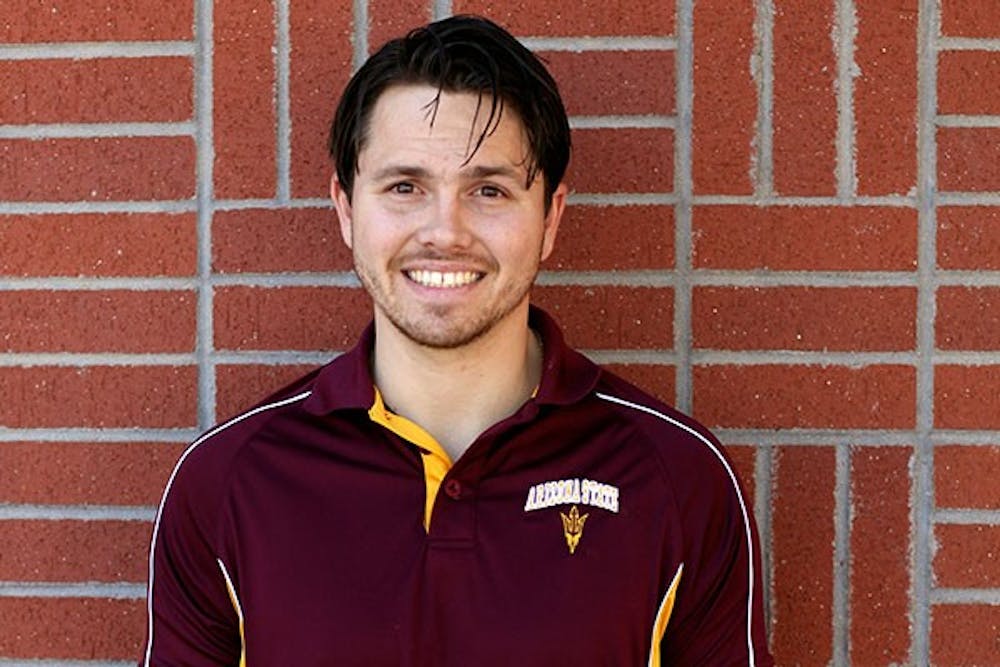
 Jonathan Cudo poses at ASU Tempe campus on Saturday, Nov. 8, 2014. Cudo is a Purple Heart recipient and is working
 towards his pilot license through ASU. (Photo by Samantha Battaglini)
It was 10:30 p.m. on Sept. 14, 2012, at Camp Bastion in Afghanistan when Sgt. Jonathan Cudo and a few fellow Marines heard gunfire. Stunned but not lacking combat experience, they organized themselves to secure the perimeter in defense.
Cudo, who was a Powerline Work Center Supervisor on Harrier jets, said he was rattled after a long day of work when he heard the commotion.
“We had just finished up our maintenance work in the hangar for the night when we heard the gunfire,” Cudo said. “We had no idea what happened.”
Cudo, a Phoenix native and graduate of Barry Goldwater High School, said Lt. Col. Christopher Raible was awoken by the gunfire and ran almost a mile to help the Marines with only a measly 9-millimeter pistol.
“We were all on edge before he came in, and it felt like forever, but it was probably only about 15 or 20 minutes,” he said. “He asked for 10 men to come out and fight and gave us a motivational pep talk, which was amazing — he was a great leader.”
In the middle of the firefight, one of the insurgents shot an RPG in the direction of Cudo and Raible. Cudo was injured when shrapnel struck his head, but Raible was killed.
“I was knocked unconscious and was going in and out of consciousness,” Cudo said. “I wasn’t all there mentally, so I wanted to keep fighting, but luckily the medical evacuation was there and took me to the hospital.”
Cudo was one of six Marines awarded a Purple Heart for injuries suffered during the attack at Camp Bastion.
However, Cudo said he denied the Purple Heart until Sgt. Maj. Michael Cayer talked to him about its meaning.
“He told me, ‘You don’t wear it for yourself; you wear it for the guys who can’t be here to wear it for themselves,’" he said. "That really stuck with me.”
Cudo said he was in the hospital recovering from the explosion a few days after the attack when he heard about what happened to his commanding officer.
“I was sad, because he was the true embodiment of a leader,” he said. “During the attack, we weren’t frightened, because he said he would get us through, and we all believed in him and would do anything he asked of us.”
He compared a commanding officer to the dean of students at a university— a leader, but unable to get to know everyone on a personal level.
However, he said Raible was much different because he had a way of being personable with all of his Marines.
“He would take the time to get to know you on a first-name basis,” Cudo said. “He would keep up with your goals and dreams and fully support you, which was awesome.”
 Jonathan Cudo poses at ASU Tempe campus on Saturday,
 Nov. 8, 2014. Cudo is a Purple Heart recipient and is working
towards his pilot license through ASU. (Photo by Samantha
Battaglini)
Four years later, Raible’s impact lives on as Cudo, 25, recently returned to school to pursue a degree in Aeronautical Management Technology at the ASU Polytechnic Campus.
He also said Raible would tell him he could be a good enlisted Marine but an even better officer.
“He definitely inspired me to go back to school because I wanted to become a great leader like him,” Cudo said. “I want to have a huge impact as a leader on others like he had on me.”
Although it has been difficult, Cudo, who recently received his pilot’s license, is finally adjusting to life at school.
“I learned that it really helps to talk to others about what happened,” he said. “You have to be able to release some of the pride in you and talk about the difficult aspects, because that’s what builds you up.”
However, the transition does not stop with school. Cudo said he recently reconnected with a few family members, most notably his father, whom he had not talked to in years.
“I called him up and told him I was sorry for being stubborn,” he said. “I’m a firm believer that positivity brings positivity and negativity brings negativity, so if you dwell on the negativity, it will take over.”
Ubaldo Ozaeta, Cudo’s friend since 2009 and now roommate, said the two are working to support each other through their respective journeys back to school.
“We are helping each out and his will to succeed pushes him to be better,” he said.
He also said Cudo has acted as a mentor to him through flight school.
“He is ahead of me in school so he’s been sort of a second teacher,” Ozaeta said. “He has passed down all his knowledge to me and has helped me succeed to this point.”
Pat Tillman Veterans Center Military Advocate Joanna Sweatt, who is also Cudo’s work-study supervisor, said his cooperativeness has been the primary reason for his smooth transition.
“He has overcome so much through his treatment,” she said. “He has been completely active in recovery therapy, and he has become the poster-child student because of it.”
She also said his positivity is not only impressive, but is a key reason for his success thus far.
“He boosts morale with his positive outlook on life,” Sweatt said. “He works to overcome instead of succumb, and he lives for those who can’t be here to experience life for themselves.”
Cudo said he wants people to learn from his story and the great lessons it has taught him.
“Regardless of who it is, when you see somebody, when you see a person, know that they have a story,” he said. “You don’t know their story, so it’s best to be receptive and give everyone the same amount of respect, because you don’t know what walks of life they’ve been through.”
Reach the reporter at Justin.Toscano@asu.edu or follow him on Twitter @justintoscano3.
Like The State Press on Facebook and follow @statepress on Twitter