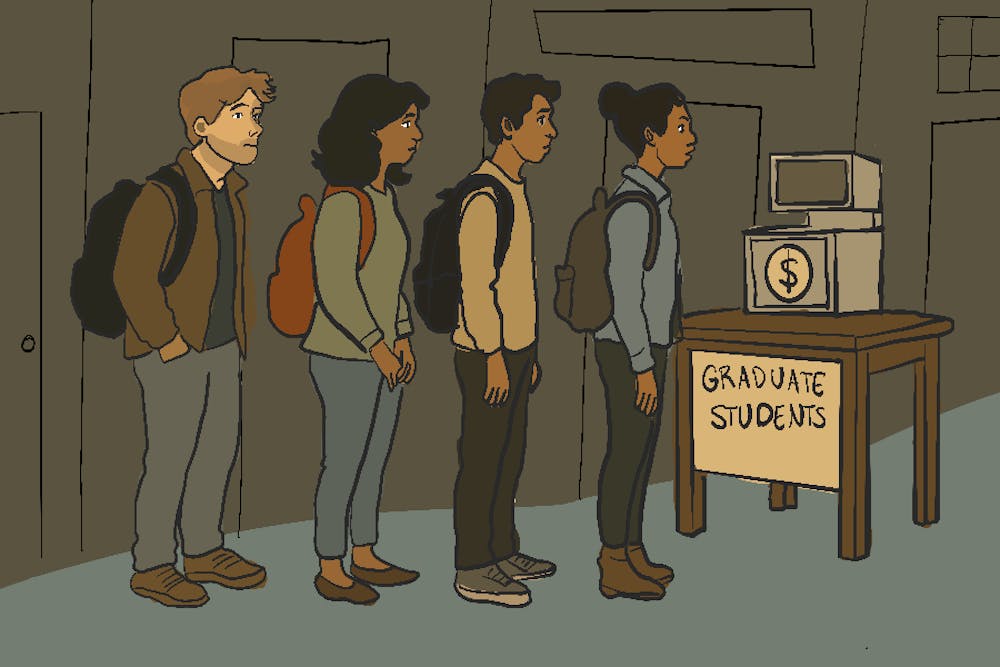
As ASU completes its investigation into the suspended Graduate Student Government, graduate students have raised worries about the organization's ability to fulfill its duties. Its leaders blame the University's administration for the issues facing GSG.
Due to the process for approving funding, the earliest graduate students can use GSG travel grants is now November. If the suspension were to continue beyond August, that date would be pushed back.
The Office of Student Rights and Responsibilities "has concluded its investigation into several matters related to the Graduate Student Government," a University spokesperson confirmed on Aug. 5. "The outcome of the investigation is forthcoming."
GSG Assembly President Michael Kintscher, a doctoral student studying computer science, said administration has yet to "produce any evidence" of misconduct by the student government.
"I don't believe that we've done anything wrong," Kintscher said. "I would like to think if something was going that wrong, I'd be aware of it, or at least aware that something is off."
READ MORE: BREAKING: University suspends GSG, potentially pausing student funding
For some graduate students, the suspension is the latest episode of chaos that has affected GSG for several years. GSG was suspended in the summer of 2024 over what Kintscher said was related to election disputes and disagreement over credit requirements to join a student organization. During the suspension, the organization was similarly unable to provide any grants.
Steven Ruiz, a graduate student studying mathematics education, said he had a poor experience with GSG when applying for a travel grant last year.
"They've been very hard to get a hold of, and their reliability has gone downhill," Ruiz said.
Ruiz said when he started his program in the fall of 2020, GSG's predecessor, the Graduate and Professional Student Association, was "much more solid."
Ruiz said he had applied for GSG funding before with no issues. However, in July of 2024, he applied for the grant again to attend a conference in November and present a study related to his dissertation.
The application was denied, Ruiz said, and he reached out to GSG to learn why. An officer told him he had applied too close to the date of the conference, but Ruiz had actually applied well ahead of the deadline for November travel.
In an email thread between Ruiz and the GSG officer, Ruiz said his travel date was on Nov. 7, not in July, and asked that his application be revisited. The officer acknowledged that it was likely a typo that led to the rejection and said they would talk to the team and respond the following day.
The officer did not respond until nine days later, after Ruiz sent them four emails and also was unable to contact the GSG president and vice president. A graduate program coordinator suggested that Ruiz stop by the GSG office.
The office was empty when Ruiz arrived, but he said the officer notified him of his application's approval shortly after he left the building.
"The most disappointing thing is you couldn't even find out what's going on, especially with an organization that's supposed to be student-facing," Ruiz said.
Kintscher said communication can be a challenge for GSG because of administrative hurdles. They added that a solution would be allowing the organization to directly email the entire graduate student body rather than relying on administrators to send out information — a measure the University has rejected.
Ruiz's experience occurred about a month after the impeachment of then-GSG President Ravi Teja Chopparapu. One of the allegations made against Chopparapu in the Articles of Impeachment was that he had been "withholding critical budget information." He was also accused of not responding to communications about student services, including funding opportunities.
READ MORE: Graduate Student Government President Ravi Teja Chopparapu is impeached by Assembly
Kintscher said in the negotiations over Chopparapu's impeachment that the Assembly decided not to remove directors he had appointed during his presidency. That means the officer Ruiz communicated with was appointed by Chopparapu, though Chopparapu had been impeached by that time.
"A lot of students are concerned about our executives appointing their friends as directors who are not qualified, have no interest in doing the job and are just there to collect student money," Kintscher said. "I do think that happens."
Kintscher added that the GSG Assembly did not have the authority to impeach those directors until the organization's constitution was amended in December of 2024.
Peggy-Jean Allin, a graduate student studying political science, said she intended to apply for a travel grant from GSG this summer. Even if her request was denied, she could receive funding from her department by showing that she had submitted elsewhere first.
Allin said she began preparing her application in late May but realized that no grants were available in the platform GSG uses to handle the submissions. She said it took a conversation with another student and outside research to learn that GSG had been suspended.
"It was a complete shock," Allin said.
The GSG and Associated Student of ASU websites do not reflect the current status of the organization, nor does the official GSG Instagram account. Allin said her department's administrators were unaware of the suspension and notified the entire department after she reached out.
Kintscher said University administration told GSG that notifying graduate students about the organization's suspension could potentially violate the Student Code of Conduct, though an email from May shows GSG President Bhagvan Reddy Vemula directed another officer to update all GSG social media accounts and public-facing information with the paused status.
GSG asked administrators to inform the student body about the suspension, Kintscher said, but that request was never answered.
Reddy Vemula did not respond to a request for comment.
Allin's department allowed her to apply for funding given the circumstances, but she is still waiting to find out whether it was awarded to her or not, she said.
Ruiz said the difficulties of relying on GSG funding have forced others in his department to forego traveling to conferences altogether.
The consequences of missing out on conferences can be particularly negative for graduate students, Ruiz said, adding that many graduate students rely on conferences to get early publications.
Ruiz said GSG travel grants usually don't cover all of the expenses of attending a conference, but they can be the deciding factor allowing students to go in person, which is often the only way to be published at these events.
Without those publications, Ruiz said students lose crucial career development opportunities and the chance to receive outside feedback on research. That will make graduates less competitive in the job market — a problem exacerbated by the current employment prospects for those students and cuts to federal research programs.
"There's forces from outside of ASU's control that no one can do anything about," Ruiz said. "The fact that GSG, that safety net, disappears as well, that's going to hurt the people who are still in the middle of their program."
Kintscher said GSG's issues, particularly its inability to provide funding to graduate students, are a result of interference from the University.
Inconsistent rules and unclear requirements have caused the problems GSG faces, Kintscher said, and "admin needs to keep their hands off and let us do the work we need to do."
"The administration is making us dysfunctional," Kintscher said. "They shut us down. We had no say in any of this."
Edited by George Headley, Leah Mesquita, Sophia Braccio and Katrina Michalak.
Reach the reporter at coyer1@asu.edu and follow @carstenoyer on X.
Like The State Press on Facebook and follow @statepress on X.
Carsten Oyer is the politics desk editor at The State Press. This is his third semester with The State Press, having previously worked as a politics reporter. He is studying journalism and mass communication and political science.