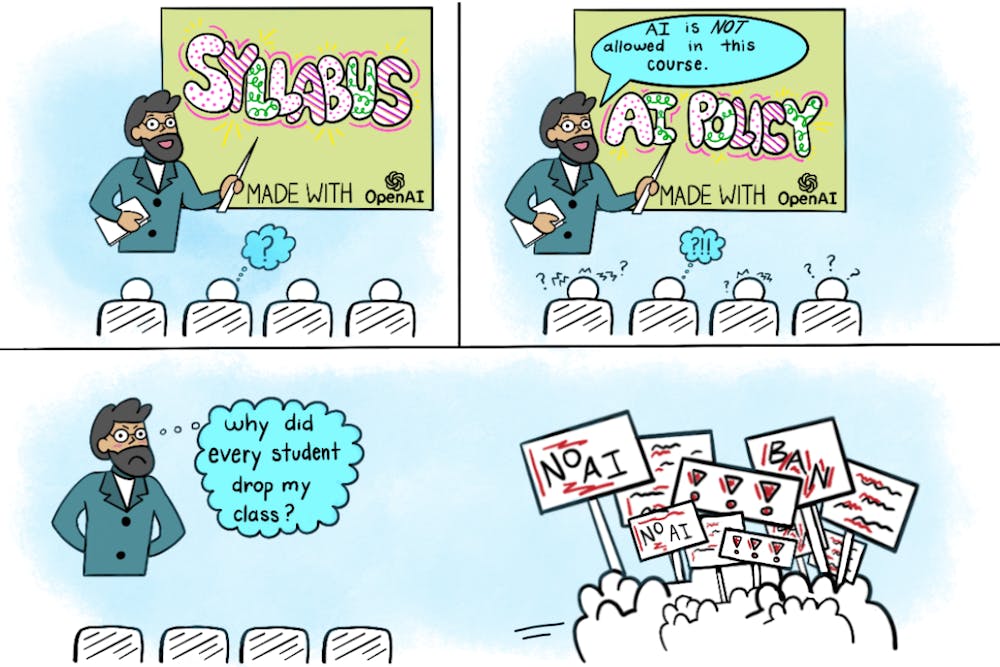
In my first semester of college, I sat in a 200-person lecture hall and listened to a professor tell us that our degrees will be useless in five years if we don't learn to use AI.
The professor walked us through different exercises where AI might be useful in the workplace, such as brainstorming, polishing our writing and — to my horror — taking over the writing altogether.
I was utterly appalled watching my peers as they eagerly input prompts. Even more shocking was when I realized that the incident wasn't isolated, and I wasn't the only one.
READ MORE: Opinion: ASU just observed AI Day — but who is celebrating?
Anthony Priego, a freshman studying electrical engineering, said he has seen classmates openly talk about using AI to do assignments for them. He added that it makes him wonder what people are getting out of their education.
"Pursuing higher education through college is about changing the way you think, and learning," Priego said. "You lose a lot of that when you do your work through AI instead."
Friends in other majors told me how they were asked by professors to use AI to do simple tasks: create a floor plan for architecture or a lesson plan for education.
According to a report by Forbes, 90% of U.S. college students have used AI academically, while 86% of college students across 16 countries incorporate AI into their studies.
Professors argue that it's more efficient to do things this way, that it saves time and our valuable brain power. But schooling isn't something you can fast-forward yourself through.
There's a distinction between true education and the piece of paper that says 'degree.' One values learning, while the other encourages us to pay exuberant amounts of money to take meaningless classes (an entire module on prompting ChatGPT speaks for itself).
It's disheartening to watch my generation become guinea pigs for tech companies and universities. My $20,000 tuition is paying for me to be a test-run for AI.
As programs across the University embrace ASU's recent partnership with OpenAI, these tools are being pushed onto us when the effects aren't entirely clear.
READ MORE: Charting ASU's future: Navigating OpenAI's first partnership in higher education
K. Selcuk Candan, a professor of computer science and engineering, is a specialist in developing AI techniques and tools, but has not used AI in the classroom yet.
Candan said he has noticed his students struggling with basic tasks that previous cohorts hadn't struggled with. He said the change could be due to students "over-relying on AI tools" and "not learning what they should be learning," although there isn't one clear cause.
"We are going through this transition," Candan said. "It's a difficult situation for the teachers ... If we basically say, 'Okay, you cannot use AI,' how do we enforce that?"
The most common rhetoric I've heard is that AI integration is inevitable. But the people who say that are the ones who profit off it anyway.
Instead of defending the values higher education is supposed to stand for, ASU chose to take the money and leave us to deal with the fallout of our AI-melted brains.
READ MORE: ASU adds a new student fee for 'Advanced Technology'
A study from MIT suggests that heavy AI usage reduces brain activity and memory, leading to cognitive decline. It's not a trade-off I think is worth it, no matter how much propaganda is shoved down my throat.
The stories of our parents and pop culture say that college should be one of the most formative times of our lives. Sure, you can prompt your way out of late-night study sessions and writer's block, but why would you?
Part of the beauty of learning is found in the struggle, in knowing that I overcame the challenge and expanded my mind a little further. I don't want to take the easy route, and I don't want to sacrifice hands-on experience for efficiency.
Armin Bartlett, a freshman studying graphic design, said if we can do a task for ourselves, we should.
"Graphic design started out by hand, not on a computer," Bartlett said. "I'm worried that we'll lose that sense of tradition, of value that traditional graphic designs have."
Having the opportunity to go to college and think freely is not a privilege everyone has. Those who try to experience new things and struggle through learning will end up being happier for it — and with an education that actually means something.
"People should be more willing to at least try to do it themselves first before they just give up on thinking," Bartlett said.
I've been able to get through this far without touching AI, but I worry for the future of higher education as I have to watch it deteriorate before my eyes.
It leads me to wonder where the line is really drawn between innovation and cheating, and how far ASU will go before the two become irreparably blurred.
An ASU spokesperson said, "ASU has been very thoughtful on the implementation of AI across the university, where applicable."
They also provided a list of resources for students to broaden perspectives when using AI.
Editor's note: The opinions presented in this column and comic are the author's and illustrator's and do not imply endorsement from The State Press or its editors.
Edited by Alan Deutschendorf, Jack McCarthy, Sophia Braccio and Pippa Fung.
Reach the reporter at ajanusee@asu.edu and follow @lexijanusee on X.
Like The State Press on Facebook and follow @statepress on X.
Lexi Janusee is a senior reporter at The State Press. She is a sophomore studying Journalism with a minor in Theatre. This is her third semester with The State Press, working previously as a full-time Echo reporter.