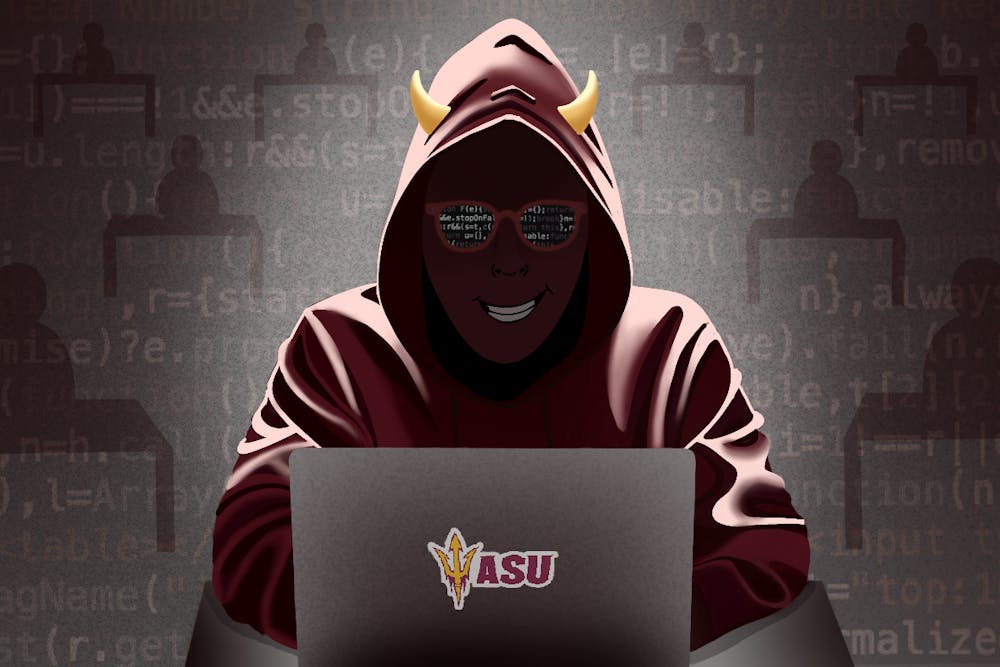
On Sept. 20 and Sept. 21, Engineering Center G Wing was filled with laptops and teams of students scribbling ideas on whiteboards and scripting code. DevHacks, ASU's student-run hackathon, was in session again and it was an event full of collaboration, creativity and innovation.
Hackathons are a key part of the technology field. The events provide students with the capacity to turn ideas into functional prototypes within a short time and learn to innovate under stress.
This is where DevHacks stands out from other University competitions.
It's not only coding; it includes experimentation and mentorships while also surrounding students with experts in the industry, said Bhoomi Sahajsinghani,a junior studying computer science and data science and the vice president of DevLabs, which organized the event.
Sahajsinghani said the organizers of DevHacks were coordinating the event for two months leading up to the weekend.
"There's a lot that goes (on) behind the stage, like all the ASU funding, ASU approvals, getting sponsors, getting the venue booked, getting the team in place for marketing and media coverage," Sahajsinghani said.
The plan for the event pivoted to emphasize building startups, Sahajsinghani said, and pushing "the startup ecosystem at ASU" with the help of their network, which included both their adviser and industry professionals.
Dhravya Shah was one of the co-founding members of DevLabs and has since founded supermemory, an AI agent that works to add memory to AI models. DevHacks included a sub competition for "Best use of supermemory," during which teams got to use the company's product.
supermemory took part in more than a ceremonial showing. Engineers from the company were able to receive feedback on their product, while helping to guide teams and support technical issues.
In addition to competing for awards, participants learned from both industry mentors and fellow participants.
Constant threads throughout the event were mentorship and partnership. Adwait Sharad More, a junior studying computer science, said the different perspectives and stories from others at the event were both helpful and impactful.
"I have met one of the sponsors," More said. "It makes a huge difference because you can, in person, talk to them, understand, specifically, the problem and we can solve it."
For some students, the weekend was an important learning experience. Javier Naranjo, a freshman studying computer science, attended the event alongside a team of collaborators.
Naranjo said the hackathon turned the competitors' focus toward features while turning ideas into working code; the point of the event was to get things done, rather than get things perfect.
"We have our ideas ready," Naranjo said. "The only thing left is that we have started coding."
READ MORE: Coding Community: Hacking Club and Hacker Devils pave the way for future innovators
Other teams combined ambition with realism to tackle challenges. For the event, More's team created a hiring tool intended to automate hiring processes, learning to put their goals first while utilizing critical thinking skills.
Gunbir Singh, a sophomore studying computer science, worked on a team that oriented their project toward cybersecurity and proposed an approach using an AI device that can redirect suspicious phone calls to prevent users from falling victim to a scam. Instead, the AI attempts to annoy the scam caller.
READ MORE: Online scams are on the rise: Here's what students need to look out for
Other students added a personal touch to their work. Tarunya Prasad, a graduate student studying computer science, with a team designed an app that helped international students keep in touch with family members living in different time zones, specifically aiming to create technology that would summarize their loved ones' days and what they did.
The weekend ended with pitches, awards presentations and celebrations. The impact and effects of DevHacks extended beyond participation in activities.
For the organizers and sponsors, the weekend was less about winners and more about momentum; they wanted the students to keep trying new things and solve real-life problems, Shah said.
"In today's day and age, if you can speed run (finding) the right people, speed run through your idea, speed run through making the code book, speed run through pitching it to people and making them like it, then it trains you for life," Shah said.
Edited by Kate Gore, Senna James and Katrina Michalak.
Reach the reporter at ngmohta@asu.edu.
Like The State Press on Facebook and follow @statepress on X.
Nikhil Mohta is a sophomore studying B.S. in Finance and is currently a Business Community Leader for the W.P. Carey School of business. He is also an active member in various clubs on campus like PIERA.