ASU's charter states, "(it) is a comprehensive public research university, measured not by whom it excludes, but by whom it includes and how they succeed," but is ASU truly including everyone?
According to a 2020 study done by the National Center for Education Statistics, about 21% of students studying for an undergraduate degree have a disability.
Roughly 23 colleges across the country offer adaptive sports teams for students with disabilities, including the UA Wildcats, according to a list made by the Challenged Athletes Association in 2019. ASU did not make the list.
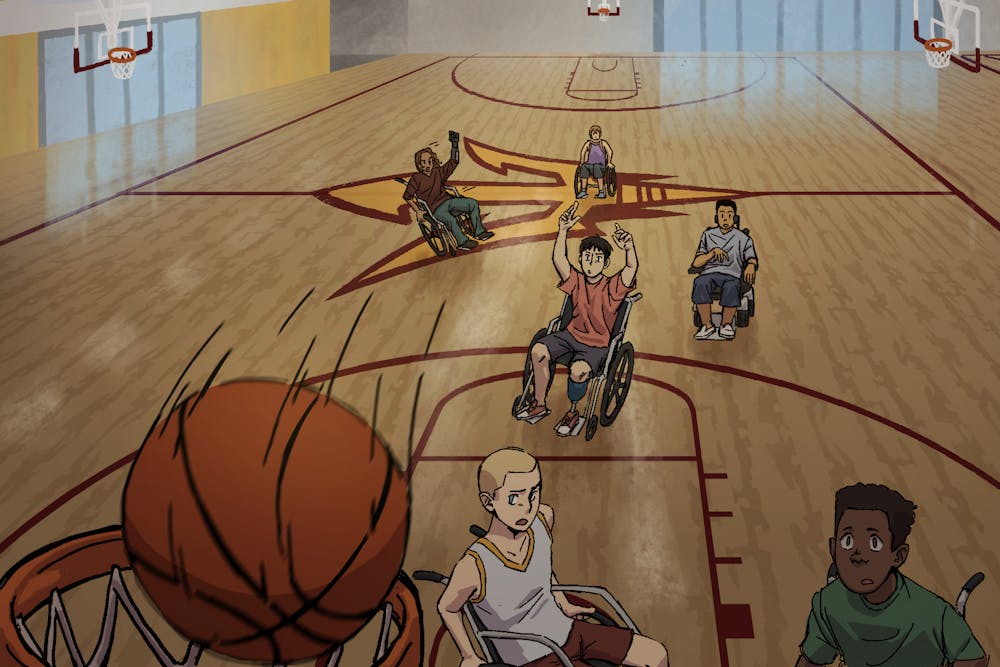
ASU currently offers one athletic program specifically designed for Sun Devils with disabilities — Devils Adapt.
Kinesiology student and Devils Adapt's inclusive recreation coordinator Abby Brookshire said in a written statement the organization offers a strength and conditioning program for students, staff and faculty with disabilities.
The student-led program was founded in 2018 and has been growing steadily ever since. According to Brookshire, the program came from around seven to ten athletes, and has grown to include 14 athletes, 12 student trainers and internship opportunities. Currently, Devils Adapt meets 10 weeks each semester, three times per week, Brookshire said.
Zach Cordell, an associate teaching professor at the College of Health Solutions, said people without disabilities should support people with disabilities' concerns instead of assuming what they need or want.
Cordell said those providing support and community members with disabilities should have "a conversation about what are the things that this community is lacking in terms of the fitness and health realm. Do they have access to resources? Do they have access to the gym? Is it just on one campus? Is it just if you can make these classes?"
Aside from athletics, ASU has eight student organizations offering community to students with disabilities. These organizations make up the Accessibility Coalition — a student-created and led organization that looks to advocate against ableism, raise awareness of the experiences of people with disabilities and educate on stigmas surrounding disabilities.
One of these organizations is the Disabled Law Student Association, which acts as a point of contact between the students and the administration, said Sebastian Shibuya, a law student and vice president of DLSA.
DLSA takes complaints from students who "don't feel comfortable telling administration they have an issue," and will communicate the problem to administration on behalf of the student, Shibuya said.
Shibuya is profoundly deaf and uses his position in DLSA to help other students with disabilities get accommodations and help them join programs they can participate in.
"At the (Student Accessibility and Inclusive Learning Services) department, some people feel like it's too easy to get accommodations, but then some people feel like it's too hard," he said. "So from what I've heard, there's that lack of consistency."
Regarding Devils Adapt, Shibuya was unaware that the program even existed.
"That's the thing: ASU can say, 'Oh, we have all these resources,' but...people need to know about it, and I think that's where the disconnect is," Shibuya said.
Devils Adapt training sessions are only held in Tempe, which can create a communication barrier for students who live on other campuses, said Dr. David Jaulus, a faculty associate for the School of Social Transformation, involved with Devils Adapt.
"(The University doesn't) have a lack of resources; they have a lack of advertising, they have a lack of communication," Jaulus said.
Each athlete in Devils Adapt sets their own goals for a 10-week program depending on their needs and how their body functions, Jaulus said. He has spastic cerebral palsy, and his goal is to continue working on flexibility, stretching and distance walking.
Devils Adapt is more than a program; it is a space where Sun Devils can come together and find a community.
"We have outings and mindful meetings once a month creating a space to build community, we love being able to plan special events and watching friendships foster within our program and grow into a family," Brookshire said.
When contacted, the University said they don't have anything to provide on this topic at the moment.
Edited by Natalia Rodriguez, Henry Smardo, Tiya Talwar, Sophia Braccio and Ellis Preston.
Reach the reporter at galawre3@asu.edu
Like The State Press on Facebook and follow @statepress on X.
Grace Lawrence is the lead reporter for the community and culture desk at The State Press. This is her 2nd semester working with The State Press.