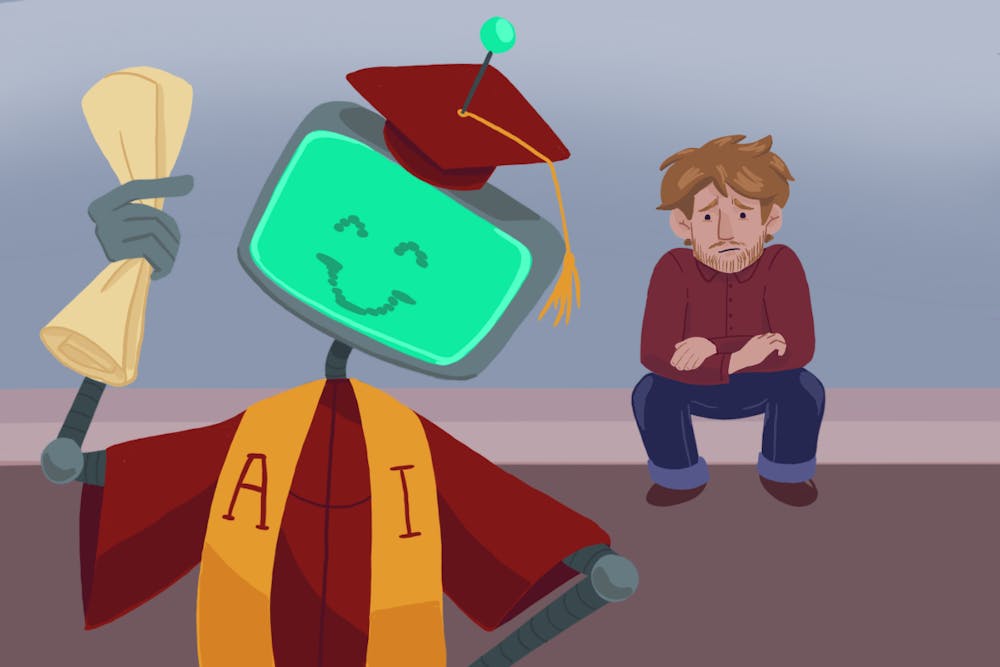
On Sept. 15, ASU celebrated "AI Day." This unusual celebration is billed as an opportunity for the ASU community "to showcase cutting-edge AI innovations, foster interdisciplinary collaboration, and explore how AI is shaping the future of education." As Teaching Professors at Barrett, The Honors College who care about our students' ability to read, write and think independently, we didn't join in the celebration — but we did pay attention.
The uncritical tenor of the ASU administration's promotion of generative artificial intelligence has become increasingly disturbing. AI is a transformative technology that ASU must prepare our students to understand.
But the consequences of encouraging the integration of AI into every aspect of student instruction are potentially catastrophic. The ASU administration is currently charting a course that risks allowing AI to undermine our commitment to both educational innovation and the democratic values of our public university as expressed in our charter.
Before addressing the effects of AI in the classroom, it is necessary to acknowledge what is undeniably the most dangerous aspect of the widespread adoption of this technology: its ecological cost. The energy and water demands of AI risk undoing our country's and the world's already insufficient efforts toward water conservation and the transition to renewable energy.
At a recent event at ASU, Republican Congressman Andy Biggs sought to address this inconvenient fact by selling his audience a dystopian vision of a future Arizona landscape. It was dotted with nuclear reactors from the Four Corners to Yuma, all to serve the massive energy demands of AI data centers like the one voters in Tucson recently organized against to keep AI out of their communities.
If it were to embrace Biggs' vision of our energy future, ASU would undercut the well-deserved reputation for sustainable innovation in higher education that President Crow inaugurated with his founding of ASU's interdisciplinary School of Sustainability. That commitment to sustainability should guide and limit ASU's engagement with AI.
AI's impact in the classroom is less easy to measure than its carbon footprint, but it has the potential to subvert ASU's commitment to cultivating inclusion and civic engagement just as surely as it threatens our commitment to sustainability.
AI platforms like ChatGPT, made easily available by expensive licenses provided free to our students by ASU, allow students, sometimes motivated by laziness but more often harried by the busy work schedules they maintain to pay for their education, to short-circuit writing assignments by spitting out a passing semblance of a student essay in seconds.
But why does this matter? If students struggle to write essays and professors struggle to grade them, isn't this a godsend? Sure, if the point of student writing is producing what ASU administrators are fond of referring to as "deliverables." But for good teachers of writing, the "deliverable" is never the point.
Writing is thinking: it is an excruciatingly difficult discipline, a process that helps us understand ourselves and the world, even when the actual end-product of a writing exercise is not something that anybody would actually want to read. By placing and revising words in sequence in ways that make sense, by exercising our mental muscles in confrontation with the blank page (or the blank computer screen), we become better and deeper thinkers.
Early studies are already confirming what should be self-evident: prompting ChatGPT to write an essay does not exercise the cognitive functions that real writing does. Humanities scholar Matt Seybold has sketched out the potentially dire consequences of the widespread adoption of AI in university classrooms. He described a future of "technofeudal education" in which the forms of critical thinking and deliberation that should undergird the most basic processes of our democracy are fundamentally and irreparably devalued.
Yet Michael Crow, in a recent op ed he co-bylined, insists that such faculty concerns about AI are overblown, comparing them to the panic inaugurated by the introduction of the calculator into K-12 classrooms in the 1970s. This comparison tempts us with a false analogy for understanding the pedagogical challenge presented by AI.
Generative AI is more like an internet-connected smartphone or tablet than a calculator, and the introduction of laptops and tablets into the classroom in the 2010s provides us with a much more useful point of comparison.
As David Sax argued a decade ago, the "iPad Classroom" promised to bring equitable and inclusive learning to all, but ended up producing distracted students, soaring educational costs, and very little in the way of improved learning outcomes. It has been a disaster we are only now beginning to recognize and undo.
We should, as President Crow urges us, learn from the history of past tech interventions in the classroom. When we do, we find that those interventions have always had mixed results: sometimes bringing some benefits, often also carrying unintended costs that boosters at the time refused to acknowledge.
We agree with President Crow that the advent of AI demands a reimagination of what higher education should be. For us, that reimagination involves a return to core principles: helping our students think independently, understand the world they are inheriting and which they will shape, evaluate sources of information with critical care, and discover who they are and who they want to become. For these core tasks, AI is an impediment, not a help.
A critical attitude toward AI at ASU would not mean regressing into a knee-jerk Luddite rejection of technologically enhanced education, but it would mean leaving cringey celebrations of AI to the Silicon Valley cheerleaders. ASU must empower faculty, rather than ed tech corporations, to make complicated determinations about the value of technology at our university.
Editor's note: The opinions presented in this letter are the author's and do not imply any endorsement from The State Press or its editors.
This content was contributed by authors who do not work at The State Press. If you are a community member who would also like to contribute, please email execed.statepress@gmail.com.
Edited by Sophia Braccio, Henry Smardo and Katrina Michalak.
Like The State Press on Facebook and follow @statepress on X.