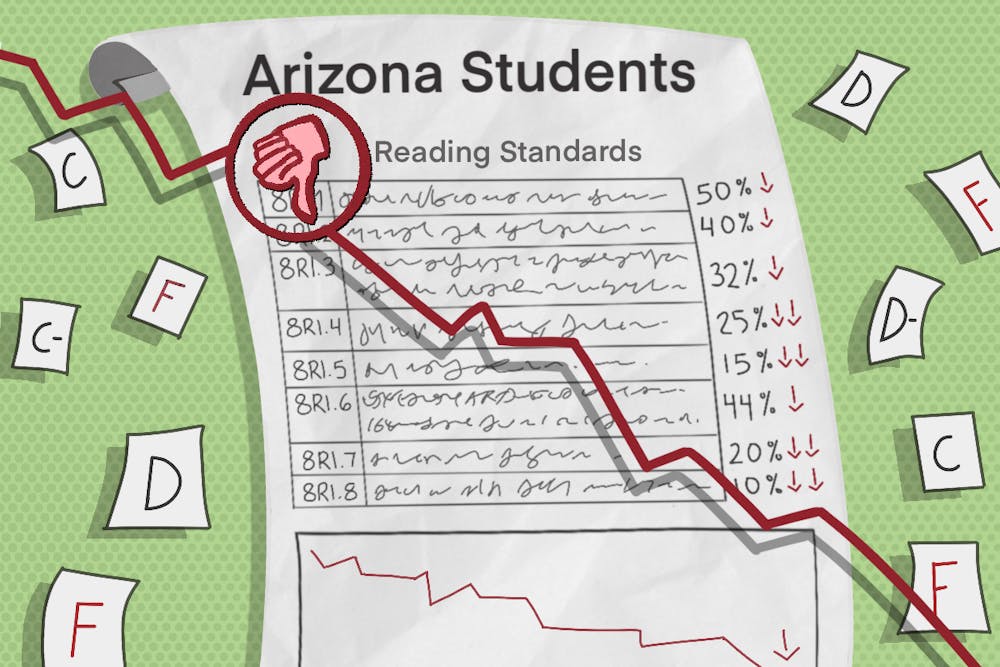
Arizona's education system consistently places low in national rankings, an issue that has attracted the attention of state and University leaders.
In early September, the National Assessment of Educational Progress released the Nation's Report Card, an assessment of students' academic performances. The most recent results showed a comparison of Arizona test scores from 2022 to 2024.
It showed 8th-grade average math scores dropping from 271 to 270, 8th-grade average reading scores dropping from 259 to 254 and 4th-grade average reading scores decreasing from 215 to 208.
The U.S. News and World Report currently ranks Arizona 45th in the U.S. for Pre-K-12 education.
The changes in these scores have motivated officials at the Arizona Department of Education, as well as organizations at ASU, to pursue solutions.
"Declining test scores are a disturbing national trend, but I have 15 educational initiatives to help improve academic performance for students in Arizona," Superintendent of Public Instruction Tom Horne said in a written statement.
Those initiatives include resources for educator training and retention, student assessments, school improvement teams and the implementation of AI technology in learning, he said.
"While I am personally involved in advancing every one of the initiatives, success will also require the commitment of the education community and the support of families to ensure that classrooms are cleared of unnecessary distractions and students remain focused on academic achievement," Horne said.
ASU is also attempting to improve learning outcomes by changing the basics of K-12 education.
Carole Basile, the dean of the Mary Lou Fulton College for Teaching and Learning Innovation, said the school is working on new strategies to address the problem.
One change that the Mary Lou Fulton College is helping schools to implement is a "team-based model." Basile said the one-teacher, one-classroom structure is unfeasible because every student and educator is different.
"We're not going to get anywhere in a one-teacher, one-classroom model where we're expecting every teacher in that classroom to be all things, to all kids, at all times," Basile said.
READ MORE: 'Kids still need teachers': ASU educators share thoughts on their future careers
The Mary Lou Fulton College's Next Education Workforce, an initiative to put teams of educators in classrooms, has shown improved student outcomes for reading and math alongside other benefits.
"Research is showing us that when you start to get out of the one-teacher, one-classroom model, and you start to build teams of teachers that have distributed expertise, that we are seeing gains in achievement at all levels," Basile said.
ASU Preparatory Academy, a tuition-free network of charter schools operated by the University, is hoping to address lower test scores at the primary and secondary school levels.
Jill Rogier, the head of schools for ASU Prep Digital, said the school's mission to design new educational models is a unique and exciting component of ASU Prep that increases academic success.
"I think students are bored," Rogier said.
She spoke with a student who transferred to ASU Prep and asked why they chose it. She said the student was disengaged at their previous school's honors program, so they made the move to gain credits toward a college degree.
Most schools look the same as they did when Rogier was in high school 30 years ago, she said. To address that, ASU Prep includes "pockets of innovation" that could help to better serve students.
Rogier said ASU Prep feels a "huge responsibility" to prepare students for higher education. For the class of 2024, 90% of seniors were admitted to a two- or four-year college.
"It's these opportunities to be a college student while you're in high school that really is motivating and exciting for kids," Rogier said.
There is no "magic curriculum" to improve test scores, Rogier said, just understanding the science of how students learn.
"We're not just building models to be cool," Rogier said. "We're building models because we're meeting kids where they are, and finding what excites them. What do they want to learn?"
State initiatives, team-based approaches and college preparation models all aim to reverse an ongoing trend of low academic performance.
"Everything that ASU is doing — given that it's ASU — is trying to really look at systems change," Basile said. "There's no silver bullet to this, but the entire system has to start thinking differently."
Edited by Carsten Oyer, Henry Smardo, Tiya Talwar and Pippa Fung.
Reach the reporters at elbradfo@asu.edu and jonahmanthey@asu.edu. Follow @emmalbradford__ and @_therealjonah on X.
Like The State Press on Facebook and follow @statepress on X.
Emma Bradford is a senior reporter at The State Press and in her senior year, studying both journalism and political science with minors in business and Spanish. She has previously interned with AZ Big Media and NEWSWELL Chicago, and completed her capstone at the Cronkite News D.C. bureau; she is currently interning with KJZZ. This is Bradford's sixth semester with The State Press; she was a part-time politics reporter for three of those semesters and a full-time politics reporter for one.