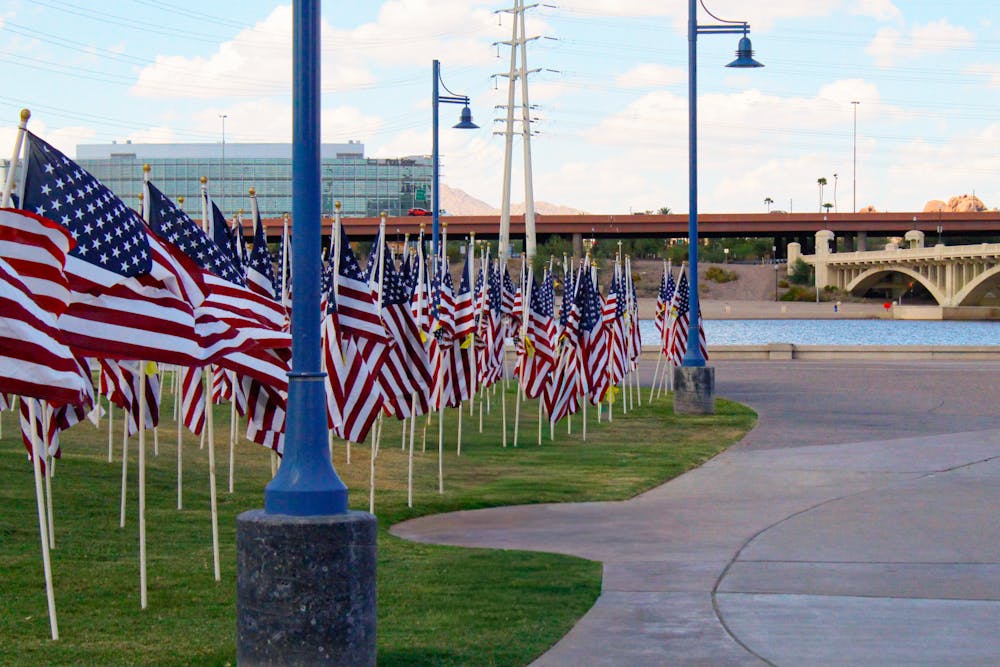
Community members reflected Thursday on the history and impact of the Tempe Healing Field memorial, which honors those lost during the attacks on Sept. 11, 2001.
Tempe has held a Healing Field since 2004. The field of flags pays tribute to the victims of the 9/11 attacks. This event also included University students who assisted in the ceremony.
Paul Swenson, the founder of the Colonial Flag Foundation, hosted the first Healing Field in Sandy City, Utah, in 2002.
"On the night before Sept. 11 — Sept. 10, 2002 — we put it up in about three or four hours," Swenson said. "This beautiful, living... field of flags emerged."
The Colonial Flag Foundation raises awareness and money for nonprofits and helps host flag fields, such as the Tempe Healing Field.
What started as one Healing Field in Sandy City, Utah, has grown into multiple memorials across the nation.
The event was brought to Tempe by Michael Whitaker and Mike Clark, members of the Valley of the Sun Exchange Clubs Foundation. They proposed the idea after attending a national convention where Swenson discussed the memorial, Mark Whitaker, Michael Whitaker's brother, said.
At first, the local community was unsure of where to locate the memorial until it found its home on Tempe Beach Park. It has now become a tradition every September.
"They had to put the flags together that day — it took them hours," Mark Whitaker said. "Now, we get so many volunteers... (that) the flags will go up in roughly an hour."
Michael Whitaker died in 2021, and his brother continues to assist with the memorial.
In the early hours of Sept. 11 each year, Tempe Beach Park is transformed into a large memorial bearing nearly 3,000 U.S. flags. Each is labeled with a name, dedicated to an individual who lost their life.
"When you see 2,977 flags, you get the enormity of the cost of that day," Mark Whitaker said. "That's why the field was created."
The display spans multiple grass areas within the park. Mark Whitaker said the layout of the memorial is symbolic.
He said that flags for the first responders encircle and protect the field. In the center of the memorial is the flight crew, who represents the initial first responders.
Volunteers at the event help visitors navigate the memorial, as well as locating the flags of specific individuals.
"When we can take someone to the flag that represents their loved one, that's when healing can start," Mark Whitaker said.
Multiple events take place during the duration of the field's display, including a candlelight vigil on Thursday and a Tunnel to Towers 5K run on Sunday.
Among these events is the Freedom Concert on Saturday, where the ASU Army ROTC serves as the Honor Guard, posting the colors.
"ASU Army ROTC has been grateful to take part in the Tempe Healing Fields year after year, and it has become a tradition our cadets deeply value," ASU Army ROTC spokesperson Hailey Heinrich said in a written statement. "Each September, they help set up the memorial, post flags, and stand watch to honor the lives lost on September 11, 2001."
Other members of the University community also took part in preparations for the Healing Field.
Four members of the 942 Crew, a student group that supports Sun Devil Athletics engagement, helped place flags Thursday morning.
"A lot of people from the community and the school were able to just come together for something great, and… I was very glad to be part of it," Samantha Dietz, a senior studying kinesiology and a 942 Crew officer, said.
Around two decades after Tempe's annual event began, its impact continues.
Flight attendant Kelly High said she has visited the site for the past six years and views it as a time to honor the flight crew affected by the attack.
"The fact that you get to read just a small piece of their life brings their memory a little bit back to life," High said. "We get to remember that each person was so special."
High said it can become easier for people to lose sight of the day's significance over time despite the common saying, "never forget."
"The fact they do this, it just brings it all back, resurfaces it for all the good reasons," High said.
Lissette Lent, the experience director for Jewell School in Queen Creek, brought students to the field to help dress flags with yellow ribbons, dedicating them to first responders. They also led volunteers in reciting the Pledge of Allegiance.
"It's one of the biggest things that's ever happened to our country," Lent said. "For these next generations who weren't there, who didn't live it, didn't understand it and see it happen live, it keeps the memory of... these fallen alive."
Sophia Braccio contributed to this reporting.
Edited by Carsten Oyer, George Headley and Pippa Fung.
Reach the reporter at emalvar9@asu.edu.
Like The State Press on Facebook and follow @statepress on X.
Emilio is a junior at Arizona State University and this is his second semester at The State Press.