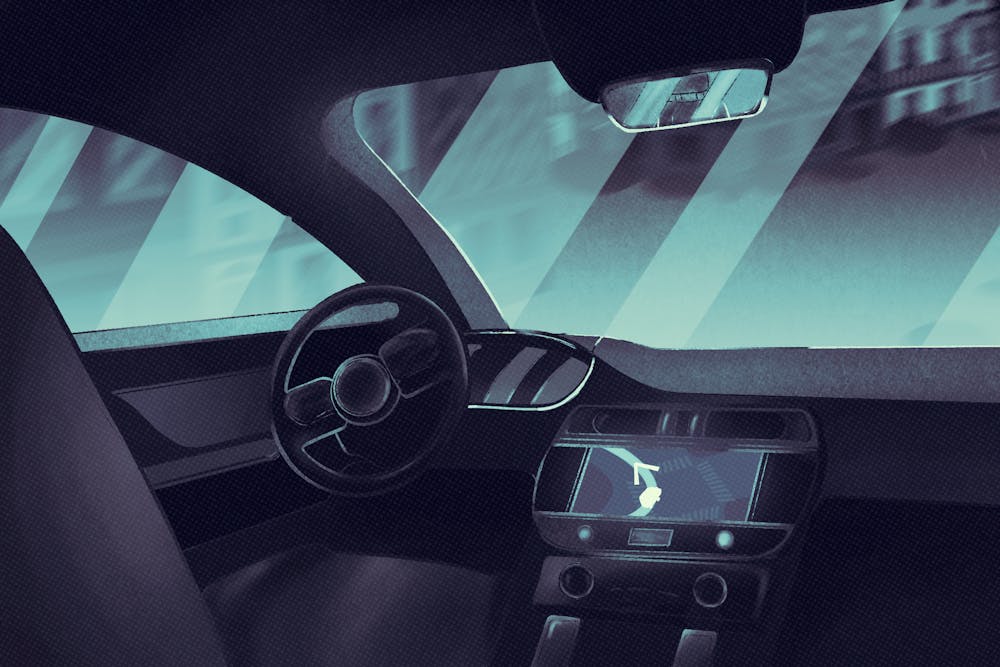
As the roads of downtown Tempe fill back up, student drivers and pedestrians are sharing lanes with the odd-looking Jaguars known as Waymo. These vehicles, which are slowly becoming a student transportation staple alongside more human rideshares, contain a world of engineering feats.
Self-driving technology is not new. Many other car brands like Tesla, Ford and Kia have a drive assist feature to function alongside human input. However, Waymo is one of the few cars — and one of the most widely known — that can drive fully autonomously on the road without a human driver. Using sensors, Waymo provides a transportation alternative that can be beneficial, but researchers continue to prioritize safety.
While Waymo claims to be a safer alternative to human driving, the technology is not without its limitations. The car has been involved in several accidents in previous years and can face difficulties in challenging weather conditions.
READ MORE: Waymo Vehicles: The New 'Wrong-Way' Drivers in Tempe
To alleviate concerns regarding the safety of the vehicle, Waymo provides public data about how their cars can minimize crashes in their locations. The data, presented by the company, shows that Waymo vehicles have 88% "fewer injury or worse crashes" than cars driven by humans.
For an autonomous vehicle to function, it has to collect raw data. Rashmeet Kaur Nayyar, aPh.D. student studying computer science, is involved with Autonomous Agents and Intelligent Robots — a research group that focuses on developing more safety measures and innovating new methods for work on autonomous agents.
She said the cars use sensors like cameras, radar and LiDAR — which stands for light detection and ranging — to make sense of their surroundings. The cameras paint a 3D image of the space around the car, and radar detects sounds in the immediate area. LiDAR uses lasers to detect velocity and movement around the car.
"The information is all raw (data) that the agent is acting on," Nayyar said. "For Waymo, it collects data using LiDAR sensors."
The raw data is processed by putting together the inputs from cameras, LiDAR and radar to create a full picture. An advanced machine learning algorithm processes that information to make sense of the car's situation and decides how to continue.
Following recent high-profile incidents, a possible concern among Waymo riders may be cybersecurity.
Junfeng Zhao, an assistant professor of engineering at the Polytechnic School, said that to address security concerns, developers protect the software with a signature unique to each Waymo that prevents hacking and potential cybersecurity risks.
Cybersecurity risks are not the only concerns with autonomous vehicles — physical risks in the environment can also pose a threat to proper functioning.
Aviral Shrivastava, a professor in the School of Computing and Augmented Intelligence, said he experienced a scary moment while riding in a Waymo. A pedestrian carrying a mirror walked in front of the car, misleading the sensors into perceiving a car that was not there.
"The car got really confused," Shrivastava said.
While some riders may be skeptical of the technology, the components of Waymo are developed to ensure that the rider has a safe drive, and the sensors are all encoded to prevent confusion with other stimuli, according to an autonomous vehicle timeline from IDTechEx.
Since the technology is still new, regulations at the government level are in development. Laws regarding autonomous vehicles are scarce and mainly put the safety in the hands of the developers.
Arizona's Department of Transportation outlines how to safely test an autonomous vehicle to keep it safe for the roads. The vehicles must follow all typical transportation laws, and companies must routinely check cars to make sure they are safe for travel.
Zhao said, as Waymo continues to advance, there is also a need to consistently address safety concerns.
"There's a lot of technology development in the AV side of things," Zhao said. "It's developing rapidly, but at the same time, we have a lot of unsolved issues and challenges."
Edited by Kate Gore, George Headley and Ellis Preston.
Reach the reporter at myerrag1@asu.edu.
Like The State Press on Facebook and follow @statepress on X.
Meghana Yerragovula is a reporter for the state press. She is on her second semester writing as a reporter.