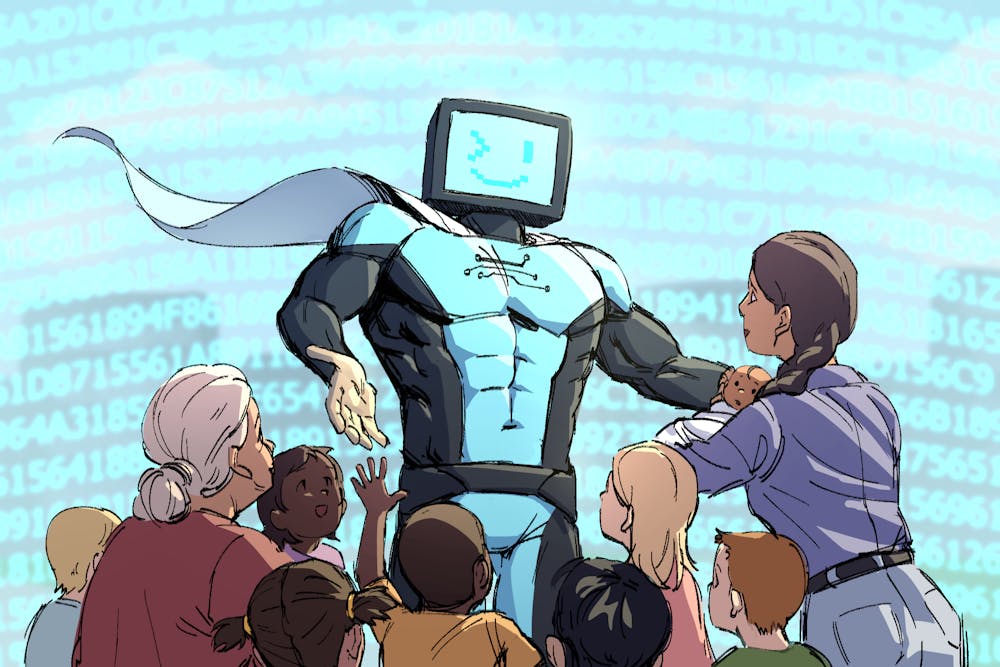
The high-performance level of ASU's supercomputer, Sol, places the system as one of the top 500 supercomputers in the world, at No. 388. But with great computational power comes a great administrative responsibility.
The power of the computer enables researchers to complete essential modeling and simulations, allowing them to study topics from AI to protein folding.
The system contains 18,000 central processing unit cores and 224 graphics processing units. This is about "2,000 times faster or more capable than a modern laptop, and in terms of data storage, you could say about 4,000 times that," Douglas Jennewein, the executive director of ASU's Research Technology Office, said to ASU News.
To gain access to the supercomputer, students must be a part of an affiliated lab and contact the principal investigator of the project. Students must then follow all relevant procedures as stipulated by the Research Technology Office. When allowed usage, students and faculty can use the supercomputer's computational power either through a web portal or a command line interface — a text-based tool for interacting with the computer's operating system.
With such broad usage, power and capabilities, it is important to safeguard access to the computer. Misuse of supercomputing resources can have detrimental effects on research initiatives and private data access.
Souradip Nath, a graduate research associate at the Center for Cybersecurity and Trusted Foundations, said the primary security concerns are unauthorized access, data leaks and the utilization of computing resources for non-research-related tasks like crypto-mining.
There are several safety procedures in place to ensure the prior risks are mitigated. Sol implements two-factor authentication, a virtual private network and common cybersecurity practices.
"For ASU VPN connections, you need ASU credentials, as well as multi-factor authentication through Duo," Nath said. "There's another layer of two-factor security there."
Gail-Joon Ahn, a professor in the School of Computing and Augmented Intelligence and founding director of CTF, said when campus researchers graduate and transfer to other institutions, their accounts sometimes remain active.
A challenge to balancing access and security is ensuring that only authorized individuals can use computing assets, Ahn said. He also said research groups may have many individuals collaborating on concurrent projects, so it is vital only the necessary personnel have access at relevant times.
If such accounts aren't properly managed or deactivated, misuse can occur, creating security risks for the system, Ahn said.
READ MORE: Staying protected online, a guide to cybersecurity
Ananta Soneji, a Ph.D. student in the School of Computing and Augmented Intelligence studying computer science, said these systems store medical records, environmental information, cybersecurity data and various other types of sensitive information.
To protect this data, the principles of least privilege and separation of duty are utilized when granting permissions to users, Ahn said. Least privilege is giving users access permissions for only their responsibilities or tasks, while separation of duty is splitting specific tasks and duties among multiple users with differing privileges to avoid potential harm.
Safeguarding such a complex system with dynamic parts, while maintaining user-friendly capabilities, can pose a challenge. However, many future solutions can be implemented. Ahn said AI-driven or -powered scheduling can lead to more "cost-effective" resource management.
"As researchers and as users of these systems, there should be more education awareness into how we should be managing, (and) how we should be more proactive about security and privacy and safety of the system, as well as of the data," Soneji said.
Edited by Kate Gore, George Headley and Pippa Fung.
Reach the reporter at jdtamay1@asu.edu follow @JTamayo46036 on X.
Like The State Press on Facebook and follow @statepress on X.
John Tamayo is a science and technology reporter in his first semester with The State Press. He is a senior majoring in Physics and Philosophy.