Jane Goodall was a distinguished figure in chimpanzee research: Her work set new standards for field research and reshaped how people view animals. Her impact has even reached ASU, as much of her archived work is stored at the University's Institute of Human Origins.
Goodall first traveled to western Tanzania in 1960 to study the behavior of the chimpanzees at the Gombe Stream Chimpanzee Reserve. There, she brought a revolutionary, non-academic perspective to this field of research.
"Jane famously was one of the first to acknowledge that animals have personalities, that animals are different from one another." Ian Gilby, an associate professor at the School of Human Evolution and Social Change at ASU, said.
As a result of her discovery, many researchers and the population as a whole began to treat animals less like things and more like complex creatures that deserved humanity.
"She was so inspirational — how she talked about animals was really different at the time," said Heather Bateman, an associate dean for graduate studies and research and a professor at the College of Integrative Sciences and Arts.
Goodall used a research approach that was more human and hands-on, choosing to get in close contact with the animals and dedicating years of her life to observing chimpanzees in the field. She took the time to look at how chimpanzee populations behaved and how they all worked together.
"She was very important for establishing one of the earliest long-term field sites, where, instead of just going for six weeks or eight weeks or a summer to study these animals, you really devote the time, energy and resources to set up long-term behavioral data collection," said Kevin Langergraber, a professor at the School of Human Evolution and Social Change and the Institute of Human Origins.
In March 2022, the "tangible assets" of Goodall's work in Gombe National Park were brought to be housed at ASU's Institute of Human Origins, according to an article from the University.
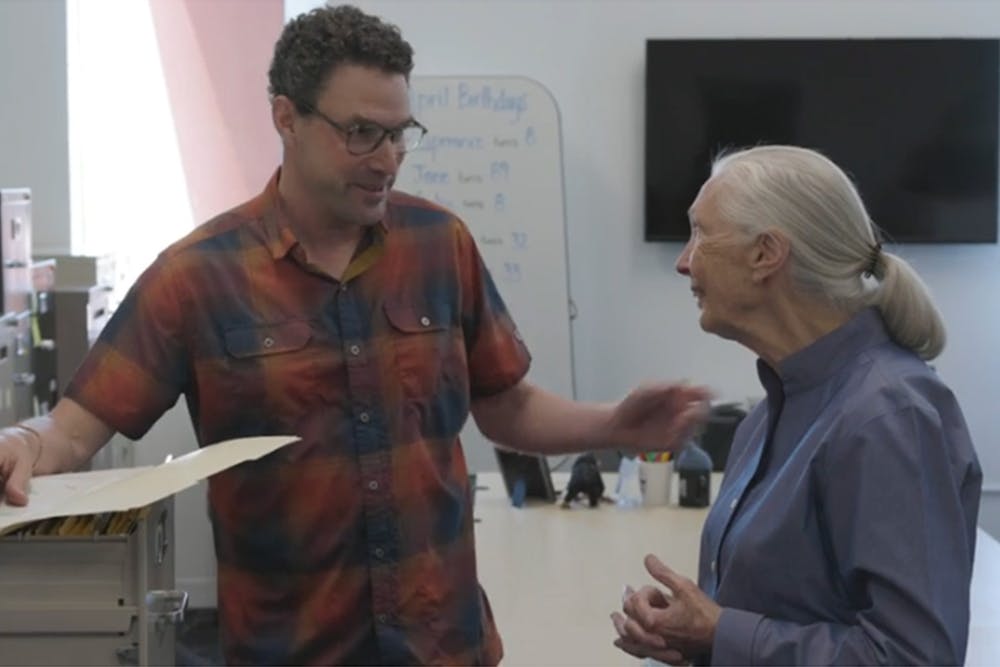
The archive holds 60 years of research and is overseen by Gilby, who is uniquely qualified to head the archives due to his extensive work with Gombe chimpanzees and with Goodall.
"I saw her once a year for the last 25 years or so, as she checked in on the research that was happening at Gombe," Gilby said.
The data housed at the Institute is invaluable, and curators are currently looking for ways to water- and fire-proof the filing cabinets to prevent any loss of data. The ASU Foundation has a website to donate to the cause.
Later in her life, Goodall transitioned her efforts from fieldwork and research to conservation. She switched her focus from working with chimpanzees to protecting animal habitats by preventing deforestation.
"She always said how she really wished that she could continue the research herself, but had a higher calling to conserve the species and also to essentially save the planet," Gilby said.
Goodall gave speeches around the world to schools, colleges and the general public. She involved herself in politics and was appointed a United Nations Messenger of Peace in 2002, bringing attention to environmental conservation.
She also founded the Jane Goodall Institute in 1977. The organization was created to further both her work in Gombe and her vision for conservation and youth empowerment.
Later, in 1991, Goodall created the program Roots & Shoots as a way to empower children to get involved in conservation efforts and to promote a positive future for the world.
According to ASU News, ASU is continuing to work with JGI to expand the reach of Roots & Shoots by adding more content to educate the children in the program, as well as by involving ASU's own conservation researchers. ASU's emphasis on sustainable practices complements Goodall's conservation work.
"She's a pioneer, right?" Langergraber said. "She's the first one to do it. We learned a lot from her."
Edited by Kate Gore, Henry Smardo and Pippa Fung.
Reach the reporter at myerrag1@asu.edu.
Like The State Press on Facebook and follow @statepress on X.
Meghana Yerragovula is a reporter for the state press. She is on her second semester writing as a reporter.