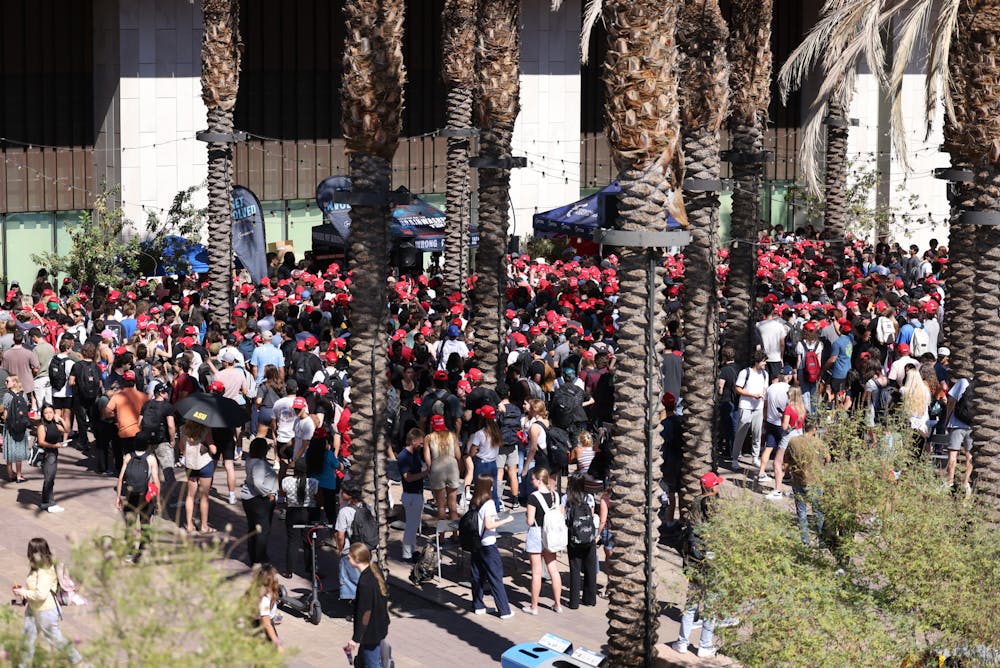
Following the death of Charlie Kirk, an influencer and Turning Point USA founder, young conservatives are navigating the new political landscape by increasing civic participation and outreach.
Experts and advocates alike emphasized messaging and engagement as the keys to maintaining momentum among conservatives, an effort they said will heavily involve college students.
Keith Miller, an emeritus English professor and affiliate at the Center for the Study of Religion and Conflict, said the future of TPUSA, as well as the campus movement it helped inspire, will depend on the organization's new CEO, Erika Kirk. Whether she continues her late husband's campus events will also determine how effective the transition will be, he also said.
"She has to choose between how much she wants to emphasize this sort of positive Christian message about love and family and how much she wants to emphasize his controversial side," Miller said. "Her decision may impact whatever amount of success she has or doesn't have."
Joel Webster, a postdoctoral scholar with the Center for American Institutions, said the future will depend on how TPUSA uses its newfound momentum among young conservatives.
"The central right of American political life is very fragmented, and in some ways, I think this is going to bring that together," Webster said.
TPUSA said it received more than 54,000 requests to start chapters at colleges and high schools within six days of Charlie Kirk's killing, a trend Webster said is proof of the unification of the conservative movement among young people.
"Seeing that type of response shows that there's interest," Webster said.
Webster said young conservatives are responding with a positive reaction, in the sense that the political violence is invoking change, recognizing "it has to happen democratically, it has to happen through the vote."
Troy Holderby, the president of College Republicans at ASU and a sophomore studying civic and economic thought and leadership, is reigniting the club after a dormant spring semester.
"We're looking to gain leaders," Holderby said. "The many students that I've seen who have been shut down in conversations on campus, we're looking to get those people to be able to get them to speak and express their ideas freely."
Holderby said the club's focus is to build a conservative community at the University.
To foster consistent involvement from students, Holderby said they need to be shown that their ideas matter and they have something meaningful to contribute.
Webster said another way to help students understand current politics and see other viewpoints is the Politics & Leadership Club at ASU.
PAL at ASU holds nonpartisan, open-ended discussions for students across the political spectrum to participate in.
"In many ways, the key to this is seeing these people as Americans, not just as Democrats or Republicans or Libertarians ... and understanding that they have needs, they have concerns, they have questions just like we do," Webster said.
Regarding the future of the conservative movement, Webster raised the question of whether Kirk's death will wear off or be overshadowed by another event. He said they must therefore unify in pursuit of shared goals rather than events.
"Conservatives are going to have to figure out a way to rally together and come to an understanding that the future depends on getting enough votes," Webster said. "In some ways, that has to be the goal, and not so much getting caught up, perhaps even on policy or principle."
READ MORE: ASU community reacts to death of conservative influencer Charlie Kirk
Matthew Martinez, a strategic director at Turning Point Action, gave a presentation to the College Republicans at ASU on how they were able to "make Arizona one of the best battleground states in the country."
"Your job, in a nutshell, as the College Republicans, is to get paper in boxes," Martinez said at the Sept. 30 meeting. "That is how you win. It's a mathematical game."
Martinez said Republicans were successful in 2024 because of improved voter engagement. In Arizona, TPUSA's Chase the Vote endeavor in 2024 drew in over 315,000 ballots and brought on an influx of Republican voters from the outskirts of Phoenix.
"We actually hired people, not volunteers," Martinez said. "We had thousands of people in Arizona engaging with this type of voter – this disengaged voter – a voter who just simply forgets to vote, a voter who doesn't think about politics the way you and I do."
Through this effort, TPUSA is hoping to encourage inactive voters through basic tasks like walking them through the voting process or informing them of polling locations, Martinez said.
Martinez said TPUSA is predicting there will be nearly 200,000 disengaged Republican voters for the 2026 midterm elections in Maricopa County, so they are hiring college students to help the Chase the Vote effort in the Valley.
Both at the national level and around Tempe, TPUSA is trying to increase conservatives' participation, whether that be disengaged Republicans casting their ballots or college students encouraging votes from community members.
"We're looking for people around ASU," Martinez said. "We'll give you a teacher's salary if you want to be a part of Turning Point. That is one of the easiest jobs, but one of the most effective jobs you could have in the conservative movement."
Edited by Carsten Oyer, George Headley, Katrina Michalak and Ellis Preston.
Reach the reporter at elbradfo@asu.edu and follow @emmalbradford__on X.
Like The State Press on Facebook and follow @statepress on X.
Emma Bradford is a senior reporter at The State Press and in her senior year, studying both journalism and political science with minors in business and Spanish. She has previously interned with AZ Big Media and NEWSWELL Chicago, and completed her capstone at the Cronkite News D.C. bureau; she is currently interning with KJZZ. This is Bradford's sixth semester with The State Press; she was a part-time politics reporter for three of those semesters and a full-time politics reporter for one.


