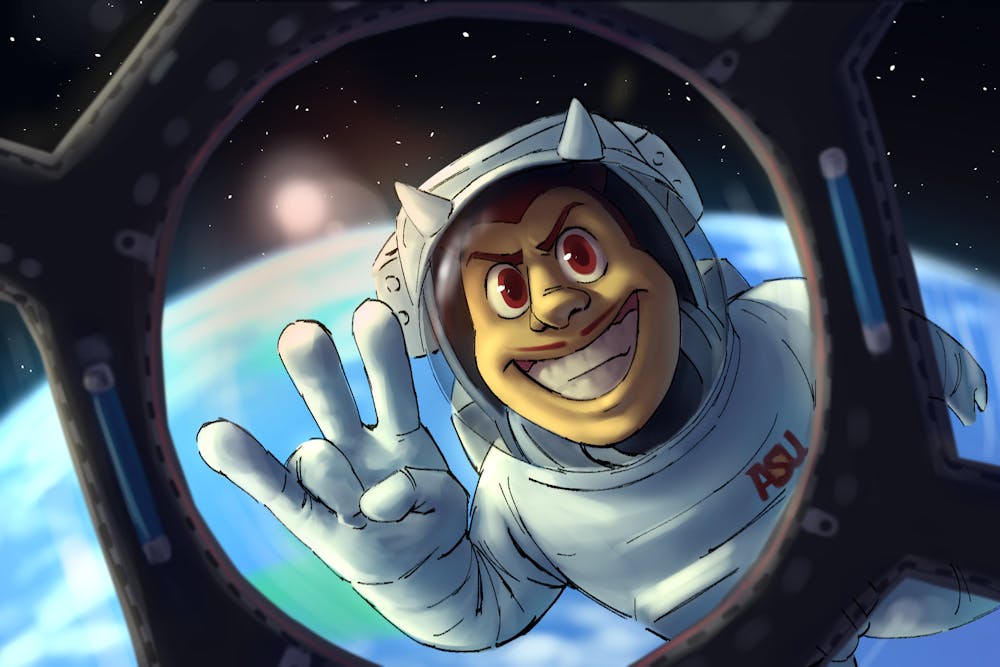
A small satellite built at ASU is preparing to head to orbit to study how ultraviolet light from distant stars affects the atmospheres and potential habitability of planets around them.
The project, called Star-Planet Activity Research CubeSat, is led by Evgenya Shkolnik, an astrophysics professor at ASU's School of Earth and Space Exploration. The CubeSat, a small space telescope, will observe how small stars emit ultraviolet radiation.
Because Earth's atmosphere blocks most ultraviolet wavelengths, the astronomers on the project need to use the satellite to perform research in outer space.
"When (ultraviolet) hits your skin, it can burn you," Shkolnik said. "So it's great that our atmosphere is protecting us here on Earth, but it's bad for (ultraviolet) astronomy."
Shkolnik said that the mission will observe about 20 stars of different ages to track how their ultraviolet activity evolves. The researchers want to study how the small planets' atmospheres are being affected by ultraviolet light from a statistical standpoint.
The SPARCS satellite is about the size of a family-sized cereal box; an added challenge of the project is the small size of the satellite.
"You are innovating to miniaturize," Shkolnik said. "We are showing how we could miniaturize some of these things, and yet do really exciting science that even some of the bigger telescopes can't do."
Daniel Jacobs, mission operations lead and professor in the School of Earth and Space Exploration, said there are not many telescopes of similar qualities currently in space. Examples include the Hubble and James Webb telescopes, but time with them is "extremely precious," he said.
"For science projects that need a lot of time, they just can't be done (with other telescopes)," Jacobs said. "SPARCS is a telescope dedicated to observing stars' activity because we want to know what they might be doing to planets."
According to Jacobs, designing the spacecraft came with unique hurdles, like keeping the system cool and clean. The camera is sensitive to several conditions, including alignment, temperature and electromagnetic noise.
Students were integral to the process of creating the satellite. From building interfaces to monitoring hardware to operating the spacecraft in orbit, they have been heavily involved in the design and use of the CubeSat.
Among the students contributing to SPARCS is Ysabella McAuliffe, a junior studying aerospace engineering and a student worker in ASU's Interplanetary Lab. She joined the mission nearly two years ago when the lab was contracted for spacecraft integration, assembly and testing.
McAuliffe said a lot of her time was spent inside a high-grade clean room, suiting up in gowns and masks to handle delicate optical components. During her shifts, she worked overnights to monitor testing on the payload.
Balancing her coursework with a multimillion-dollar space project was demanding, but McAuliffe said the experience was "very rewarding."
"The most rewarding part is having put so much time, dedication (in) and working so closely with other engineers," McAuliffe said. "I've seen the spacecraft go from being assembled, being tested, (to) the final product."
SPARCS is scheduled to launch aboard a SpaceX Falcon 9 rideshare mission within the next year.
"One thing we've already done is demonstrated the value of building small satellites at a university, because that's where we have access to so many amazing students," Shkolnik said.
Edited by Natalia Rodriguez, Kate Gore, Henry Smardo and Pippa Fung.
Reach the reporter at ngmohta@asu.edu.
Like The State Press on Facebook and follow @statepress on X.
Nikhil Mohta is a sophomore studying B.S. in Finance and is currently a Business Community Leader for the W.P. Carey School of business. He is also an active member in various clubs on campus like PIERA.