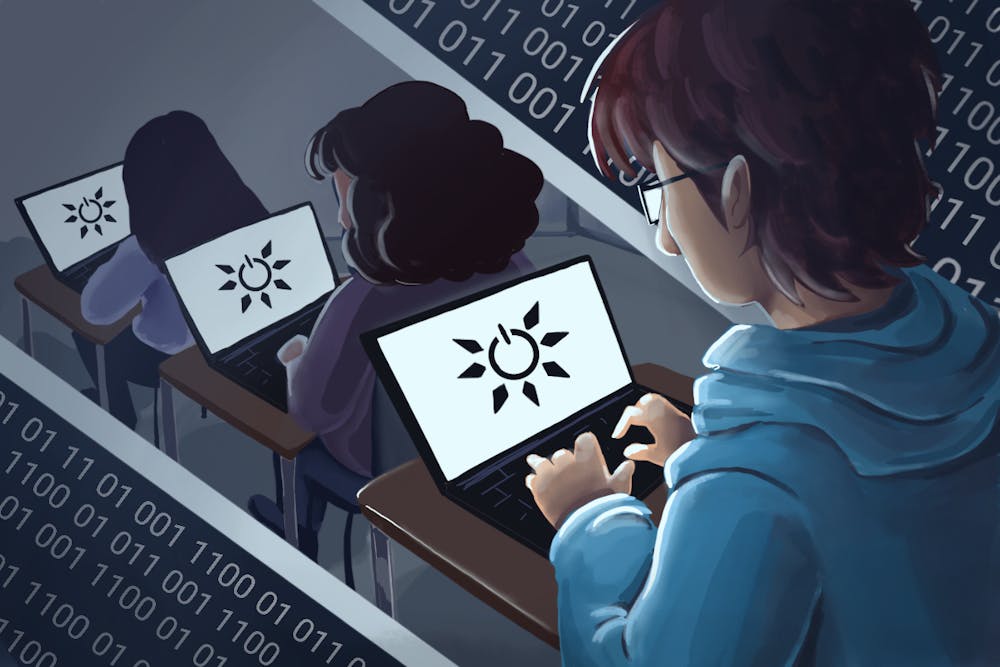
sunhacks, one of the biggest hackathons in Arizona, took place from Sept. 27 to Sept. 28 in the Tempe Sun Devil Fitness Complex. The event recorded the largest number of participants at sunhacks ever, with 603 people in attendance.
The annual hackathon started in 2018, and it entails marathon-style efforts to prototype a software- or hardware-based project.
Hackathons typically last for about a day, but sunhacks participants had only 23 hours to complete their prototypes. The official development for the projects started at noon on Sept. 27 and ended at 11 a.m. on Sept. 28.
With very little time for development, the teams of one to four participants produced 137 projects, the most in sunhacks' history. The projects were displayed following the submission deadline and can be viewed on the Devpost website.
Cecilia LaPlace, an ASU alumna and one of the founders of sunhacks, said the competition originated as a "collaborative event that came out of two hackathons" — Desert Hacks and Southwest Hacks.
Since its founding, the event has been an official Major League Hacking event. According to MLH, the organization is an "official student hackathon league" and supports hackathons that join its league.
Before the competition, LaPlace said MLH helped answer organizational questions. Then, on the day of sunhacks, a coach/representative from MLH attended to provide support and education.
Companies like Amazon, State Farm and General Dynamics also supported sunhacks through their sponsorships, either giving monetary support or free merchandise.
Penny Duong, a junior studying computer science, competed at sunhacks with her team. The group created the software project "Knowledge is Power," a quiz application they turned into a game with in-app incentives for correct answers.
The team made it using GameMaker, a 2D game engine, and plans to use Gemini AI to help strengthen learning within their application.
The organizers of sunhacks tried to bring attention to the event, specifically for freshmen. Omkaar Shenoy, an ASU alumnus working at the event, said one of the largest marketing events each year is freshman orientation.
"This is a great opportunity for (freshmen) to meet other freshmen in the same domain," Shenoy said. "When you work with them for 24 hours, you pretty much become friends with them."
Participants' reasoning for attending sunhacks varied; some people wanted to get practical experience of the concepts they learned in class, and others participated for the challenge associated.
Regardless, participation in the competition does not require planning or previous experience. Mitansh Maheshwari, a senior studying computer science, competed with a team that went into the competition without a specific idea, only knowing they wanted to involve AI.
The team ended up winning third place with their project "Plz_use_it," an AI study assistant.
Experience is not necessary for students to compete at sunhacks, so any ASU student aged 18+ or University alumni who graduated within a year can participate.
"We say that even if you don't know how to hack, that's fine," Shenoy said. "We have mentors, we have workshops — come here, and we'll teach you how to code."
Edited by Kate Gore, Henry Smardo and Pippa Fung.
Reach the reporter at dmle5@asu.edu.
Like The State Press on Facebook and follow @statepress on X.


