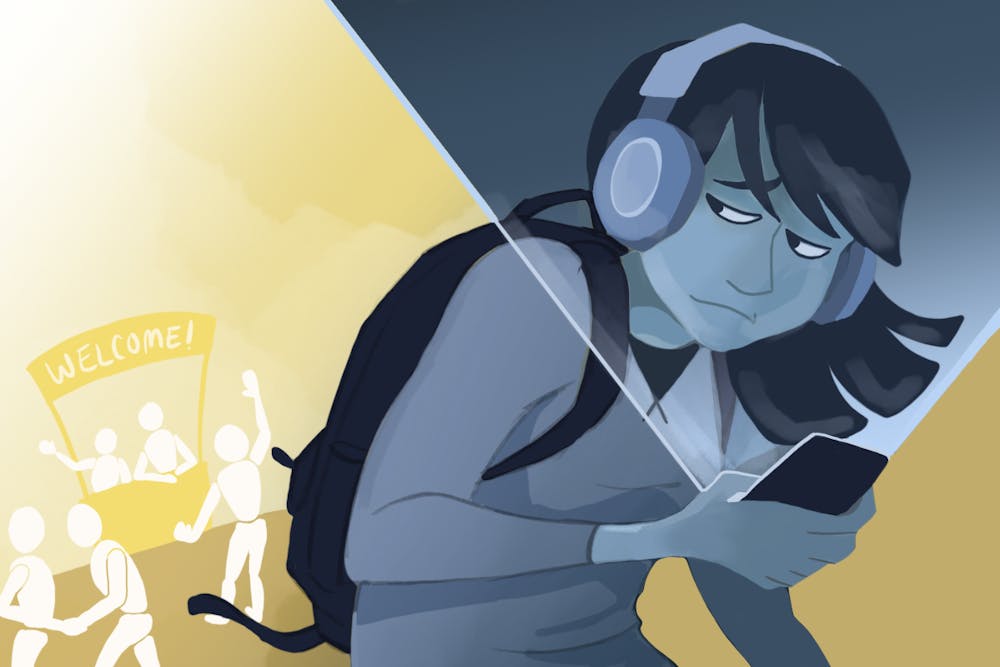
There has not been a time when I have opened X, Instagram or even TikTok and not seen political content since the 2024 election period.
Political polarization has always lingered in the shadows of my social media timelines, but over the past year, it has seemed inescapable. Opinions from the right and the left, and others in between, that I wasn't educated on, have flooded my feed.
At first, I told myself I was only noticing this change because I had reached the age where I could be politically involved myself. I turned 18 just before the 2024 election took place.
Leading up to the election, I saw political advertisements and public opinions, which I deemed perfectly normal considering the upcoming event. It was the continuation and intensified nature of this content that caught my attention.
Content that was once generally politically partisan began to seem like blatant attacks across new lines drawn in the sand. It didn't take long for the rising online tension to seep into my personal life and relationships.
Instagram stories from my peers reading "if you don't agree with me politically, unfollow me" and "it's just politics" overwhelmed my phone in the days following the election. Friends with whom I had never talked politics with blindsided me by the content they were posting.
I had never really based my relationships on political opinion, but seeing people I associated myself with making these kinds of posts made me reevaluate the values I seek in friendship.
Are differing values a deal breaker in my friendships? What values do I consider to be deal breakers? How do I communicate these values with my peers?
There was a lingering cloud of division and distrust over my head. A cloud that I believe was following many other students at the time too.
READ MORE: United in fear ... and not much else
Even now, almost a year later, politics is still a fragile topic for many, including students. Craig Calhoun, a professor in the School of Politics and Global Studies, said that he has noticed a sense of nervousness when discussing political subjects in his classes.
"I have noticed people being wary about discussion and worried that there will be arguments," Calhoun said. "Just in general, a sense of anxiety that things that people would have said could be taken the wrong way."
Calhoun said that, either way, most of the political polarization we experience today is online and not in person.
It occurred to me that even though most of the separations I've seen have been online, face-to-face confrontation is what I worry about the most. Like Calhoun's students, I envision conversations surrounding politics turning into heated, violent arguments.
"My general sense of the ASU environment is that it fits with this feature of the polarization, which is that everybody thinks the other side is out to get them," Calhoun said.
Calhoun's point reminded me of a recent event I saw taking place in the student pavilion. Members of College Republicans United held signs urging that members of Antifa be reported to the Federal Bureau of Investigation.
READ MORE: Antifa reporting event by College Republicans United at ASU draws opposition
Many students ignored the chants and remarks from the group, but some stopped and even debated members on their stance, others pulling out their phones to record the interactions.
Michael McQuarrie, center director and professor at the T. Denny Sanford School of Social and Family Dynamics, said that he would like to see more student groups working to build community.
"There is a desire among students and people generally to find ways to connect that aren't in this grist for this kind of partisan mill," McQuarrie said. "(It) doesn't seem to produce much in the way of productive change."
There are plenty of organizations at ASU that aren't centered around political partisanship, but even in those spaces, the topic is bound to come up. McQuarrie said we can use this as a way to better understand our own politics and the differing opinions of our peers.
"If you can relate with people around other interests, then you can sort of come to understand other political positions and things like that," McQuarrie said.
The mass polarization I find myself a part of today won't disappear overnight. Its nationwide presence has infiltrated spaces I have been in, both on and off campus. Amid separation, I don't want my anxieties to steer me away from the social aspects of my college experience.
Edited by Natalia Rodriguez, Henry Smardo, Kat Michalak and Pippa Fung.
Reach the reporter at dbell39@asu.edu and follow @dhemibell on X.
Like The State Press on Facebook and follow @statepress on X.
Dhemi Bell is the editor for the Community and Culture desk. This is her third semester with The State Press, working previously as a part-time Community and Culture reporter.