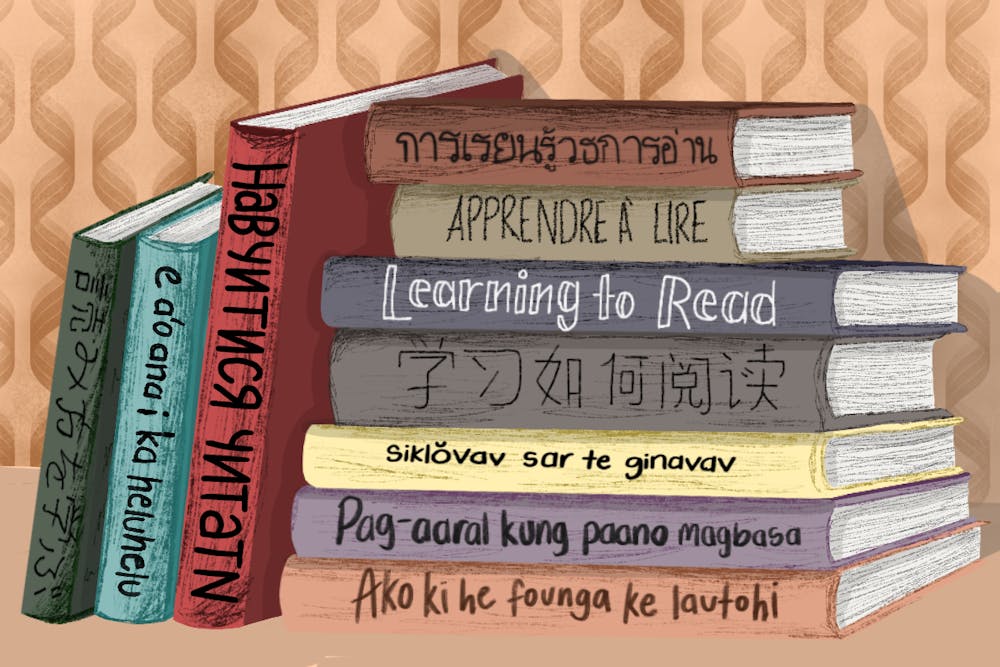
The University's Learning & Development Lab on the Tempe campus is conducting ongoing studies to gain insight into how children learn words based on the environment in which they grow up.
The lab focuses on various aspects of language learning, including research about children's experiences learning multiple languages simultaneously, as well as investigations into how children form words based on interactions with new objects.
Viridiana Benitez, the lab director and psychology professor, established the Learning & Development Lab in 2017 to conduct studies, train students in the research area and disseminate findings to families.
"One of the most important things children are learning is language," Benitez said. "Language is so critical for communicating with others in our environment, for forming the foundation of literacy skills, and it's a really important thing that children have to figure out in the first few years of life."
Bilingual cross-situational word study
In collaboration with the Children's Museum of Phoenix, the lab is conducting a study researching "bilingual cross-situational word learning in 4- to 7-year-old children," according to Benitez.
The study focuses on comparing how children learn words in monolingual and bilingual environments. Researchers from the lab go to the museum once a week to conduct the study.
Benitez said the researchers create a game simulating different environments: one monolingual and the other bilingual. They assign fake names for certain objects, introducing the child in the monolingual environment to only one new name, and the child in the bilingual environment to two names, one English-like and one Spanish-like.
The lab found that when presenting children with two different sets of words for objects, they tend to learn the first set of words well, and then "have a harder time" learning the second set, Benitez said.
These findings can be seen in real-world applications. Lucia Arellano, a junior studying business law, began learning English when she immigrated to the U.S. in third grade. During that time, she said she experienced some difficulties while trying to understand the grammatical structure of the new language compared to what she was familiar with.
"In Spanish, we have pronouns for every object, so a 'he' and a 'she,' and when they're in English, it's 'it' or 'the,'" Arellano said. "It was a bit challenging trying to translate to whether to use pronouns or not for objects in English."
An additional motivation for Benitez's research focus is that she is bilingual and a parent of a bilingual child. She said the lab gives her the opportunity to probe some parenting-related questions she has herself.
"What's the best way to talk to my child so that he maintains strong knowledge of his vocabulary in both of his languages?" Benitez said. "It's a question that many parents ask themselves."
Novel object talk project
The Learning & Development Lab's focus isn't only on bilingual childhood development. Researchers also investigate how children's word formation is influenced by object interactions.
The Novel Object Talk (NOT) project focuses on the parent-child interaction with unfamiliar objects, such as kitchen utensils, and familiar objects, like a doll.
Luka Smolens, a research assistant at the Learning & Development Lab and a senior studying psychology and Asian languages, said he works to code data from the lab's recorded Zoom sessions for study. Smolens watches the parent-child play sessions and records the on and offset of utterances from both parents and the children.
"I'll do that for the entire 20-minute video," he said. "That could range anywhere from 300 speech images (and) 300 utterances to 600. It really just depends on how much the parent (or) child is talking."
While the NOT project's objective is to create a dataset using the recorded sessions, discoveries can be found within the coded information.
Smolens explained how parents reinforce connections children might make between unknown and known words. As an example, he noted that by pointing out how a plane is flying, parents help their child make the new connection that a plane can fly.
The information learned from the NOT project indicates parents can be "great natural teachers just by having fun and playing with their child," Smolens said.
READ MORE: How childhood friends shape you: ASU research explores culture and diversity in early bonds
While the Learning & Development Lab is focused on children and their word development, parents may be just as involved through the questions they can ask about what to do to improve word-learning development in their children and simply being included in the research process itself.
"We couldn't do the work that we do without parents who are interested in participating in the work and contributing to our science," Benitez said.
Edited by Kate Gore, Senna James, Tiya Talwar, Sophia Braccio and Ellis Preston.
Reach the reporter at dmle5@asu.edu.
Like The State Press on Facebook and follow @statepress on X.