Inside the Visual Cognitive Neuroscience Laboratory at ASU, researchers investigate how the brain turns sensory signals into meaningful perception.
Led by Professor Gi-Yeul Bae at the Department of Psychology, the lab utilizes various research techniques to study perception, memory and decision making. Bae said one of the lab's main focuses is investigating how the brain perceives the world around it.
"Perception is not merely detecting some physical stimulus in the environment," he said. "Perception is more about our understanding of that stimulus."
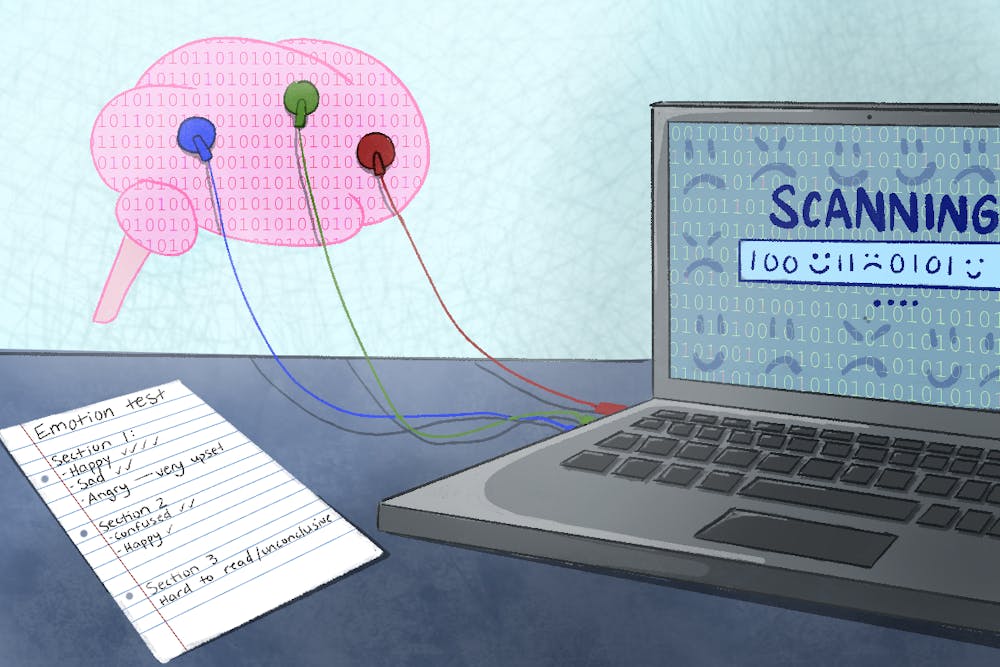
The team uses psychophysics and EEGs in their studies to follow how perception unfolds over time, examining how past experiences influence memory and the decisions people make. Psychophysics allows researchers to measure behavior, while EEGs provide a moment-to-moment view of brain activity.
"If you can track all of these processes with very high temporal resolution, then you can make better inferences about what's going on in your brain," Bae said.
Bae also said the methods have real-world potential. EEG-based decoding could contribute to assistive and brain-controlled technologies, controlling a range of devices from keyboards to drones.
Although she had no lab experience when she started, Jordan Dolinar, a junior studying neuroscience, said she knew she was interested in cognitive research after reading the work of various professors through the ASU Psychology Department's website.
"Going through the ASU Psychology website is super easy," she said. "There are so many options for labs — it's just whatever your interests lie in."
In her work at the lab, Dolinar assists in conducting experiments with participants twice a week. She said the role has taught her about how working memory operates and how timing affects its accuracy.
"I've learned a lot about how the brain remembers certain things and how there are different biases that go along with your memory," she said.
READ MORE: ASU lab builds semiconductors modeled off the brain
Scott Janetsky, a second-year doctoral student studying psychology, works in the lab and researches various topics related to cognitive processes. One project he is working on at the lab researches how the brain maintains the stability of what people see.
"What we are studying are the underlying mechanisms of how our brain and our mind creates a coherent and cohesive visual experience across time, even when there is noise and there are large sudden changes in our visual experience," Janetsky said.
Another lab project investigates adaptation, a process in which repeated exposure makes a stimulus less noticeable. Janetsky said reduced sensitivity develops over time, and his research investigates whether this same mechanism may also lead to certain biases in how people perceive visual information.
For Janetsky, an important aspect of his work at the lab is constant learning and development of new skills. He said he wants to publish his research and leave a lasting mark by contributing to broader scientific knowledge.
"You can really leave a lasting legacy," he said. "If you're a really productive researcher, you can fundamentally change the way we understand the human mind."
Edited by Kate Gore, George Headley and Pippa Fung.
Reach the reporter at ngmohta@asu.edu.
Like The State Press on Facebook and follow @statepress on X.
Nikhil Mohta is a sophomore studying B.S. in Finance and is currently a Business Community Leader for the W.P. Carey School of business. He is also an active member in various clubs on campus like PIERA.