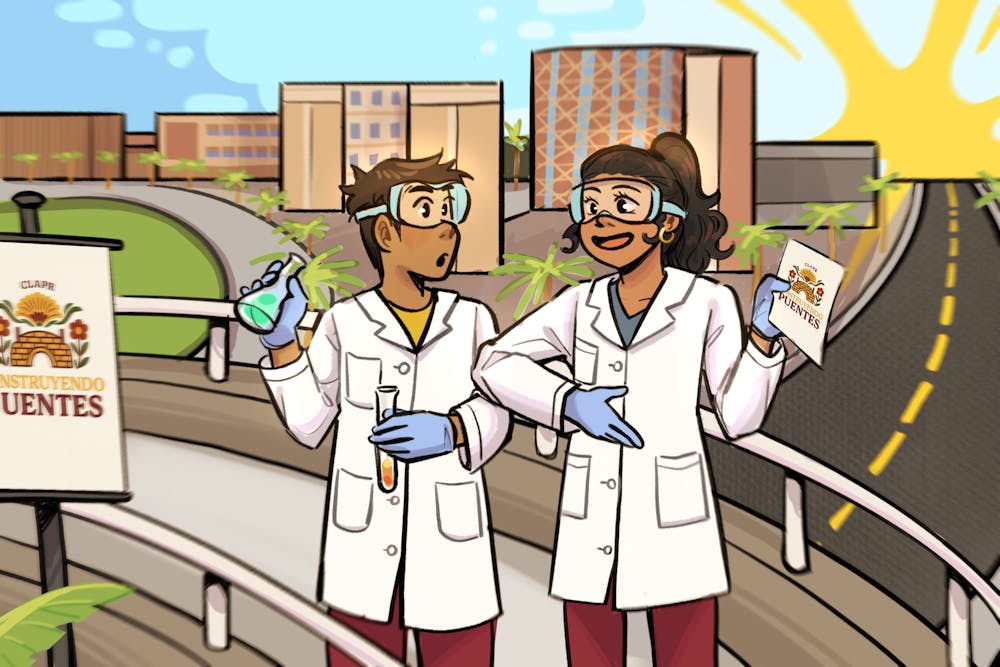
Construyendo Puentes is an ASU student initiative focused on translating and interpreting research completed at the University to extend key research to a broader audience.
Through the Center for Latina/os and American Politics Research (CLAPR), María Blandón, a sophomore studying political science, and Mariana Rojas Ribero, a junior studying finance and supply chain management, lead the initiative. Blandón said the two started the project as a way to give back to the Hispanic community.
"If you're getting information about these communities, you have the moral responsibility to give it back to them," Blandón said. "An essential part of this project is not only the translation, but also the simplification."
The initiative is currently working to translate research published by the University into Spanish, Blandón said. She added while many publications focus on researching Hispanic communities, language barriers may make accessing the results of that research challenging for the very communities they cover.
READ MORE: Insight: Language barriers
Beyond translating the research, the team is working to interpret the data, making it accessible to more readers, Rojas Ribero said. The initiative also creates summaries that share main ideas and takeaways from the research papers.
"My whole family lives back home, and my parents speak English, but their English is very limited," Rojas Ribero said. "So, sometimes when I share articles with them or research papers or things like that, they don't really understand it, and they need to ask me to help translate it."
CLAPR director Francisco Pedraza, who helps oversee the initiative, said the program started from a group of students discussing possible actionable projects of public impact where they could "take the driver's seat" and make a difference.
"Some of the students had noted that it feels strange when the research being produced about a community, about a group, is not accessible by the members of that group," Pedraza said. "The vast majority of research is done not only in English language, but it's done with a version of English language that's very technical and often draws heavily on jargon-y language."
READ MORE: How language barriers impact involvement in the political process
Pedraza said Rojas Ribero and Blandón started by converting research from the School of Politics and Global Studies, using already published documents and then translating the information to reflect the meaning of the original English reports.
"(They are) combining skills that they develop in class, like making really straightforward tables with scientific information or charts and other kinds of visuals, and recreating them using tools that they use in the course of their classwork to make sure that the numbers that you would see in the English version are also replicated exactly in the Spanish sentence version," Pedraza said.
Blandón said a current focus of the initiative is expanding the team and reaching out to media outlets and community organizations to gain traction as a center to increase awareness of their work. Rojas Ribero added that the team is looking to involve more ASU students in the project.
As part of the outreach, the team put up posters around campus and started an Instagram account. Pedraza stressed the importance of the continuation of the initiative's efforts, adding that the next generation of students can be inspired, continue to build on the program and further improve it.
"It turns out that if you set a high standard and hand the reins over, our Sun Devils can come up with amazing ideas," Pedraza said. "They don't have to be things that are expensive and require million-dollar grants, they can be very simple, straightforward, but high-impact ideas, and that just means everything."
Edited by Kate Gore, Senna James, Emilio Alvarado and Pippa Fung.
Reach the reporters at dforres5@asu.edu.
Like The State Press on Facebook and follow @statepress on X.