When the Star-Planet Activity Research CubeSat (SPARCS) space telescope launched aboard the SpaceX Falcon 9 rocket in January, it marked the culmination of years of work, much of it by a team of undergraduate ASU students, who are actively helping command the spacecraft from mission control on campus.
READ MORE: Tiny satellite, big discoveries, from campus to cosmos
SPARCS, a NASA-funded CubeSat mission that is in orbit studying stellar flares from low-mass stars, is now undergoing a weeks-long commissioning phase.
Engineers and students are testing the spacecraft system by system to ensure it is operating as expected.
"It's been enormously exciting (and) thrilling," said Evgenya Shkolnik, the mission's principal investigator and professor at the School of Earth and Space Exploration. "Some subset of us were able to go to the launch in California ... and some of us had to stay back here on campus, because this is where our mission operations center is, so we needed people in the operations center to look to see if we had communication with the satellite."
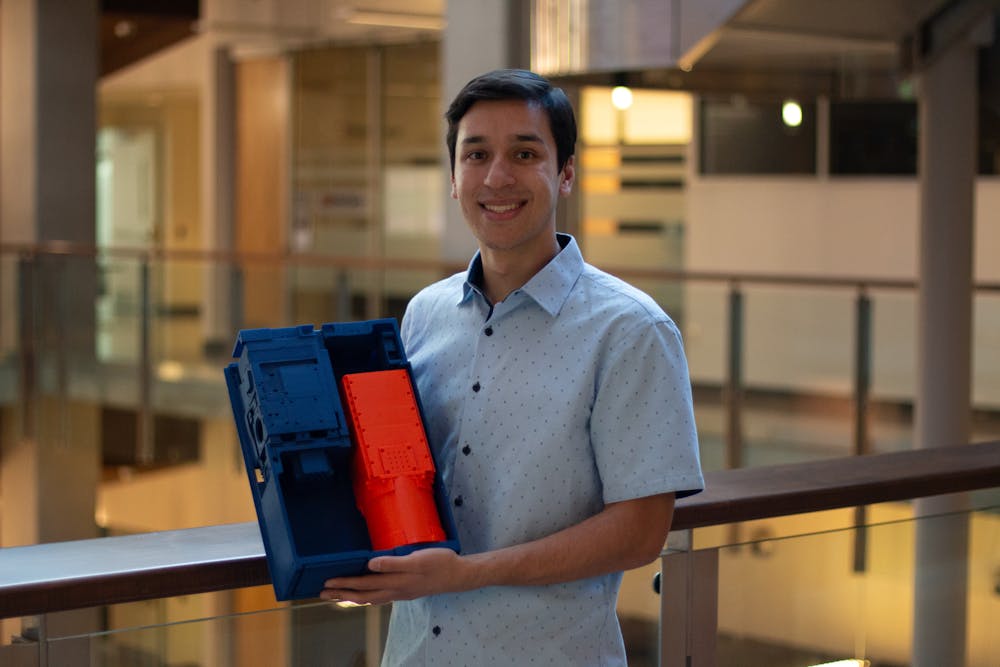
The operation center, located on the Tempe campus, is partially staffed by undergraduate students who helped assemble, integrate and test the spacecraft before leaving Earth.
Shkolnik said having student involvement was intentional from the get-go. Because SPARCS is a smaller mission built largely at ASU, the mission was able to involve undergraduates in nearly every stage.
"This is ASU, and we have a very clear mission to keep students involved, educate the students and give them exciting experiences that they can get nowhere else," Shkolnik said. "It's for the students' benefit because they're getting experience on a real space mission. But it's also to our benefit, because we have hard-working, smart people who are really dedicated to doing something super cool."
There are currently up to 28 students working on SPARCS. These same students are currently helping command the satellite in orbit.
"They're literally the ones typing in the commands like 'turn on your heater,'" Shkolnik said. "We had to turn on the heater to bake off any crud that was on the camera or in the telescope. They're the ones typing it in, sending it up."
Paulo Gonzalez Soto, a sophomore studying aerospace engineering, joined SPARCS after becoming involved with ASU's Interplanetary Laboratory. Gonzalez Soto began working on mission operations last summer and later helped develop procedures and data visualization dashboards to monitor the spacecraft.
Leading up to launch day, Gonzalez Soto said the workload had increased.
"Over winter break and the end of last semester, we really ramped up again, and that's when we did nine-to-fives," Gonzalez Soto said.
He said it was "all hands on deck" right as school was starting back up. The team was writing procedures, practicing communications and preparing for short satellite passes.
After launch, Gonzalez Soto said that reality set in quickly.
"We all got there at 6 a.m. on a Sunday, the day before class started at ASU, and we're watching this rocket go up to space," Gonzalez Soto said. "We were like ... 'we got to show up now, (before) was practice. Now it's the real thing.'"
READ MORE: ASU welcomes former NASA alum to University leadership, further developing space research
Shkolnik said watching the students take ownership of the mission has been one of the most rewarding parts of the journey.
"Because the project has been running for a few years now, we've seen students come, graduate and leave," Shkolnik said. "They tend to get excellent jobs in the aerospace industry ... We did our job of helping them develop the skills that they need outside in the aerospace world."
SPARCS is expected to remain in orbit for about a year, with students continuing to assist in mission operations as the telescope begins its observations and the team continues to hire more students.
Edited by Henry Smardo, Jack McCarthy and Ellis Preston.
Reach the reporter at mmart533@asu.edu.
Like The State Press on Facebook and follow @statepress on X.
MJ Martinez is a senior reporter at The State Press. She has worked for the paper for 3 semesters, working previously as a SciTech Reporter.