In recent months, professors at colleges and universities have been sharing growing concerns for their safety and that of their students due to the nature of what they teach. However, many people believe the solution to political upheaval is increased civic conversations that normalize disagreement.
While some professors have expressed concerns about their safety on campus, one professor has been urging greater involvement in civic discourse.
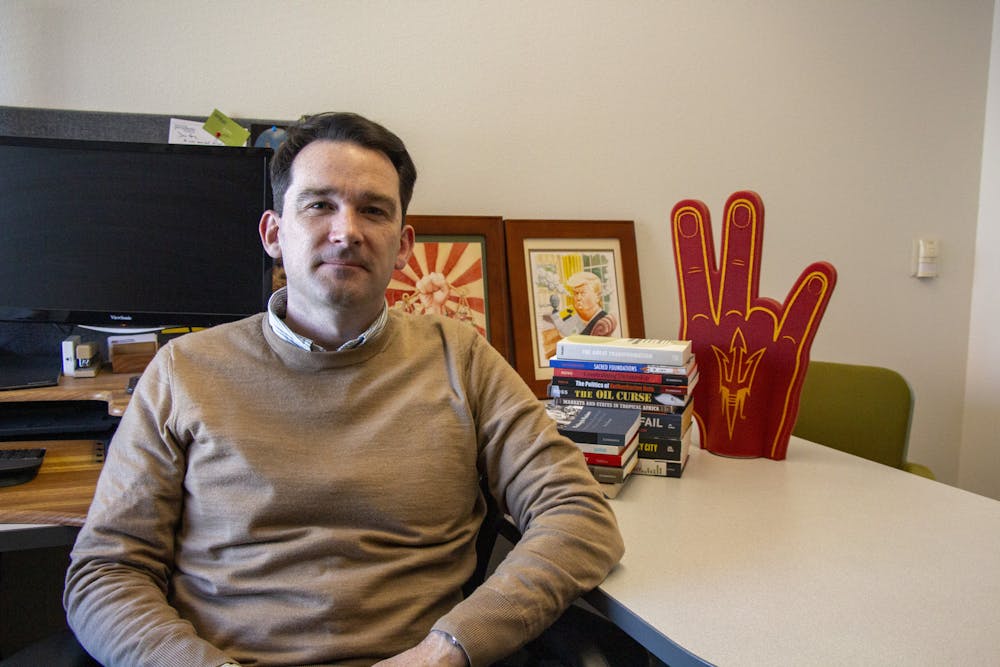
Henry Thomson, a professor in the School of Politics and Global Studies, has been pushing for more engagement in political conversations, calling it necessary following the death of Charlie Kirk.
READ MORE: Professors express growing concerns for safety, implications for higher education
In his op-ed to The Arizona Republic, Thompson said he is able to see firsthand "how arguing about politics reduces division and even leads to unlikely friendships" in his Special Topics class: Talking Across Political Differences.
He formerly hosted the podcast "Keeping it Civil" in co-production with the School of Civic and Economic Thought and Leadership and Arizona PBS. The podcast sought to answer "key questions about the future of American life with fast-paced interviews with scholars and intellectuals."
Thomson first pioneered the class three years ago when Duke University professor John Rose, who was teaching a similar topic, asked ASU to lead the course.
Rose served as the associate director of the Civil Discourse Project at Duke, which sponsors academic courses and events that "promote civil discourse through modeling or teaching the capacities and virtues necessary to engage in healthy exchange across difference."
Since starting the class, Rose has helped inspire 70 other universities to teach their own version of the class, one of which is at ASU.
A surprising aspect for Thomson was how subjects he thought would be contentious were not as polarizing to students.
Jack Panzarella, a senior studying political science, took the class in Spring 2025 and said the topics put up for debate stayed civil throughout the course.
"There were people who would say to your face, 'I disagree with you,' but there was no conflict of any sort," he said.
Panzarella said he enjoyed taking the class because it was a good outlet to talk to people about current political issues.
Jace Malarcik, a junior studying political science who also took the class in Spring 2025, said she enjoys taking discussion-based classes.
"It's a privilege not to be informed on politics, because it means that it likely does not affect you," Malarcik said. "It's a privilege that we are at a university where we are encountering several different ideologies and opinions throughout each of our classrooms and every interaction."
Malarcik said she wanted to be able to embrace the ideological differences within the classroom. A takeaway from participating in this class and engaging in her other discussion-based courses was how many people are willing and want to engage in these conversations.
She said the reason why most people do not typically want to get involved is that they fear these conversations will turn angry or violent.
Thomson chooses a topic for debate that is immediate or happening in and around campus.
The biggest concern is not whether the students will grow hateful toward one another, but rather that they will all agree on a topic, making the conversation boring.
A downside of a class like this, however, is that it's self-selected, Thomson said. Only the students who are interested in engaging in dialogue take the course.
Panzarella said it's easier for students who major in political science to become exposed to multiple viewpoints; as for students in majors that are dominated by one ideology over the other, it becomes an echo chamber of their biases.
"I wish that everyone was as open-minded as a lot of political science majors," Malarcik said.
She recommends students stay up to date with what comes out in the news and actively search for unbiased media sources.
Thomson said students should speak up in their classes and debate more, even if the topics are not contentious or political, because it is how they learn. Asking questions and debating ideas is an important skill to have, yet many students don't speak up in class, he added.
"Use the opportunity while you're at university to have these conversations in class and with your friends after class," Thomson said. "If you hear something you think is provocative in class, then talk about it with your roommates, your friends or whatever, and that's how you understand these ideas better."
Edited by Senna James, Jack McCarthy and Pippa Fung.
Reach the reporter at elbradfo@asu.edu and follow @emmalbradford__ on X.
Like The State Press on Facebook and follow @statepress on X.
Emma Bradford is a senior reporter for The State Press. She has previously worked at the Cronkite News Washington, D.C. bureau as a politics and money reporter. Bradford is currently also an editorial intern for AZ Big Media. She is in her fifth Semester with The State Press, previously working on the politics desk as both a part-time and a lead reporter.