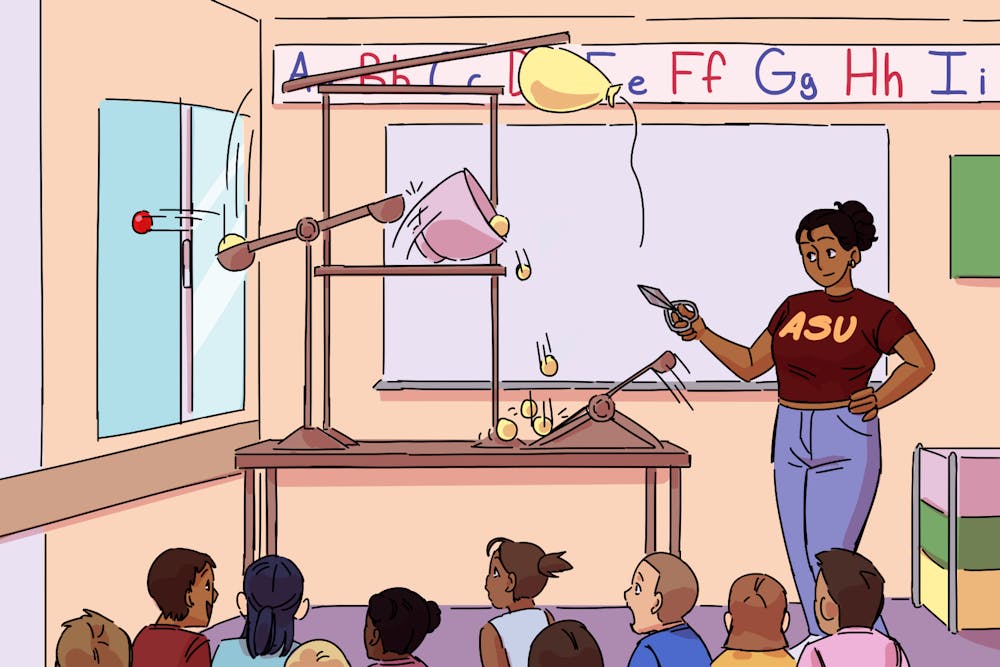
Science Detectives, an ASU student-led organization, provides free, hands-on science lessons for third to sixth-grade students from Tempe and Mesa.
Run primarily by undergraduate volunteers, the club focuses on inquiry-based experiments designed to make science accessible and engaging for young learners. Alex Park, a junior studying biophysics and the education director for Science Detectives, emphasized that the mission of the club is centered around student education.
"We're a team of students that are dedicated to teaching science experiments to local kids," Park said.
Each semester, the team hosts six lessons, with sessions on Friday, Saturday and Sunday. The sessions are both structured and interactive. Volunteers begin with ice breakers and introduce a "Scientist of the Week," often highlighting scientists from diverse backgrounds rather than the figures students are typically familiar with.
"There are a lot of cracks where students can fall through and where they're just not feeling engaged in the content," Park said. "We want to expose them to an environment where they can understand different types of science."
The session also covers vocabulary and background before the students dive into the week's experiments. Camila Naranjo, a junior studying biomedical sciences and co-president of the organization, said the team always focuses on participation from the students.
"We don't do demonstrations," Naranjo said. "We guide the students through real experiments so they can think critically and ask questions and also feel like a scientist themselves."
Experiments range from biology and physics to chemistry and sustainability. The program is designed to remove barriers to entry into science education by providing students with free lessons and experiments, funded by Barrett, The Honors College, Naranjo said.
The organization's accessibility efforts extend beyond offering no-cost classes and experiments: Naranjo said the club avoids using formulas and complex terminology, instead focusing on simplified slides and open-ended discussions.
"We're not doing equations, we're not doing problem sets, we're not doing worksheets," she said. "We're doing hands-on experiments, we're doing things where they can ask questions."
READ MORE: ASU researchers explore how environments impact children's word development
Tiffany Duong, a senior studying biomedical sciences and co-president of the organization, said the impact is visible in quieter moments, when students learn something new and express it in unexpected ways.
"A light bulb kind of goes off in their head," Duong said. "You can see when they light up when they really understand a topic."
Duong said the club's long-term impact becomes clearer when students return year after year, or even when they age out of the program. She added that students want to stay connected, and that the club can provide role models to help them grow in their science education.
Park said the impact of early science, technology, engineering and mathematics (STEM) outreach is personal for her. She said she benefited from similar outreach programs when she was growing up.
"The people that were reaching out to me showed me that there are people like me who are in STEM," Park said. "There are people like me who are doing these cool things, that are scientists or that are studying science, and it doesn't just look like the regular people or the status quo of who is a scientist."
Edited by Kate Gore, Jack McCarthy and Pippa Fung.
Reach the reporter at ngmohta@asu.edu.
Like The State Press on Facebook and follow @statepress on X.
Nikhil Mohta is a sophomore studying B.S. in Finance and is currently a Business Community Leader for the W.P. Carey School of business. He is also an active member in various clubs on campus like PIERA.