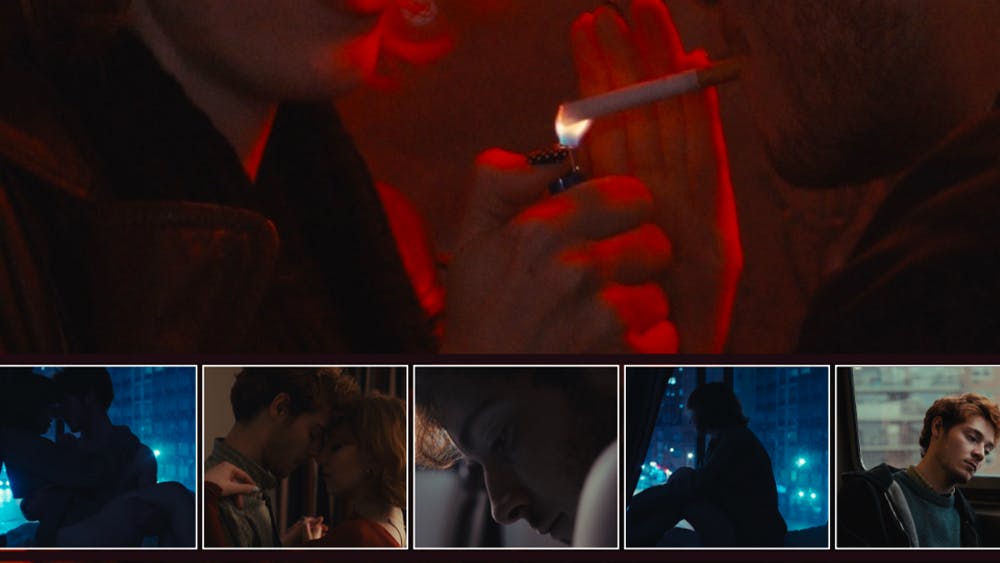
We've all been there. It's family movie night and everyone is curled up on the couch. After finally deciding what to watch, you all quiet down and hit play. For a while, there's not much going on — but you begin to sense some tension between two characters on screen, and start to pray that nothing comes of it.
The movie was PG-13, they couldn't possibly go there, right? Wrong. Soon thereafter, the characters find themselves alone, and your living room goes still. You either get up and pretend to use the bathroom as soon as you realize what's about to happen, open your phone and try to nonchalantly scroll through an app until it’s over, or you bite the bullet and let it run its course.
Sitting through an intimate scene of any kind while in the same room as your parents is a less-than-ideal situation and yet, this uncomfortable scenario is an almost universal experience in modern households. Sex scenes in film and TV as we know them now can range anywhere from a subtle innuendo to a quick cut between a couple kissing then lying in bed to several-minute-long sequences that leave nothing to the imagination.
There was a time, however, when the imagery of a train driving through a tunnel was just about the most explicit depiction of sex you'd see on screen — no bathroom pass required.
Pre-code Hollywood
The 1920s marked the beginning of a new era for film. Following the release of "The Jazz Singer" in 1927, a new type of movie was captivating audiences: "the talkie."
With the commercial success of these new talking motion pictures, filmmakers were able to expand their storytelling through active dialogue and create deeper emotional resonance with audiences through hearing the actors' voices.
This depth, however, brought about new concerns from critics surrounding the intensity of "immoral" depictions on screen. Filmmakers turned to bawdy and oftentimes violent narratives as an escapist medium amid the hardships of the Great Depression, and conservative religious groups around the country were not pleased.
Public outcry and calls for government intervention in Hollywood resulted in the creation of the Hays Code in 1934 — a self-imposed set of guide- lines prohibiting the use of profanity, glorifications of organized crime and violence, explicit portrayals of sex and more. The code, also referred to as the Motion Picture Production Code, was born out of cultural pressures to instill "morality" in film.
Before the code went into effect, filmmakers left no stone unturned in their depictions of these "immoral" vices. This period, from 1929 to 1934, is known today as Pre-Code Hollywood. During this time, films like "Red-Headed Woman" and "Baby Face" made waves for their unabashed approach to sex on screen.
"Red-Headed Woman," released in 1932, was a particularly scandal-ridden film right before the code was placed. This movie depicted its leading woman, Lillian (played by Jean Harlow), using her sexuality to make her way into high society. Nudity, adultery and strong innuendo without punishment for the protagonist were some of the defining aspects of this film that eventually led to a demand of 17 cuts after the implementation of the Hays Code.
"Morocco" is a film that explores sexuality in a different way. This picture from 1930 featured cross-dressing, an on-screen kiss between two women and a general challenge of traditional gender roles, similarly placing its leading female character in a sexually liberated and powerful role.
Lilli Danseglio, a junior studying film and media production, noted another significant film of this period: "Ecstasy." Though this was not an American-made picture, it became the first film banned from entering the U.S. for being “obscene and immoral” in 1935. The obscenity in question is based on the film's inclusion of full-frontal nudity and a scene regarded as the first depiction of a female orgasm in a feature film.
Sex on screen today
By modern standards, many pre-code portrayals of sex were fairly mild, and following the dissolution of the Hays Code in 1968, there has been no short- age of these depictions on screen. According to UCLA's Teens and Screens report from 2025, 48.4% of adolescents between the ages of 14 and 24 feel that there’s "too much sex and sexual content in TV and movies."
"I just really dislike all the sex scenes in movies and TV shows and I think they could do a lot better with that cause they’re really pointless," a 19-year-old respondent said. These findings are indeed reflective of the current media landscape for this age group. One of the most popular shows on television right now, "Heated Rivalry," has become a pop-culture osmosis.
If you haven’t watched it yet, chances are you’ve already heard about it. This show has become famous for its groundbreaking approach to masculinity and queer relationships. In a 2025 Associated Press article, show creator Jacob Tierney described the program as a harlequin romance and stated: "This is about two boys in love and a lot of sex."
"Heated Rivalry" is one of many sexually explicit films and TV shows available on HBO Max, a platform famous for this very content. As a premium cable network, HBO Max was able to feature adult programming and became known for this risqué material in the 90s and 2000s.
Today, this identity is still largely present, and through streaming, younger audiences now have more access than ever to this content.
"Nowadays, especially with streaming (and shows like) 'Euphoria' and (others) within that realm, it's becoming more normalized (with) younger audiences, and especially through the social media aspect, it's almost kind of like a desensitization," Zach McGhee, who graduated from ASU in 2025, said.
With this access, some audiences are understandably discontented with the volume of sexual depictions on their screens. Recently, discussion surrounding the value of intimate scenes in film and television have surfaced. "Because we’ve gotten used to a lot of stories being told without sex, when sex appears, it can feel a little more like spectacle, and like it's interrupting the narrative," Katherine Morrissey, a film and media studies professor, said.
Commentary online has illustrated a variety of differing opinions on whether or not sex offers a necessary narrative utility in film. Greta Moore, a sophomore studying film and media production, expressed her own thoughts on this discourse, "Intimacy happens in real life, so I think it’s really important to have that exposure."
Stewart Bassett, an ASU alum, shared a similar perspective: "Sexuality in film is a powerful narrative device, if done right and carefully.
In exploring this conversation, it’s also important to note the many strides taken in recent years on the production of intimate scenes. In 2018, following the #MeToo Movement, concerns surrounding protections for actors involved in these scenes garnered attention.
Moore touched on this progress and expressed concern for the pressures many actresses on set can face when performing in narratives that are driven by the male gaze — a concept that refers to the depiction of women in visual stories from an objectifying and sexualized heterosexual male perspective.
While commentary surrounding the narrative implications of intimacy in film has emerged among younger generations, another pressing conversation is being conducted about the processes behind them.
According to Bassett, "We’re less conservative about what’s in the product and more conservative about how you go about getting that product."
A new understanding
McGhee and Bassett recently produced their own film, "With Time," and shared their experiences creating an intimate scene while respecting their actors’ boundaries.
"We were trying to make that very intimate scene feel intimate. We decided, as a collective (between) the actors and me, that instead of showing the actual intimacy process, we (would) do a dance, because dancing is very intimate in itself,” McGhee said.
"We're seeing them finally have human connection and sit there in their own world and be together in this moment. (It) felt more intimate than actually showing (the) act of kissing. Initially we had that scene written out as a kiss and we took a pivot so everybody (would be) comfortable.”
McGhee and Bassett's process in creating this scene, reflects a greater movement occurring right now in the film industry. According to Morrissey, "We're having a much more productive open conversation about consent and what's acceptable in films and other kinds of media. But also what that looks like to ensure consent, and how you make that part of a story."
Today, intimacy coordinators play a crucial role in the production of these scenes and establishing said standard of consent and comfort on film sets. This role requires acting as a liaison between actors and production crews, ensuring safety and consent while choreographing intimate scenes.
While this position has become an industry standard for films produced within SAG-AFTRA, it is not entirely mandatory. Some actors and filmmakers have foregone using coordinators on their sets, a recent example being actress Mikey Madison on the set of "Anora." Madison stated in a conversation on Variety's "Actors on Actors," that she declined offers from producers to bring in an intimacy coordinator, noting the film director Sean Baker's "dedication to authenticity." This decision triggered outrage online with many fans concerned about the lack of absolute requirement of coordinators on sets.
"Intimacy coordinators are doing what the Hays Code pretended to do," Bassett said, "The Hays Code was about controlling art, whereas intimacy coordinators are about keeping art safe for the people that are practicing it."
The strict limitations enforced by the Hays Code almost 100 years ago were based in moral policing and fear. While current discourse surrounding intimacy in film is, in part, focused on how these depictions aid in narrative progression, the broader discussion centering on the process of the art itself has seemingly taken paramount with younger audiences.
This generation is learning from mistakes made by the Hays Code, which dealt with sex by eliminating it entirely. By shifting focus to protection in the production of films, modern pictures are able to explore this subject in a more intentional way. When actors are able to advocate for themselves and their characters, their stories are less likely to be harmfully depicted.
"It’s even more important now to push those boundaries," Bassett said, "To tell authentic stories from all different groups of people and to not shy away from it in a time where that might be the safe thing to do, but to be bold about it."
Edited by Leah Mesquita, Natalia Jarrett and Abigail Wilt. This story is part of The Love Issue, which was released on February 25, 2026. See the entire publication here.
Reach the reporter at kwalls6@asu.edu
Like State Press Magazine on Facebook, follow @statepressmag on X and Instagram and read our releases on Issuu.
Keyanee Walls is a magazine reporter at The State Press. She is a second year student at ASU’s Walter Cronkite School.


