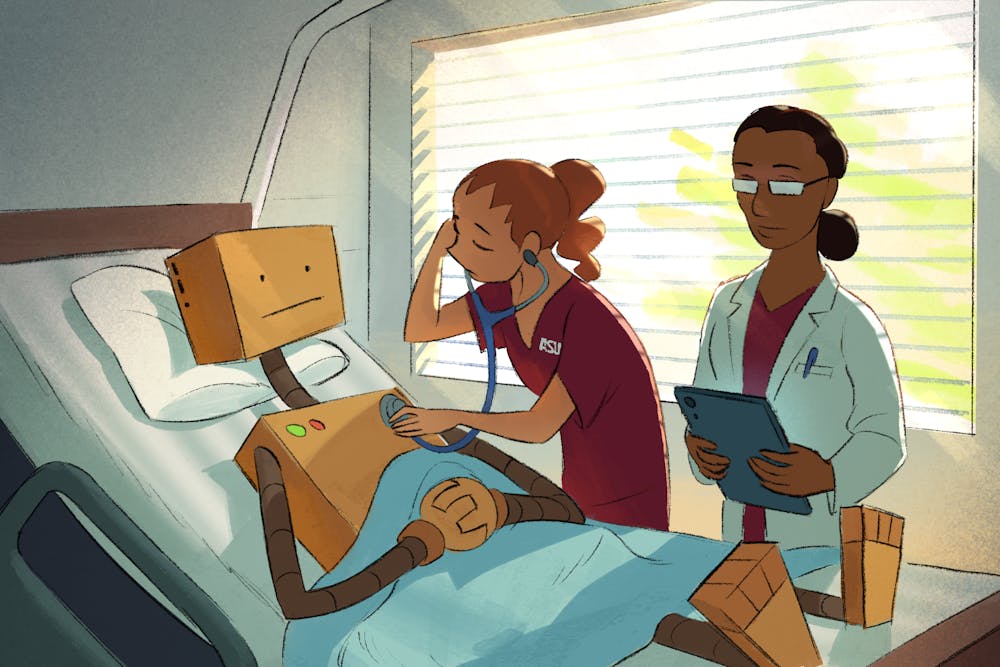
Aspiring physician assistants usually have to wait until PA school to learn essential skills like intubating, suturing and navigating patient interaction, but the Downtown Pre-Physician Assistant Club at ASU is helping bridge the gap between undergraduate coursework and the skills PAs use every day.
Based on the Downtown Phoenix campus, DPPAC organizes hands-on skill workshops for members, hosts keynote speakers, collaborates with other clubs and volunteers in the community. Denise Prieto, the club secretary and a senior studying health sciences, said the club aims to set members up for success in the PA field early on through technical skill demonstrations.
"I'm a very visual learner and a very hands-on learner," Prieto said. "To be able to both visually see the demonstrations and also be very hands-on with them, it's been really great."
For example, the club hosted an intubation skills lab with the Kinesiology Honors Society in February.
Prieto said that such events put members into a hospital setting, which enables them to stand out in PA school.
"When we do reach that milestone of being hands-on with intubation and suturing in PA school, I believe we'll feel more comfortable and possibly even excel at the skill more than other students who may not have had that opportunity," Prieto said.
In the future, Prieto wants to act as a liaison between patients and physicians, especially in the emergency room. She is particularly interested in working in pediatrics because of the complexities involved in the work.
DPPAC plans to host a trauma bleeding control training with American College of Surgeons Stop The Bleed. The group also participates in tours and demonstrations at the Virtual Reality Simulation Lab in the College of Health Solutions.
"Speaking from personal experience, I personally felt that (the workshops) made me less anxious and definitely more excited to be able to be more hands-on with patients," Prieto said.
The club focuses on creating a welcoming environment for members to encourage socialization and participation, skills that will help with networking with other medical professionals and communicating with patients.
READ MORE: Student organizations emphasize the importance of networking for STEM majors
Caroline Agyei, a freshman studying health sciences, attended her first DPPAC event in January. She volunteered at St. Vincent de Paul, serving food to community members who ate and participated in karaoke.
"It was very fun, very welcoming," Agyei said.
She also said she enjoyed exchanging stories and advice with other club members, and said she is already starting to build relationships that will help her in the future.
Club President Katie Dè Los Sañtos-Dominguez said her three semesters as a member of DPPAC helped bring her out of her shell, which helped her become a better health care provider.
"I have definitely seen a change in how I talk to patients in my current role as a medical assistant," Dè Los Sañtos-Dominguez said. "I'm more open, I'm more caring, I'm more of a listener. I would say I pay attention more to what they're saying and telling me, and it will most definitely help me network with people in the healthcare field in the future."
Dè Los Sañtos-Dominguez was originally a nursing major, but switched to medical studies her sophomore year to become a PA because she wants a flexible schedule, the ability to work with different specialties and more autonomy over patient care.
She is particularly passionate about preventing misdiagnosis. She was misdiagnosed at 12 years old, later being correctly diagnosed with the autoimmune disease lupus, which caused chronic kidney failure.
"They had misdiagnosed me with a sinus infection, which is insane to compare a sinus infection to kidney failure," Dè Los Sañtos-Dominguez said.
She said she spent two years on hemodialysis and then switched to peritoneal dialysis until her kidney transplant at age 17.
From teaching members how to perform lifesaving medical maneuvers to creating a social environment, DPPAC works to effectively prepare students for PA school and their future careers tackling various health issues.
"Being able to give that insight to students so early on, for me, it got me excited," Prieto said. "I'm sure many other students who came to our clinics were also very excited to be able to have that hands-on learning experience and grow their interests more into the medical field."
Edited by Kate Gore, Jack McCarthy and Pippa Fung.
Reach the reporter at sevoorhe@asu.edu.
Like The State Press on Facebook and follow @statepress on X.
Sydney Voorhees is a Senior Reporter at The State Press. She is also an intern at Arizona PBS and a member of Delta Gamma Fraternity. This is her second semester with The State Press, working previously as a part-time Sci-Tech reporter.