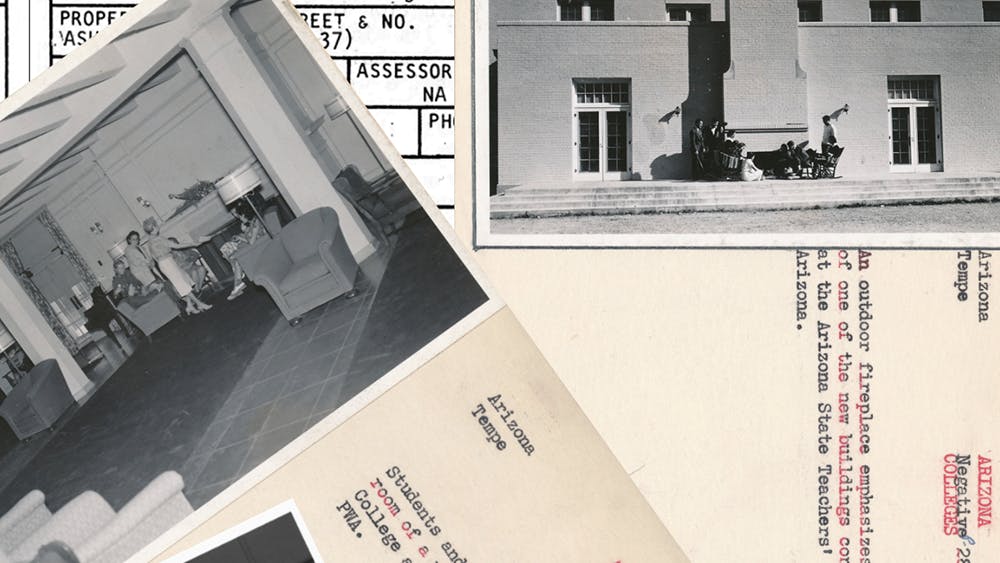
I've passed the B.B. Moeur Activity Building on ASU's Tempe campus hundreds of times. It never stood out to me. In view of the concrete and glass facade of Coor Hall or the iconic circular form of the Music Building, it's simple by comparison. But hidden under its plain adobe walls, the Moeur Building is a piece of University — and American — history.
According to a 1982 Arizona State Historic Property Inventory form, the building, completed in 1939, is the "largest structure of its kind to be built in Arizona by the labor of the Work Projects Administration." Its combination of earthly materials and Federal Moderne style make it unique, both on campus and in the state. And ever since the construction workers set down their shovels and moved on to the next project, the Moeur Building has witnessed decades of growth and change.
If only walls could talk.
The Moeur Building is one member in a cohort of buildings on campus erected by the New Deal, a set of programs in which the U.S. government worked to resolve the troubles of the Great Depression. In the process, federal agencies created over 10 million jobs and built public works across the country. The WPA also constructed West Hall, Irish Hall and the Center for Family Studies.
Over 80 years after the WPA came to campus, though, preserving the heritage of the New Deal at the University has been a difficult task. Irish Hall is being torn down and replaced, and students are working to maintain the Center for Family Studies to protect it from a similar demise.
Since discovering the history of the New Deal on campus, I've found myself wandering around campus like a ghost. My fixation has taken me to unexpected places: sitting in the famous Secret Garden during midday heat, staring at mundane brick patterns amid the bustle of student activity and asking my fellow students to join me on an architectural odyssey they didn't ask for.
Building meaning
Bob Leighninger, a retired ASU faculty associate from the sociology program, is a New Deal scholar and board member for Living New Deal, which maintains an archive of sites built by New Deal programs and works to advocate for its vision of government programs serving the country.
"The New Deal was probably the most creative outpouring of public policy in our history," Leighninger said. "In terms of public works, that all went on within seven years, between 1933 and about 1939. The agencies lasted until the early 40s — they were winding down by then. But in that time, they produced a vast amount of our cultural and physical infrastructure."
Leighninger said he always had an interest in architecture. Challenges to President Bill Clinton's long-range public investment programs during the early 1990s led him to study the New Deal in the first place. Since the end of the programs, he said, the capacity for government to get things done has been limited by both the political right and left.
"People like (then-Republican Senate Leader) Bob Dole were saying there's no such thing as long-range public investment," he said. "I thought, wait a minute, I've seen a lot of cornerstones, a lot of plaques. I know there are public buildings that go back to the 1930s. So, I started thinking about that and looking around."
Today, infrastructure and buildings like schools — construction that was the focus of agencies like the WPA — are decaying, Leighninger said. It's a far cry from the accomplishments of the New Deal, which produced a vast amount of public works with minimal corruption.
"We are going to need to realize that we can build things on a large scale, and we can do it without the customary problems associated with public administration," he said.
Losing an era
In Tempe, I saw what appeared to be a large-scale project of its own. This one, however, was the precise opposite of construction.
Irish Hall, completed by the WPA in 1940, sat in front of me beside a mound of wrecked stucco and metal that hadn't been there a week before. Hayden Hall, one of the dormitories making up a block of student housing alongside Best Hall and Irish Hall, was being brought to the ground.
This is soon to be the fate of Irish Hall, too. According to the University's capital improvement plan for the 2027 fiscal year, the three dormitory compounds will be demolished to make way for Center Complex, a $400 million structure that will provide roughly 2,000 to 2,500 beds for students.
I anticipated that Irish Hall's end would be met by feelings of "good riddance" from students. After all, it's old. It certainly did not have some of the amenities of newer constructions.
However, online forums show mostly positive reviews of living in Irish Hall. Former residents frequently acknowledged its age and lack of certain niceties, but praised its quiet atmosphere, room layouts, natural light and shady courtyard.
Luis Encinas, a senior studying marketing, lived in Irish Hall from August 2023 to May 2024. While the dorm wasn't the most luxurious, Encinas said it felt like a community.
"I still thought it was very enjoyable, and I did like living there for that year," he said.
Residents could see Irish Hall's signs of age, but Encinas said amenities remained functional and up-to-date. In fact, its distinctive features — including what Encinas called "submarine-like doors" and the building's unique exterior — were part of the charm. Not even the communal bathrooms could damage his appreciation for the building.
More than its age or history, though, Encinas said he was attached to the memories he made in Irish Hall. It was his first dorm, his first time living away from home and the place where he met his first girlfriend.
In a written statement, a University spokesperson said ASU regularly evaluates campus facilities to make sure students' safety, accessibility and modern living needs are met. The Center Complex will offer better residences, amenities and environment. Still, the spokesperson acknowledged the feelings Encinas expressed.
"Arizona State University understands buildings like Irish Hall hold meaning and memories for generations of Sun Devils," the spokesperson said in the statement.
The physical footprint of the New Deal isn't the only way the era has gone by the wayside. Students, even those who spend time around the buildings, don't know they were built by the WPA.
I talked to Bronwyn Courtney, a senior studying aerospace engineering, as she walked out of the Moeur Building one afternoon. Courtney said she has a class in the building and is there two to three times per week.
Courtney said she works mainly in its basement, so she doesn't pay particular attention to the building as a whole. She didn't know the building was built by a New Deal era program.
"I personally don't really know anything about it, so it is interesting to learn about, but I don’t know what to do with that without looking it up myself," Courtney said.
Finding beauty
I stood outside West Hall for at least five minutes, my head cocked and my eyes scanning the tops of the columns. Each one is capped with a Corinthian-style capital, a form of elegant, classical ornamentation. The three doors at the front of the building were designed in a Palladian style. Arched windows perch above the entryways, a signature feature originating in the Renaissance and deriving inspiration from ancient Greece and Rome, according to a blog post published by the Madison Trust for Historic Preservation.
Frankly, the beautiful columns and doors look out of place. Birds have begun nesting between the tops of the columns lining the wall, which offer visual interest, but not significant support. They are, in effect, pretenders.
I had to know why West Hall's architects insisted on including those features. Thankfully, there was a history lesson for that, too.
Leighninger described the style of New Deal era architecture with three terms: "stripped down classicism," "starved classicism" and "Greco deco." They all describe a movement that incorporated neoclassical facades and simplified them with the materials and embellishments of 1930s art deco.
"Some of these buildings that were done in this style are, I think, quite handsome," he said.
This style became a signal of New Deal construction because it was popular among architects at that time, Leighninger said. The classical columns, Palladian doors and plain brickwork are thus a remnant of what was in vogue when West Hall was built.
Still, Leighninger said there was variation in the ways architects designed their buildings at the time, including regional differences.
"They don't bear enough resemblance to one another to remind us that they're New Deal buildings," he said.
Preserving what remains
On the northwest side of campus sits the Center for Family Studies, which was also built in 1940, according to the capital improvement plan. While it now serves as the Tempe Graduate Student Center and a space for the Graduate Student Government, it was once the Home Management House and Nursery School, according to a GSG resolution. Efforts to preserve the structure have run headfirst into layers of bureaucracy that could eventually be the building's downfall, GSG officers said.
It's cozy, complete with a small kitchen for public use, meeting spaces and offices. Although the walls show some signs of their age, the rooms are uncluttered and homey. It's a third space for many graduate students to access resources and gather together, GSG Assembly Speaker Cole Cloyd said.
"It's a historical landmark," Cloyd said. "It's something that we have to be stewards of (for) our graduate student community, but also the history of the campus, of the state in general, and that's something we try to communicate with folks."
Richard Robert Reithal, the GSG parliamentarian and a graduate student studying engineering, said the way the building was constructed makes it unique on campus. The WPA built it out of thick concrete that increases insulation for temperature control. Most buildings of its size and age were built out of wood, Reithal said.
Cloyd and Reithal said GSG is working to spend $250,000 on renovations they said were needed to preserve and improve the structure. For one, they want to replace its single-pane windows, which leak heat into the building. It is running against simultaneous challenges: a deadline of May 8 to spend the money before it vanishes and difficulties getting things done with the University bureaucracy. Officers have been meeting with University staff and other stakeholders to assign the funding to projects before the deadline.
Cloyd said it is important to hold onto historic spaces that are integral to the University's identity, including the Center for Family Studies. Reithal echoed him.
"Do we really need another building full of glass and steel towering over campus?" Reithal said. "These things add character, right?"
As for Irish Hall, Encinas said he isn't necessarily excited for Center Complex, but he is intrigued to see what is done with the space. Still, he wished the University would have preserved the building instead of tearing it down and replacing it.
"Those buildings, you can tell their age just from their design alone," Encinas said. "They don't look anything like a (Hassayampa). They don't look anything like an Adelphi. They don't look like the new buildings over with the arts at Herberger. They're really unique. I don't think there's another dorm that really looks like them, at least from the exterior."
Ultimately, the end of Irish Hall means looking back on his freshman year and being unable to point to an important physical part of that experience. Following its demolition, he will lose a piece of personal history in the same way the University is losing part of its architectural history.
"Obviously it is a little sad for me that it's not going to be there anymore," Encinas said. "It's going to be a ghost story in maybe 10, 20 years when I have kids of my own, and I'm like, 'Oh yeah, I lived at these dorms, but they're not there anymore.'"
Edited by Leah Mesquita, Natalia Jarrett and Abigail Wilt. This story is part of The Best of ASU, which was released on April 29, 2026. See the entire publication here.
Reach the reporter at coyer1@asu.edu and follow @carstenoyer on X.
Like The State Press on Facebook and follow @statepress on X.
Carsten Oyer is a managing editor at The State Press. He has previously served as a politics reporter and a politics editor, and this is his fourth semester at The State Press. He is a junior studying journalism and political science at Arizona State University. Oyer has also worked for Cronkite News and interned at PolitiFact.