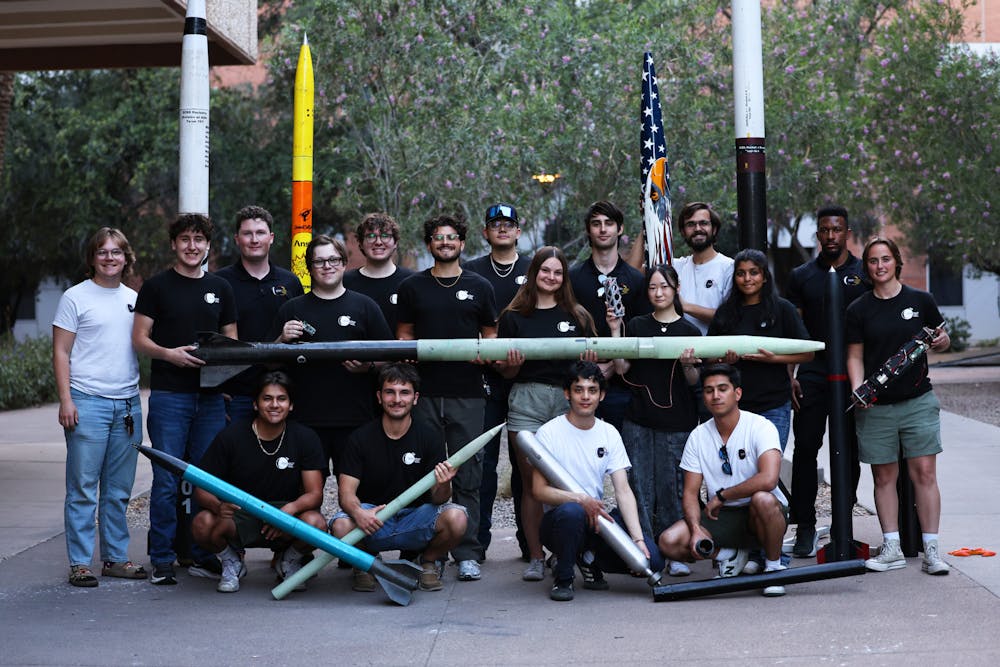
Students for the Exploration and Development of Space — Rocketry Division at ASU is putting the finishing touches on the first student-researched and developed hybrid rocket in University history for the International Rocket Engineering Competition in June.
Since rebuilding the club in the Fall of 2023, President Michael Bravo, a junior studying aerospace engineering, has led the team to IREC two years in a row, flying a rocket with a commercially bought solid motor. He said the club shifted to the less popular hybrid rocket category this year to up the difficulty and lower the competition pool.
"It's the first time a student has ever flown a hybrid rocket or, let alone any rocket with any kind of liquid propellant or oxidizer on it," Bravo said. "This is a pretty big first."
The propulsion subproject, led by Bravo, modified a commercial hybrid motor, which combines solid fuel with liquid oxidizer, with their own custom motor grains. He said their goal was to 3D print plastic grains to create custom shapes that are not made through traditional motor grain manufacturing.
"We 3D print (what) looks like a star, and then you rotate the star down the length of the grain and that forces the nitrous to stay along the walls of the grain," Bravo said. "That small little edit, versus just a standard circular, donut-shaped grain, gives us a 20% performance boost from what is commercially available in that motor size."
Ava Prechel, a junior studying aerospace engineering, is the avionics bay lead, meaning she is responsible for integrating the flight computer into the rocket. She ensures the flight computer design is up-to-date with current IREC regulations.
"I probably printed the avionics bay six times over the course of the semester, and had to rewire it multiple times," Prechel said. "That's a challenge that a lot of the sub-projects face, just making sure that they are always up to date with the different rules that are sent out every single month."
With regulations changing constantly, the team has to quickly adjust rocket components across multiple subprojects. However, Prechel said their interdisciplinary team, with majors spanning beyond aerospace engineering, is vital to that process.
"It would be very difficult to make a very well-integrated, comprehensive rocket without having the different aspects, and the different majors, and the different people coming in from different backgrounds," Prechel said. "That's kind of what makes the club a little bit more special and unique."
In order to succeed at IREC, the rocket has to do more than just fly; it also has to collect data to inform an experiment.
"Launching a rocket in space is cool, but it's also kind of pointless if you're not learning anything from it," payload lead Logan Price, a junior studying aerospace engineering, said.
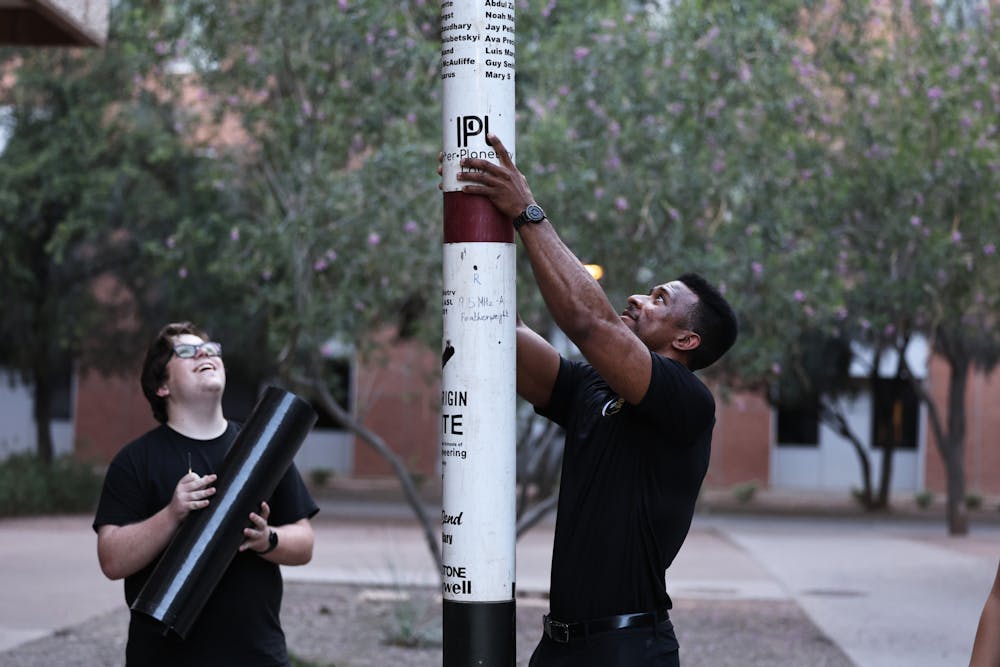
SEDS RD at ASU partners with Solestial, a company developing solar-powered technology for space, to conduct their payload experiment.
Solestial provided the club with a solar cell to test its ability to withstand a rocket launch. The payload team bolted their prototype, equipped with an infrared camera, custom circuits, dampers to reduce vibrations and a battery pack, into the bulkhead of the rocket's nose cone to monitor the cell and measure how much vibration it can handle.
"During launch, we want to see if any light emits from the solar cell, because ideally it shouldn't, but if it does, we will see it in the different little cracks of light," Price said. "If we see that, then we can see at what time frame that happens. Then we can go to that time frame in the data and see at what vibrations did the solar cell crack, and then we can report it back to them."
IREC judging is a year-long process, adding up to 1,000 points. It takes regular progress checks, a technical report, tabling and more into account even before the official launch in Midland, Texas.
"There's pressure for everyone on the team, just because we want to succeed and we want to do well as a team," Prechel said. "This being our third consecutive year with the same leadership going into the competition definitely helps, because we know our place, we know what to expect from the competition, from the judges and we try to pick a new thing to improve every year."
Bravo said the build is complete and the team is making final adjustments ahead of the June competition. He said their goal is to make the Top 10 overall and Top 3 in the hybrid category.
"If the motor works, I'm going to be happy no matter what altitude we hit, but I would like to see us walk home with a trophy this year," Bravo said.
Edited by Alan Deutschendorf, Jack McCarthy and Ellis Preston.
Reach the reporter at sevoorhe@asu.edu and @sydneyontheair on Instagram.
Like The State Press on Facebook and follow @statepress on X.
Sydney Voorhees is a Senior Reporter at The State Press. She is also an intern at Arizona PBS and a member of Delta Gamma Fraternity. This is her second semester with The State Press, working previously as a part-time Sci-Tech reporter.


