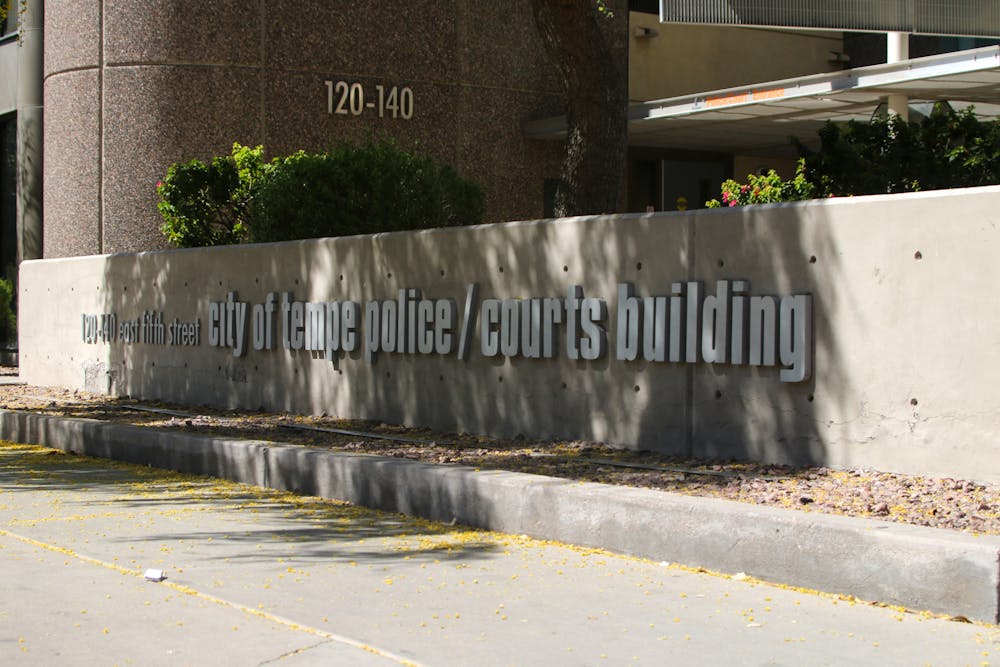
Advocates for Tempe's homeless community have criticized how the city enforces certain laws, saying officials are making it harder to exist in the city as a homeless individual. The city denied those claims and pointed to investments in homeless outreach services.
Austin Davis is the founder of AZ HUGS, a volunteer organization that provides meals and assistance in Tempe. He said the city is selectively targeting homeless populations using urban camping and trespassing violations.
"People deserve better than to be pushed into this box of criminal and to be constantly criminalized simply for existing in public and looking impoverished," Davis said.
Kris Baxter-Ging, a spokesperson for the city of Tempe, said in a written statement that Tempe police officers and park rangers properly enforce city laws. There is no separate standard of enforcement for homeless individuals, she stated.
Baxter-Ging also stated that Tempe can legally increase penalties for repeat violations, though cases dismissed for legal or factual reasons are not counted as violations.
"In cases of urban camping and other park code violations, we lead with compassion and education," Baxter-Ging stated.
Tensions between the city of Tempe and AZ HUGS have escalated in recent years, Davis said. Following the displacement of a homeless encampment at the base of the Salt River in 2022, homelessness became more visible, according to Davis. Tempe subsequently implemented new enforcement measures, like requiring permits for food distribution in public parks.
READ MORE: Tempe, nonprofits dispute collaboration on homelessness reduction
Davis has been in jail three times for feeding people in Tempe parks, he said. He received his first citation from the city of Tempe in December of 2023.
"All the times that I've been in the Tempe jail ... I knew the majority of folks were in there because they were homeless. It's not like I was surrounded by dangerous criminals," Davis said. "I was surrounded by poor people who were, for the most part, arrested for minor ordinance violations like I was."
A recent court case involving a Tempe man cited for urban camping has drawn renewed attention to how the city enforces homelessness-related laws.
Francisco Garza, a man experiencing homelessness who attends AZ HUGS meals, was cited for urban camping by a police officer and a park ranger, said Megan Rakaric, an AZ HUGS volunteer.
Garza's citations included an automatic six-month ban from several public parks, including Moeur Park, where AZ HUGS holds their meals, Rakaric said. The ban thus limited his ability to receive food provided by the volunteer group.
Garza said the city bans urban camping but doesn't offer a suitable alternative for homeless people.
"That's just stupid," Garza said.
Davis said Garza's case was dismissed after insufficient evidence was produced. Russell Facente, an attorney who works closely with AZ HUGS and served as Garza's lawyer, said in a written statement that the dismissal filing was labeled as "in the interest of justice."
It was found that excluding Garza from public spaces did not help him find housing, because Garza has been on the housing waitlist for eight months, Facente said. There was "no apparent purpose beyond retributive punishment."
"Exclusion from public spaces as a pre-adjudication restriction or as a punishment after conviction would provide no societal benefit but would keep Mr. Garza from healthy and adequate amounts of food, and set back his ability to find work and housing even more," Facente stated.
Rakaric also highlighted the difficulties individuals face when receiving citations and said keeping track of court dates presents issues when individuals lack reliable access to a device or the internet.
"The idea that you would then ask that person to jump through all the administrative hoops to improve their life and to be able to get off the street is absolutely insane," Rakaric said.
READ MORE: City of Tempe now requiring special events permit for AZ Hugs For the Houseless
Baxter-Ging stated that all citations list the upcoming arraignment court date, time and location. The public can freely access that information online, including at city locations like the Tempe Public Library or by calling Tempe 311 at 480-350-4311.
Rakaric also stressed the importance of allotting space for individuals to find refuge when shelters are at maximum occupancy and waitlists are long.
"When you are unable to get a solid night's sleep, it makes it hard to face any other challenge in your life, whether that be medical challenges you're trying to overcome, financial challenges, legal challenges," Rakaric said.
Baxter-Ging said in a statement that the city has invested about $137 million to expand homeless services and affordable housing in the past four years. It provides services for homeless individuals through a city-funded Homeless Outreach Program Effort, or HOPE, team.
"Police officers and rangers refer unsheltered people to our HOPE team and make connections for those in need on a daily basis," Baxter-Ging stated.
Sue's Espacio, a city-owned transitional shelter, typically has capacity "for those in Tempe who are ready to accept it," Baxter-Ging stated. The city also works with nonprofits to help those in need.
Garza disputed the impact of Tempe's initiatives to address homelessness. Despite the "Effort" in HOPE's full name, Garza said officials have not put effort into the issue.
Davis said AZ HUGS will continue to support those experiencing homelessness in Tempe.
"Access to food is a basic human right, and we're going to stand our ground on this for as long as it takes for them to recognize that this isn't something that we're willing to sacrifice," Davis said. "Once people's human rights are on the table, if that's being restricted, that's really dangerous territory."
Edited by Carsten Oyer, Jack McCarthy, Emilio Alvarado, Sophia Braccio and Ellis Preston.
Reach the reporter at ksmitten@asu.edu.
Like The State Press on Facebook and follow @statepress on X.
Kaitlyn Smitten is a politics reporter for The State Press. This is her first semester at The State Press. She previously served as a staff writer and correspondent for the Berkeley Beacon at Emerson College. She is a third-year Political Science major with a Writing, Rhetorics, and Literacies minor.