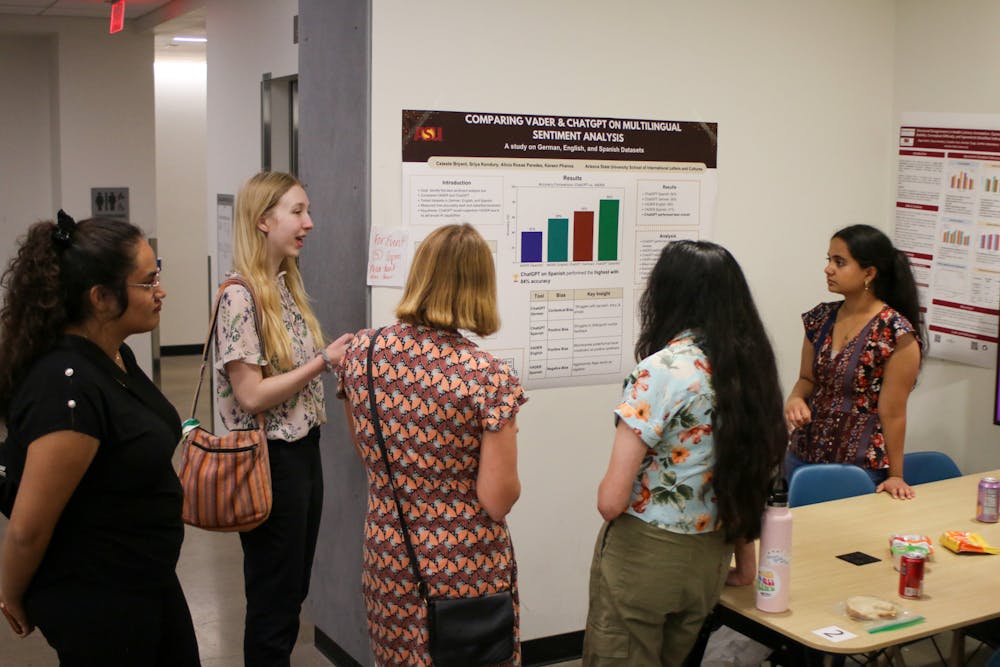
The School of International Letters and Cultures hosted Hot Topics and Cool Drinks: A Research Evening on April 28 for students to present final projects and showcase the research they've done throughout the entire semester.
"It's important that actually other faculty and other students see what other students are doing here, how they contribute to research, and that's also a good practice for students to present their work," said Olga Kellert, a professor in the School of International Letters and Cultures.
The presentations act as a way for students to show off their final projects for the courses she teaches about regional Spanish variation and digital humanities.
Kellert said the presentations teach students about research techniques as well as time management and teamwork skills.
"We embed students in visibility and research as early as possible," Kellert said. "They're working on interesting topics that are cutting-edge, using cutting-edge technology or social media (or) big data analysis."
Kellert said she enjoys seeing students from different backgrounds and areas of studies come together to work on these projects and bring together ideas that might have otherwise not have come to fruition.
The night showcased projects about health education in Latin America, linguistic variation in Spanish-speaking countries and AI systems evaluation for sentiment analysis.
Emme Velasco, a senior studying biomedical science, did a presentation studying the Mexican variety of Spanish and looking into indigenismos, which are Spanish words with indigenous roots.
"I wanted to study Mexican Spanish, because my family's from Mexico, and so I was interested in that variation," Velasco said. "It's important to study indigenous languages. They're so important to our history."
Velasco said that her group had been working on these projects since the beginning of the semester, and that her project has taught her patience.
"Everybody had their own research projects that we chose a theme for in the beginning of the semester that had to do with studying the variation of Spanish in the world," Velasco said. "Over the course of the semester, we've been collecting the data, doing statistical analysis, showing conclusions, finding resources, talking and learning about the current conversation of whatever research topic we had."
Madison Aharrah, a senior studying Spanish and biological sciences, conducted her project on how the English social media term rizz is grammatically integrated into Spanish digital discourse.
"My friends had to explain what rizz was to me when it came out," Aharrah said. "So I've actually learned a lot in terms of how countries are adopting it, and I'm really interested in how social media and technology is globalizing, especially with language contact."
Kellert pushes to embed these students in public research as quickly as possible.
"As long as you have a professor to guide you along the way, it is way easier than one would think, just develop a research question, find where your data is going to come from and, most importantly, read the already existing research in that region," Aharrah said.
Edited by Natalia Rodriguez, Henry Smardo and Ellis Preston.
Reach the reporter at galawre3@asu.edu.
Like The State Press on Facebook and follow @statepress on X.
Grace Lawrence is the lead reporter for the community and culture desk at The State Press. This is her 2nd semester working with The State Press.