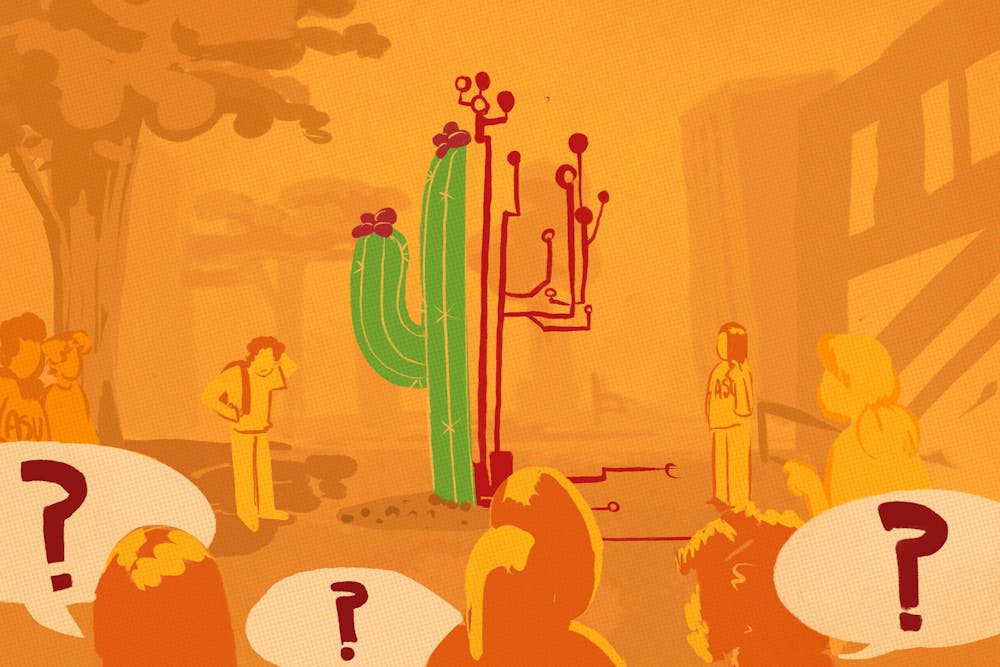
Amid concerns about AI's environmental impact, Sun Devils are advocating for innovative problem-solving to combat water supply depletion and energy-intensive practices.
ASU has rapidly adopted AI technology in classrooms, research and day-to-day operations. At the same time, an ASU research team found data centers in the Phoenix area are warming surrounding neighborhoods by several degrees, AZFamily reported.
In an interview with The State Press on March 24, ASU President Michael Crow emphasized the importance of creating data centers with "minimal environmental footprint" while continuing to stress the key role he said AI will play in the future.
"Some companies, like AWS for Amazon and others, and their big AI data centers, are looking at renewable energy systems, distributed formats, distributed locations," Crow said. "We're going to try to be a part of helping to figure out how all of that can happen."
READ MORE: Michael Crow talks technology advancements, dining hall worker strike, rising tuition
Chloe Bethune, a junior studying sustainability and president of SustainHUB at ASU, has talked with her professor and read research projecting AI's growing energy demands.
"If it's headed in the same direction that it is, we're definitely going to have more problems than we do now," Bethune said.
Kyle Bowen, the deputy chief information officer at ASU, said sustainability is a key consideration when the University develops AI initiatives. He said the University considers environmental strain associated with AI use, and that its data centers are off-campus at a shared facility to reduce impact.
Bowen also said the University developed CreateAI to help users choose AI models suited to specific tasks, rather than large-scale AI models that use more resources. Within the platform, the size of models is shown to users.
"We actually put a little green leaf next to smaller models to help people make choices around, 'Hey, these are smaller models that have a smaller impact in terms of the ways they consume resources,'" Bowen said.
Bowen said the AI industry is growing, and the development of smaller, device-based AI model systems that can run on smartphones or laptops rather than relying on centralized cloud systems is one sign of efficient resource use. He added the University should work to both address the technology's environmental impacts and look practically at the future.
AI is also discussed as a tool that can assist researchers in solving environmental problems through processes from climate modeling to precision agriculture.
Gunika Dhingra, a graduate student studying data science and student advisor for The AI Society at ASU, said the effect of AI's impact on the environment depends heavily on the policy, energy sourcing and how industries responsibly scale their use of technology.
Dhingra said she believes that students are not considering the environmental issues of AI, but rather focusing on how AI can be used to get work done.
She said there is a gap in education on sustainability concepts, including carbon awareness and model efficiency. Dhingra added those ideas should be taught in computer science and AI classes, with support from student organizations that can pick up where coursework leaves off.
"AI is both a very big contributor to, and it is also a tool for solving, environmental challenges," she said.
READ MORE: 'The great equalizer'
Bethune suggested starting sustainability work with conversations. She said engineers and environmentalists should be in the same room for open communication to increase understanding on both sides.
"Awareness on both parts would actually be really beneficial," Bethune said. "Awareness for the engineers, and then awareness for also the sustainability groups of both groups, would be really good."
She also discussed the possibility of using recycled wastewater in AI facilities and data centers to reduce pressures on fresh water supplies, a technique companies like Nona Technologies are currently exploring.
Bethune said she hopes to see technological advancement at the University continue to improve, not at the cost of the environment, but intertwined with the nature around ASU.
"I don't see technology slowing down," Bethune said. "As the environmentalists and the sustainability professionals, we have to keep up with that pace if we want to have a balanced future of both technology and sustaining what makes us whole and alive and thriving."
Edited by Kate Gore, Sophia Braccio and Pippa Fung.
Reach the reporter at ngmohta@asu.edu.
Like The State Press on Facebook and follow @statepress on X.
Nikhil Mohta is a sophomore studying B.S. in Finance and is currently a Business Community Leader for the W.P. Carey School of business. He is also an active member in various clubs on campus like PIERA.