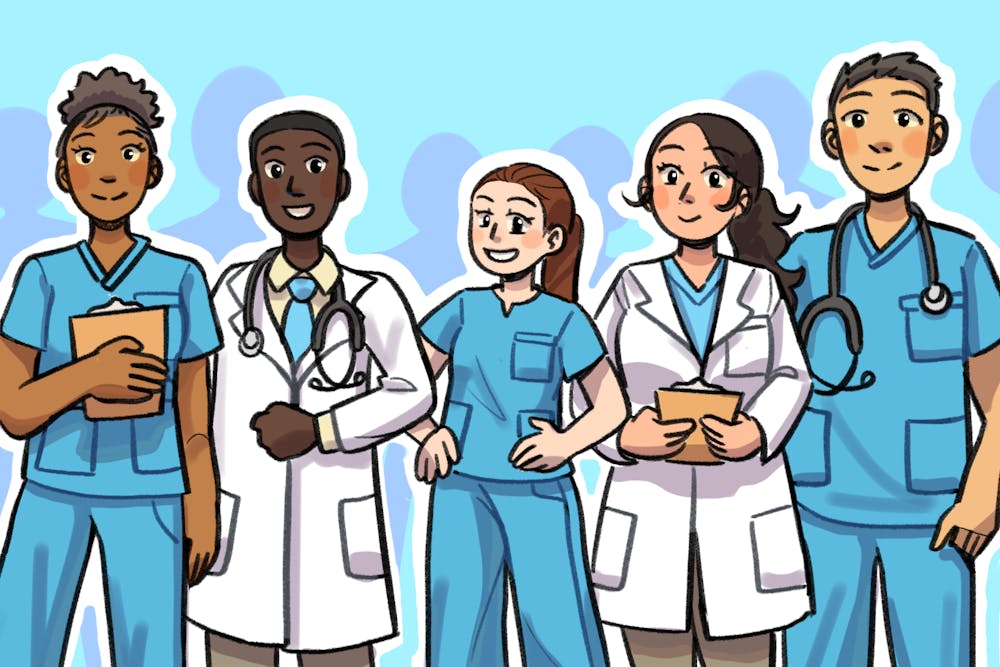
With growing efforts for and attention to diversity in healthcare, the Multicultural Training and Supervision Lab at ASU is researching how multicultural skills are taught and examining data to better inform clinical decisions.
Ankita Sahu is the lab director and assistant professor in the School of Counseling and Counseling Psychology. Her focus is on improving instructional strategies in the graduate curriculum to better prepare the next generation of practitioners and researchers to provide responsive mental health care.
"When we are working with clients, we understand that their psychological distress ... is in their social context, because under staggering behaviors, emotions, doubts, outside of the context in which an individual grew up in, can be pathologizing if we do not consider the context," said Sahu.
The lab has taken a special interest in a technique called multicultural case conceptualization. This studies how clinicians understand their clients and the client's well-being, and then use that knowledge to inform the therapeutic interventions and treatment planning. This makes it possible to add more personalization to health services.
Using this technique, the lab has completed research studying clinical supervisors who have developed these skills and translated them into the real world. This helps to better honor their story while also informing evidence-based practices in mental health care.
"It's important that our professionals who are going out in the fields are able to work with all individuals," Sahu said. "So having that knowledge and the skills and the awareness to serve the differential needs of our very diverse communities ... is crucial."
Minorities in Medicine is a student club that prioritizes all types of minorities. The organization provides resources that members may not typically have easy access to and helps to accelerate pre-med students on their track, no matter their background.
Alana Clark, a senior studying biomedical sciences, is the president of the club. She pulls from her past experiences navigating healthcare and shadowing professionals to expand her multicultural awareness.
"I try to put myself in different scenarios, not just the typical, everyday clinic," said Clark. "I try to go more into low-income communities, minority based communities, just to see how the clinical practice works in those communities and how to properly interact with those patients."
Stephanie Igbokwe, a senior studying biomedical sciences, is the vice president of the club. She emphasized the importance of immersing students in communities outside of their own to make a well-rounded clinician, diminishing the gaps in multicultural training both in and out of the office.
"Putting (students) in those socioeconomic situations or different racial situations just to understand (that) you may not have gone through this, but this is what a group of people has lived through," said Igbokwe.
The American Indian Social Work Student Association also works to provide and expand cultural recognition and understanding, focusing on social work.
READ MORE: Organization promotes Indigenous social work through community building, training
Debbie Garcia, a graduate student studying social work and the president of AISWSA, explores cultural sensitivity through clinical practices in Native and Indigenous populations.
Drawing from her own experience as an "urban Indian," she aims to create a welcoming space, no matter the client's background, to make them feel safe, heard and respected.
"We're creating a safe space," Debbie said. "Letting them know that I see them, I hear them, I respect them, I'm not judging."
Benny Garcia, the vice president of the club and a graduate student studying social work, also works with the Policy, Administration and Community Practice program. His involvement in both clubs helps him see two different sides of social work, better informing him and those around him on the importance of cultural awareness in a clinical setting.
A specific issue he focused on was information gaps between tribes, which he said leads to an incomplete understanding in clinical settings. He said that these gaps can lead to misunderstanding and uneven access to resources.
To address these gaps, he recommends education and humility while training and actively participating in the mental health field.
For each of these groups, they prioritize patients through recognizing individuality in each one of them.
"We have a lot of shared human experiences like joy, pain, grief, anger, jealousy, exhilaration," Sahu said. "The expressions of those can look different. Understanding behaviors, emotions and thoughts in the cultural context and social context in which it occurs is important."
Edited by Henry Smardo, Jack McCarthy, Emilio Alvarado and Pippa Fung.
Reach the reporters at dforres5@asu.edu.
Like The State Press on Facebook and follow @statepress on X.