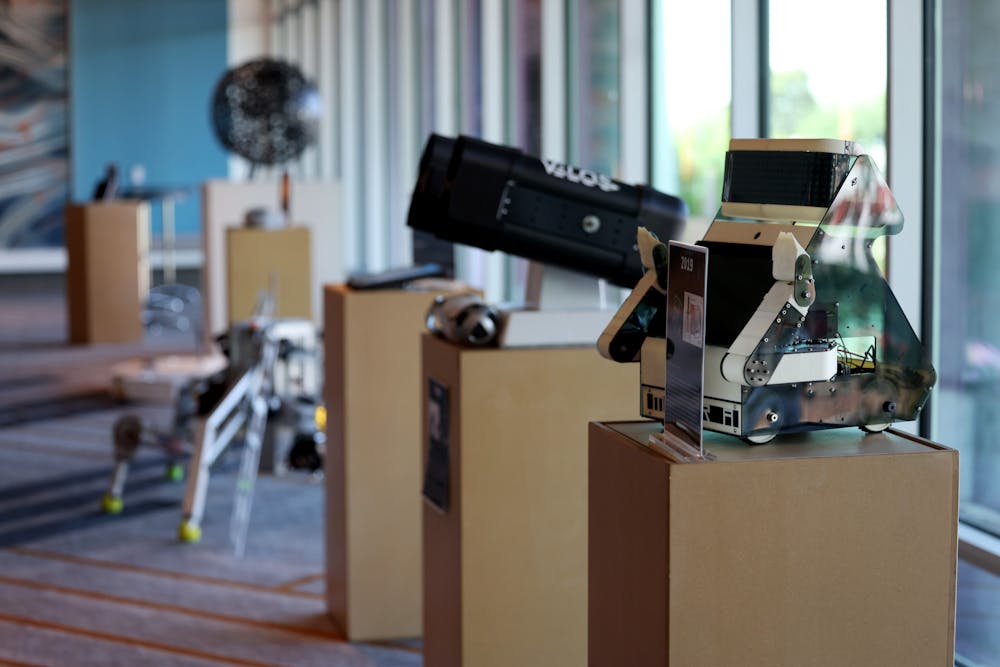
Student teams presented research, projects and startups Thursday and Friday at the Omni Hotel in Tempe for 2026's inaugural Nexus Summit, hosted by the ASU Luminosity Lab.
The summit expanded what the Luminosity Lab has been doing for years beyond the ASU community, Luminosity Lab Senior Director Tyler Smith said.
"We've been doing this in Luminosity for some time, where we are bringing together students of different academic disciplines to work on complex challenges," Smith said. "What we saw is that we wanted to be able to bring that out to more people and invite more groups in."
The two-day event consisted of student symposium presentations, project demonstrations, panel discussions with industry professionals and keynote speeches, including an address to the students from Tempe Mayor Corey Woods.
"As you all know, we are facing lots of challenges, both nationally and internationally, but the work that you're doing can really make a huge dent and help us to address a lot of things that are very pertinent in people's minds right now," Woods said.
In a written statement, Luminosity Lab Director Robb Olivieri said 18 teams presented or demonstrated their projects on stage, and 23 teams set up booths or demonstrations throughout the conference space.
Among the projects were a device allowing users to control technology with their mind and a cancer treatment that uses proteins and artificial intelligence.
The BlueMatter Project
Erik O'Bryant is a sophomore studying biomedical engineering and the project lead for The BlueMatter Project, an initiative to make an affordable, non-invasive brain computer interface that allows seamless technology control.
O'Bryant's team created a device prototype in the form of a baseball cap that uses a complex system of sensors to comfortably pass through the wearer's hair. It uses a process called a self-organizing map, which collects the user's brain data and generates a map of the brain based on detected correlations.
The map is then used to train an AI model, and that model translates brain signals into tasks.
At this point, the BlueMatter Project's prototype is a cap with some exposed wires that can interpret eye movements as instructions to control items like a video game, O'Bryant said during his symposium presentation. However, the goal is to make the product look like any other hat.
O'Bryant said his team wants the product to be able to control anything from a prosthetic arm to a Bluetooth speaker with the user's mind.
"The end-all be-all would be that controlling your technology would be as easy as controlling your body," O'Bryant said.
Project Ilion
In the health field, Ethan Pitzer, a senior studying data science, is leading Project Ilion. His team aspires to outsmart breast cancer by using proteins as drugs, he said.
Project Illion seeks to minimize the issues with current cancer treatments by leveraging the same mechanisms cancer relies on for survival and growth, Pitzer said. That way, existing treatments can maintain or increase efficacy.
"You can use half the dose of chemotherapy alongside our treatment, reduce the toxicity effects and find the same effect overall and actually kill the cancer," Pitzer said.
The team is working to build the proteins in silico, which is a process using computational machine learning tools.
First, they pick a target protein in the cancerous cell whose function they want to temporarily inhibit. They feed structural information about the target protein into the machine learning model, which creates a new protein backbone structure.
From that backbone, they get an amino acid sequence. A program called AlphaFold shows how the sequence will interact, and they can start to generate proteins through chemical synthesis.
"The primary objective right now is to get the molecule to work, to have the behavior that we want it to have, and then figure out the delivery mechanism for it second," Pitzer said.
Summit takeaways
Keynote speaker and founder and CEO of Colorado Health & Tech Centers, Afshin Safavi, said he was open to investing in and mentoring some of the teams he encountered and plans to return to the Nexus Summit annually.
"There's a lot that we can also learn from this next generation in terms of entrepreneurship, because, by nature, this coming generation is more entrepreneurial than the previous generation," Safavi said.
Arpit Gaba is a senior studying aerospace engineering. His team, Harvest, proposed a space rover that can descend into the moon's lava tubes to collect lunar crust data and test inhabitability.
Gaba said he found the summit to be an opportunity for feedback and learning from other teams.
"I always appreciate a fresh set of eyes looking at our project and poking holes at it so I can understand, okay, this is where we're lacking," Gaba said. "Secondly, all these other projects inspired us to continue as well."
Edited by Carsten Oyer, Jack McCarthy and Ellis Preston.
Reach the reporter at sevoorhe@asu.edu and @sydneyontheair on Instagram.
Like The State Press on Facebook and follow @statepress on X.
Sydney Voorhees is a Senior Reporter at The State Press. She is also an intern at Arizona PBS and a member of Delta Gamma Fraternity. This is her second semester with The State Press, working previously as a part-time Sci-Tech reporter.


