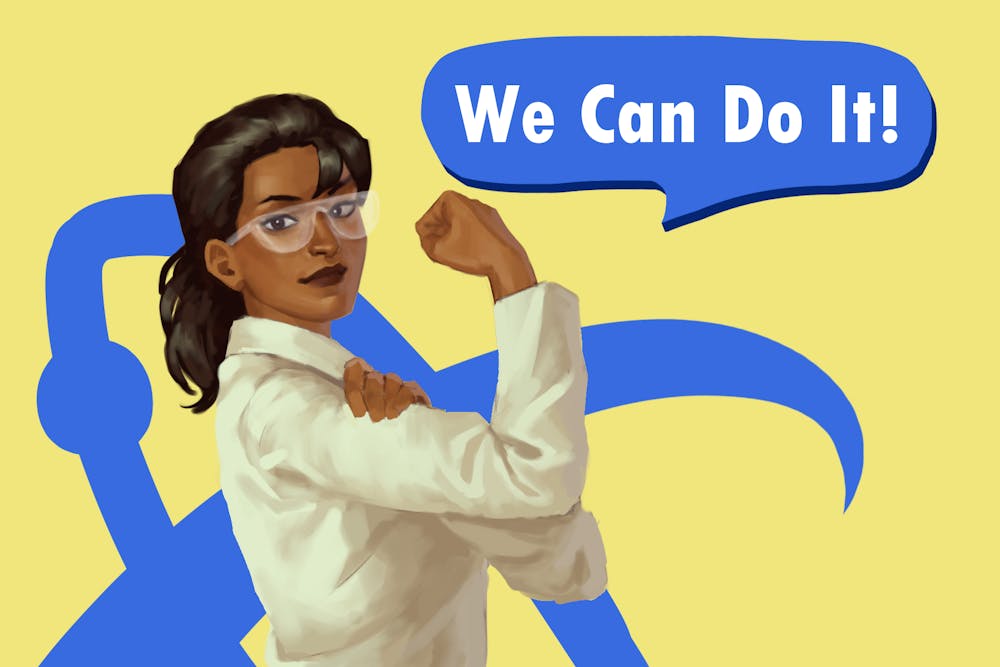
Student researchers have worked to develop solutions for the unique challenges women face, countering the historic dominance of STEM fields by men.
Zoe Haise, a senior studying biomedical engineering and a team member on one of the research projects, said many issues have been studied primarily for men rather than women.
The research teams hope to change that by building products that specifically help women.
"At the end of the day, the women are 50% of any product's stakeholders," Haise said. "We want to make sure that their voices are heard and taken into account."
BV Balance
At the 2026 Nexus Summit, hosted by the Luminosity Lab, three students presented their team's solution for bacterial vaginosis called BV Balance.
"The more that we looked into bacterial vaginosis, the more we saw that there's a really large gap in treatment," team member Claire Kennedy, a senior studying biomedical engineering, said. "Current treatment is antibiotics, and antibiotics aren't able to fully clear up the infection, so women kept getting a recurrence over and over again."
Daniella Gentile, a senior studying biomedical engineering and another team member, said they saw thousands of women online asking for advice because antibiotics do not keep BV at bay long-term.
READ MORE: Student teams present innovative solutions to real-world issues at Nexus Summit
Haise said the team designed a tampon-like insert device with antimicrobial properties to be used alongside antibiotics. The device expands to conform to the vaginal canal, holding it in place and allowing fluid to flow through.
A common issue with BV antibiotics is that they kill "good bacteria" called lactobacilli in the vaginal microbiome, Gentile said. BV Balance's product addressed the issue by releasing lactobacilli to restore the healthy vaginal microbiome and reduce the risk of BV recurrence or other infections.
After roughly 25 days, the insert biodegrades and does not need to be removed, Haise said.
Postmenopausal women's cardiovascular health research
In another group project, Karla Sanchez, a sophomore studying biological sciences, researched the relationship between a gene variant more common in women and levels of a sensitive protein serum that indicates chronic inflammation, which can be a sign of cardiovascular disease in postmenopausal women.
"Our hypothesis for this whole research was that we believe that postmenopausal women who are carriers of the APOE4 allele would exhibit significantly higher stem levels of the inflammatory biomarker hsCRP (protein serum), compared to non-carriers," Sanchez said.
Her team used a database to gather a cohort of postmenopausal women over the age of 50 and a control group of non-postmenopausal women. They compared the women's hsCRP levels in relation to the APOE4 allele, but the results failed to support their initial hypothesis.
Going forward, Sanchez said she would like to explore how other APOE alleles impact postmenopausal women's cardiovascular health. As a researcher, she found limited information on the topic.
"Women's issues are so overlooked because, as a society, women are seen as less than, even though we are capable of doing as much as men," Sanchez said.
App and research for the Society of Women Engineers
Nandana Shibu Elizabeth, a senior studying computer science, centered her Barrett thesis around her experience with the Society of Women Engineers at ASU, which she joined as a freshman.
Shibu Elizabeth said that when she came to college, she experienced a moment when "you walk into a class of 200 people, there's 10 women in there."
She said being a part of an organization like SWE gives students a supportive community of female engineers and a sense of belonging.
Shibu Elizabeth also pointed out the bias that women in STEM face. She said she doesn't feel she has been discriminated against, but sees barriers working against women in engineering.
READ MORE: Phi Sigma Rho sorority combines Greek life with STEM
Inspired by her work as director of public relations for the club, she crafted an SWE app to organize the club's information and a literature review exploring the impact of community on female engineers. The review broke down into multiple parts, such as gender representation, theories about women in engineering and a survey that asked her peers about their experience in the field, she said.
Much like her own experience, she found that a strong female community within the male-dominated engineering field encourages women to stay and benefits them professionally, she said.
She said she hopes her SWE app will make it easier for future members to reap the benefits of that community.
"I feel like this will be a nice little legacy to leave behind if it actually ends up being used by a lot of people," she said.
Edited by Carsten Oyer, Henry Smardo, Emilio Alvarado and Ellis Preston.
Reach the reporter at sevoorhe@asu.edu and @sydneyontheair on Instagram.
Like The State Press on Facebook and follow @statepress on X.
Sydney Voorhees is a Senior Reporter at The State Press. She is also an intern at Arizona PBS and a member of Delta Gamma Fraternity. This is her second semester with The State Press, working previously as a part-time Sci-Tech reporter.