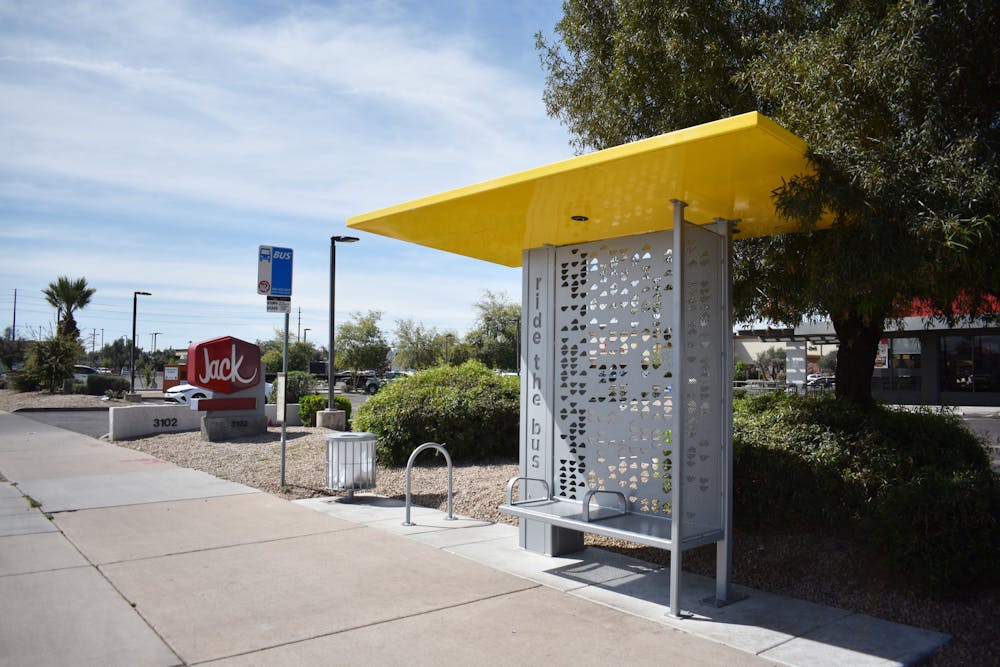
A new bus stop shelter along Mill Avenue does more than provide shade. The intricate steel cutouts are a public display resembling the patterns found in O'odham basket weaving.
The shelter demonstrates the personal heritage of artist Joshua Yazzie, who was selected to be a part of the City of Tempe's initiative to build shelters that are not only functional, but also inviting spaces that enhance the transit experience.
The artist-designed transit shelter initiative was commissioned in 2024, and four shelters are expected to be installed along Mill Avenue during the spring of 2026, according to Tempe's website.
An Our Town grant by the National Endowment for the Arts provides the funding for thinking about arts and culture as it relates to urban design issues. Through the grant, Tempe connected with an Indigenous artists continuum called Hekiu, according to Tempe public art manager Rebecca Rothman.
The result of the grant was the creation of set principles which cities and municipalities around the Valley can use as a guide to consider not just land acknowledgements but how the built environment reflects Indigenous culture, according to Rothman.
"Tempe Transit was starting this process of fabricating the transit shelters," Rothman said. "We were able to partner with them, partner with Hekiu, and put some of those principles into action."
Yazzie and artist Jacob Butler were selected to represent the principles and create designs that could be implemented into steel while enhancing the transit shelters.
READ MORE: Between cities and across zip codes: a guide to getting around ASU
Rothman said designing the shelters "really forces an artist to think about real-world application" as they consider visibility and safety.
The Tempe transit shelter project was Yazzie's first public art installation, and created challenges with computer-aided design software, but Hekiu artists helped clean up the final design.
READ MORE: Tempe residents share thoughts on Danelle Project redevelopment
The resulting structure, which is now installed, gives members of the public in downtown Tempe a look into Yazzie's artistry.
Yazzie said there is a flaw in the design, symbolizing humility and the occurrence of mistakes.
"There's always going to be some type of a mistake in any direction I go in, with my personal life or my artwork," Yazzie said.
Bobby Zokaites, an artist who worked on a different project for Tempe, said public art is quintessential.
"The work that is done in public art, it's not just the production of the artwork, it's doing the research into the area and meeting with the community," Zokaites said.
Tempe's public art plan considers connecting every resident and every visitor to Tempe with an arts experience.
"It also creates a unique setting and landmark that allows you to note that you are in the city of Tempe. It is unique and different here," Rothman said.
Edited by Alan Deutschendorf, Sophia Braccio, Emilio Alvarado and Pippa Fung.
Reach the reporter at csfishe4@asu.edu.
Like The State Press on Facebook and follow @statepress on X.
Charley Fisher is a reporter for the Echo at The State Press. She is a finance major and is currently in her third semester.