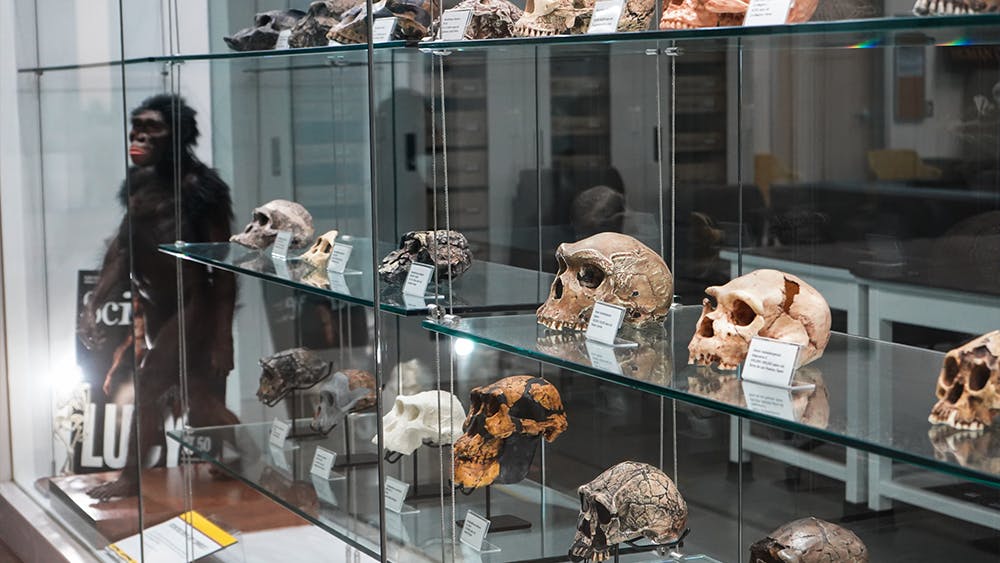
On Nov. 24, 1974, in the Hadar Triangle, located in Northeastern Ethiopia, a 31-year-old Donald Johanson made a discovery that changed human history forever.
As lunch time came around and the temperature reached 120 degrees, a team of paleoanthropologists were convinced they had seen all there was to see in the area. They'd been out since the early morning, surveying the land. As they headed toward their Land Rovers to leave for lunch, Johanson caught a glimpse of something over his right shoulder — a fragment of an elbow.
Johanson thought this could have been a monkey bone, but as he got closer and picked up the fragment, he realized it belonged to a human ancestor.
After a few minutes, he found more bone fragments belonging to a human. Their lunch plans quickly changed as Johanson went back to the camp and announced his discovery. The team rushed down to the site, and the partial skeleton was brought back to camp.
The discovery was monumental, but was only the beginning for the team. There were questions to be asked: Was it a "he" or a "she?" If it was a she, who was she? How old was she? Did she have babies?
"We were listening to a Beatles tape, and 'Lucy in the Sky With Diamonds' was playing," Johanson said. A member of the expedition named Pamela suggested the skeleton be named Lucy, since they were sure she was a female. Once a name was suggested, you couldn't change it. So the Lucy we know today came to be.
Her skeleton, and the other human fossils found on the site, had unique features in their teeth, jaws, bones and brain sizes that were distinct from any other known Australopithecus — a family of extinct primates, closely related to human beings.
Johanson's discovery has paved the way not only for science, but also for the ASU community. When Johanson founded The Institute of Human Origins and later brought it to the University, he marked his legacy as a scientist who contributed to the training of a new generation of paleoanthropologists and made science more accessible to everyone.
What brought Johanson to the Afar region?
To understand why Johanson ended up in a remote part of Northeastern Ethiopia, we need to go back to his first expedition to the country. As a graduate student, Johanson was working in southern Ethiopia. He met up with colleagues from Paris, France, who were there to study different fossils from various animals, including elephants and rhinos.
While in Paris, a young geologist named Maurice Taieb showed Johanson an envelope with photos of fossils over 3 million years old that had been found at the Hadar Triangle. Johanson was stunned, as these fossils were in more complete pieces from this time period than any he had previously seen. This led him to the Hadar Triangle to continue the search for more of these fossils.
Lucy was significant because she was found to have lived between 3 and 4 million years ago. At the time of her discovery, in the 1970s, the Australopithecus Africanus from South Africa was thought to be the common ancestor that led to later humans. But Lucy's discovery meant that the Australopithecus Afarensis was the new common ancestor, reshaping the family tree.
Now, given Lucy's status as a brand new human ancestor, she needed a scientific name. Johanson, wanting to honor the local people and region of Afar, named her Afarensis. "In 1978, she was published as a new species, a new kind of human," Johanson said.
The Institute of Human Origins
In 1981, Johanson founded The Institute of Human Origins in Berkeley, California. The IHO is a non-profit organization meant to research early human ancestors and promote scientists through public outreach. IHO became internationally recognized and moved to ASU in 1997 with the goal of training the next generation of scientists.
Yohannes Haile-Selassie, a world-renowned paleoanthropologist with a PhD from the University of California, Berkeley, became the director of the IHO in 2021. He then worked at the Cleveland Museum of Natural History as a curator of physical anthropology for 20 years. Haile-Selassie then came to ASU as a professor for the School of Human Evolution and Social Change, as well as the director of IHO.
Haile-Selassie described one of his professional goals as mentoring and training the next generation of paleoanthropologists. In the early days of the IHO, much of the research focused on fossils and archeology, or "bones and stones," as Haile-Selassie said. However, since the IHO moved to ASU, its focus became more interdisciplinary. Rather than just focusing on ancient fossils and tools, research has expanded to anything relevant to understanding humans, including biology, culture and genetics.
When Haile-Slassie first assumed his role as director, he wanted to showcase the interdisciplinary research of the IHO. He broke down the 18 tenured research scientists into three different groups: one group would focus on paleoanthropology, the core of the IHO; another would focus on culture, evolution and human behavioral ecology; the third group would study evolutionary genetics.
Each group had anywhere from 5-10 researchers, and this new approach changed how the scientific community viewed the IHO. It was no longer a small institution, but a large one putting out research on all aspects of human origins.
Haile-Selassie emphasized the importance of making research relevant to society. For example, researchers at the IHO study ancient diseases, which allows them to understand how these diseases affected populations millions of years ago, and how we can eradicate them today. Some researchers go to Tanzania and Uganda to study chimpanzees, not just to understand human origins but also for conservation projects.
IHO researchers go nearly everywhere in the world, from South America to Europe, Africa and all over the United States. There are still active projects going on in Hadar, Ethiopia, where Lucy was discovered. Haile-Selassie emphasized how interconnected the world is and how conservation is vital for protecting every one of us.
"We are combining our past with the global future," Haile-Selassie said. A core mission at the IHO is connecting the past to the future for the benefit of humanity. Sustainability and global futures are emphasized at the core of research.
She also believes that public outreach is an important part of paleoanthropology and the IHO. Under his leadership, the IHO prioritizes training graduate students to effectively communicate scientific discoveries to those with non-scientific backgrounds.
PhD students at the School of Human Evolution and Social Change receive their degrees from the school while conducting training and research under the IHO. There are currently over 30 graduate students training at the institute, and some undergraduate students even do work studies at the IHO.
By studying how plants and animals reached that change, researchers can be better prepared for the current period of global warming we are in. What happened on Earth, even 3 million years ago, can teach us all a valuable lesson about our present and our future.
Edited by Leah Mesquita, Natalia Jarrett and Abigail Wilt. This story is part of The Best of ASU, which was released on April 29, 2026. See the entire publication here.
Reach the reporter at jbanihan@asu.edu
Like State Press Magazine on Facebook, follow @statepressmag on X and Instagram and read our releases on Issuu.
Jude is a junior studying finance. This is her second semester with The State Press.