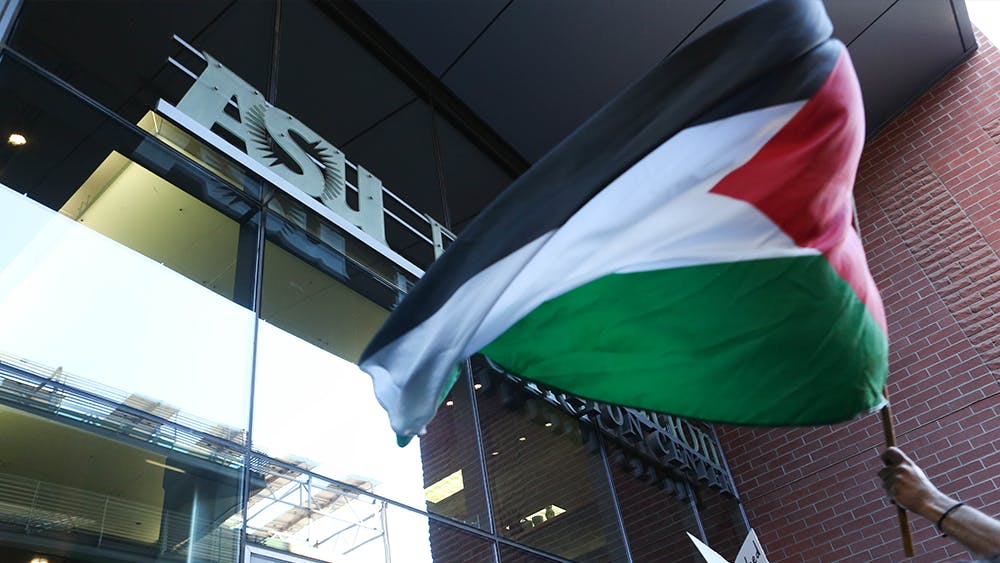
It's a Tuesday. Hot. I'm walking to the Hayden Library when I pass a protest. They're holding signs and carrying megaphones, their voices cutting through the air. A bead of sweat rolls down my back as I turn the music in my headphones up, put my head down and try to slip past unnoticed.
Protests like these are commonplace at ASU — so much so that they can fade into the noise of everyday life — but their role is pivotal in shaping our campus' culture.
Historically, ASU students have been seen as uninterested in politics. In a 2007 article by the Phoenix New Times, ASU earned the nickname "Apathetic State University," which described students as only being interested in politics when it came to high-profile individuals or media-focused events.
Despite these claims, ASU has a rich history when it comes to politics. In 1969, amid growing opposition to the Vietnam War and the draft, 22 students were involved in a three-day hunger strike to protest the presence of the Reserve Officers Training Corps on campus. These students endured intimidation from supporters of the program, and ten of them were ultimately arrested. This protest marked a defining moment in ASU's political history, carrying students into the race riot of 1989, demonstrations against the United States Customs and Border Protection recruitment in 2019 and the significant labor and anti-war protests of today.
The University's extensive past, along with the increased visibility and accessibility from the expansion of social media, has helped fuel the growing political community at ASU. From online engagement to protests gathering over 1,000 people, ASU continues to fight the "apathetic" stereotype.
Showing up
Jack Hinrichs, a junior studying politics and the economy, finds that more students are beginning to engage with politics. As the president of the Politics and Leadership club, he has noticed that more people are showing an interest in attending. Through this club, Hinrichs is able to facilitate an environment where students can share their beliefs in a space without judgment. Although the club is non-partisan, it seeks to inspire students to advocate for the policies they believe in, encouraging open conversation.
"One of the things that we seek to drive home is that you have a lot more in common with different people than you think," he said.
Kyah Antolos, a sophomore studying psychology, finds that these face-to-face interactions play an invaluable role in facilitating activism.
"At the end of the day, it's still important for students to continue communicating and spreading their opinions and their voices about things in person to other students," Antolos said.
Through her role in the Student Worker Alliance club at ASU, Antolos uses informational meetings and study groups to connect students with resources to make their voices heard.
"I definitely think that students at ASU, they do care about things going on, and they do care about wanting to make a change, but a lot of them just don't know how to get involved or what they can do to have their voices heard," she said.
Aside from her role in SWA, Antolos is very active in other forms of activism. During her time protesting on campus, she has found that optimism plays a titular role in fueling her drive to engage. For her, some of the most meaningful moments while protesting come from watching students realize their collective power, and that their voices can make a difference.
"People [that have] those moments where they realize that they are able to make change and that there is truly an ability for a better world to exist as long as people really fight for it," Antolos said.
She pointed to a recent example where ICE had been invited to attend a career fair in Downtown Phoenix, sparking protests.
"I believe a day or two later, ASU announced the fact that ICE was no longer going to be coming to that career fair," Antolos said. “That's just one instance [of] the power that students can hold when they're able to use their voices to speak out against the issues that they face on campus."
Hayden Nguyen, a junior studying business, built on this idea, believing that protests aren’t only about visible change. For him, they represent a change in consciousness as people gain an understanding of the powerful role politics play in shaping our lives.
In the broader landscape of American politics, Hinrichs argues that the true power of protests lies in consistency and sustained collective action.
"The effectiveness of protesting isn't from one individual protest, from one spectacular march or one especially moving speech. It's from the sheer weight of all of them combined," he said.
"It's in the aggregate. It's telling the people in power that we're not going to take it and we're going to stand on the street corner every day until you change whatever it is you're doing that we're not satisfied with."
Despite this, protesting consistently and showing up can be challenging. Antolos finds that many people don’t attend protests because they don’t think it will result in real change.
“To those students, I would encourage them just to come out to a protest and to see how it makes them feel, even if there isn't an immediate change in policy or immediate change in conditions,” Antolos said. “Protesting is an amazing way to bring people together and to use your voices in a way to uplift hope for the future and hope for our communities.”
Throughout his experiences protesting at ASU, Nguyen has found that the campus is much more politically active than people perceive. Rather than an indifferent student body, he describes a community that consistently shows up and is passionate about making a difference.
"ASU is my favorite place to have a protest, because every time I have a protest at ASU, it disproves what we're told about ASU," Nguyen said. "ASU is not an unserious school. It's not a conservative school … ASU is a vibrant community where people are ready to act."
Some students, however, find the rules associated with protesting on campus to be repressive. Nguyen notes that at many protests he has attended, the ASU Police Department has threatened to arrest attendees. During a pro-Palestine protest in April 2024, 72 people were arrested for failing to adhere to campus rules regarding encampments, with 20 of those individuals being students. Those students also faced an academic suspension that barred them from things like attending classes and prevented seniors from attending graduation ceremonies.
On the other hand, Nguyen argued that these sanctions are not applied evenly, pointing to events where more controversial demonstrations led by non-students were allowed to continue freely.
"I don't understand why they believe that it's acceptable free speech to have somebody, multiple times a semester, holding up a sign that says women are property in the middle of Palm Walk." Nguyen said, "When we have someone out there… advocating for their own communities that is unacceptable."
'Tweets to Streets'
As social media grows, its role in activism is ever-evolving. Social media is one of the easiest and most accessible ways for people to engage with politics, giving it a unique role in developing our political landscape. Shirven Zeinalzadeh, a graduate student studying political science, explores this topic in his study called "Tweets to Streets."
In it, he explores the role social media plays in fueling protests, finding that simply engaging with political topics on social media can be as powerful as physical participation.
"Protest in this day and age, particularly in the digital era, can be something as simple as liking a tweet [and] clicking the heart sign ... If you click that 'like' button, technically, that's a form of protest. You've agreed with a statement that can be deemed to be a form of protest," Zeinalzadeh said.
By engaging with a post, you are effectively sending a message. Zeinalzadeh described these new kinds of protests on a sliding scale, ranging from liking or reposting something, to actually showing up.
"It doesn't have to be arming yourself with pitchforks and burning torches and then setting fire to a house. It can be as simple as agreeing with something," he said.
One of the most prominent examples of this was displayed during the #MeToo movement, where social media allowed individuals to share their experiences. As more information was shared, the movement began to snowball, creating an online protest.
"[For] people clicking 'like,' it's not necessarily 'liking' the fact that she's [a female #MeToo member] come out, but they're 'liking' the fact that it's publicized, and they are protesting against the perpetrators of these crimes," he said. "That sends a signal saying we have identified this victim, we're with that person and we support this movement."
However, for Hinrichs, activism on social media is insufficient, saying that real work occurs on the picket lines.
"Ultimately, it's [social media] just a bunch of zeros and ones in a database somewhere. And so in that way, all social media activism — when performed alone — is performative," he said.
Despite this, the role of social media in shaping our political landscape is profound. The largest change Zeinalzadeh has noticed is how momentum on social media can mobilize a movement more quickly than in the past.
"You used to have to pin a notice up on the town notice board to say there's a protest. Now we can see that a protest can be organized, executed and broadcast instantly," he said.
Through his research, Zeinalzadeh explores the motivations behind protesting. He has found that it takes a deep, underlying belief for an individual to engage in a topic. The importance of that belief will determine the risks that people are willing to take to defend it, ranging from simply liking a post to being willing to put their lives on the line.
"There has to be an underlying cause of belief that people are passionate about," Zeinalzadeh said. "So there are plenty of protests taking place around the world at the moment, but for people to actively engage with it, it takes something to spark that interest."
As the popularity of social media rises, it is beginning to take a more formative role in inspiring and fueling these strong beliefs. Zeinalzadeh describes how the algorithms on social media often lean toward extreme content, because that is what makes users stop scrolling. As a result, content that evokes a strong reaction can play a major role in whether someone feels compelled to engage.
In addition, algorithms on social media can lead to the creation of an "echo chamber," where users are constantly exposed to information that aligns with their beliefs. This reinforcement can encourage participation, especially when people see others engaging. Zeinalzadah equates this to a form of peer pressure driven not only by people, but by social media platforms as well.
"Peer pressure comes not necessarily from the people that you hang around with or who you believe in the same cause as, although that's a major part, but it's also being contributed [to] now by the fact that social media clicks work out what you're interested in, and try to flood you with more," Zeinalzadeh said.
As the social media manager for Students for Justice in Palestine, Nguyen finds online platforms to be a powerful and crucial tool in furthering the club's goals.
"Its role when it comes to protests is to allow people to understand where we're coming from, even if they're on the fence," Nguyen said. “Social media serves the purpose of being there, to be the force that encourages people to come out."
Whether it's through social media or on the picket fence, it's clear that protesting at ASU isn't going anywhere anytime soon.
"In the arc of history, we're always fighting for justice, and justice is always achievable," Nguyen said.
Edited by Leah Mesquita, Natalia Jarrett and Abigail Wilt. This story is part of The Best of ASU, which was released on April 29, 2026. See the entire publication here.
Reach the reporter at llzettle@asu.edu
Like State Press Magazine on Facebook, follow @statepressmag on X and Instagram and read our releases on Issuu.
Lucia Zettler is a Magazine Managing Editor for The State Press. She is a junior studying Business (Law) and Journalism at ASU. This is her second year working at The State Press, with her previously holding the position of part-time magazine reporter.