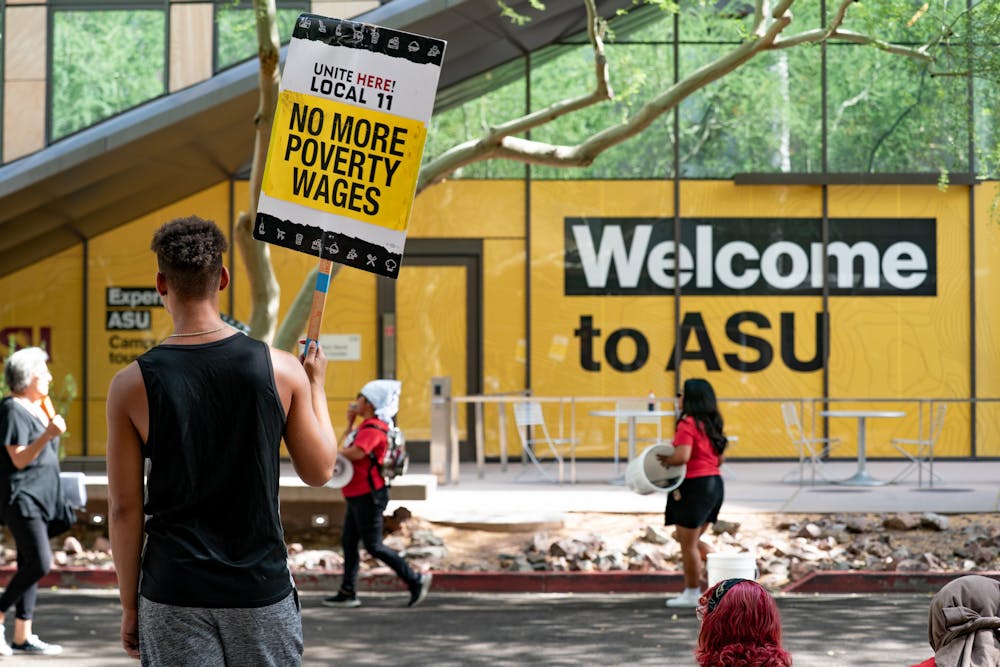
The union representing ASU's dining hall workers sued ASU Thursday, arguing that University officials violated its members' First Amendment rights.
The lawsuit, filed in federal court by the UNITE HERE Local 11 union, accuses ASU of using excessive force to unconstitutionally restrict the union's right to protest. The University, two ASU police officers, the Arizona Board of Regents, President Michael Crow and other University administrators were named as defendants in the lawsuit.
The complaint stems from ASU police arresting two union organizers at a protest outside the undergraduate commencement ceremony in May.
An officer forced one of the organizers to the ground and restrained her during the arrest. The complaint alleged the officer used unreasonable force, causing the organizer to "briefly experience choking" as the strap of her bullhorn pressed against her neck.
When another organizer moved to call attention to the alleged choking, she was also arrested. The arrests resulted in a serious wrist sprain among other injuries, according to the complaint.
The union workers were both charged with criminal trespass in the third degree, a misdemeanor, after not leaving University property despite several warnings from officers.
READ MORE: ASU police arrest two union organizers at protest outside undergraduate commencement
UNITE HERE Local 11 wrote in its complaint that University officials told protesters they could not enter areas around graduation venues, including a city of Tempe-owned sidewalk.
Both organizers were released from Maricopa County jail the next day, according to the complaint and are now banned by the University from entering ASU property for one year.
In a written statement, a University spokesperson declined to comment on the pending litigation. They said the University has policies and procedures supporting free expression, including the use of outdoor, public spaces.
"However, the university must also maintain normal campus operations and is not a place with unrestricted public access," the spokesperson stated. "ASU does not regulate the subject, content or viewpoints of speech, but has adopted time, place and manner guidelines for when and how that speech can take place on campus."
The government may limit protesting in public spaces if it does so indiscriminately and for the purposes of the public interest, according to Freedom Forum.
But public sidewalks, such as the one UNITE HERE Local 11 said its members were barred from protesting on, are historically viewed as places where expression can only be narrowly restricted to avoid specific harm caused by the speech.
The union said the University's restrictions on its assembly went beyond existing time, place and manner restrictions, alleging that the University effectively instituted a total ban on the union's protesting activities around graduation ceremonies despite other non-authorized groups being allowed to remain.
"By the time of graduation, ASU's restrictions were no longer a matter of time, place, or manner, but rather content-specific: the message of the workers' economic plight was not welcome in any form, at any volume, or at any time of day—precisely the kind of speech that powerful institutions would rather keep quiet, and that the First Amendment exists to protect," the union stated in the complaint.
Rachele Smith, a lead communications organizer with the union, said organizers are not aiming for a settlement, but accountability from the University and Aramark.
"What we're looking for is justice always," she said. "Economic justice, but also justice for our rights, because it is a very foundational right to be able to speak freely, to make your voice heard when you feel like you're not being treated correctly."
This lawsuit is the latest development in the nearly year-long labor dispute between Aramark, the company that operates the University's dining services, and its workers. The previous collective bargaining agreement expired on Aug. 31, 2025, and workers have protested and organized several strikes since.
The union has accused Aramark of paying employees unfair wages, offering meager benefits and maintaining unsafe working conditions. Aramark has consistently expressed a willingness to reach a settlement with the union.
READ MORE: Sen. Mark Kelly joins Aramark workers in picket line
Over 20 workers protested Thursday on the Downtown Phoenix campus, feet away from freshman students and their families moving into the Gordon Commons building.
Vanessa Martinez, who works at the Panda Express in Gordon Commons and whose sister was one of the two organizers arrested in May, said they held the protest Thursday because it was also Aramark workers' first day back. It offered the union an opportunity to welcome and reach new employees, she said.
Her sister's arrest further encouraged her to be active in the worker protests, she said. The lawsuit is a response to what she characterized as a pattern of the University restricting the union's freedom of assembly.
"We're not causing anyone any harm out here, and it's part of the First Amendment right," Martinez said. "They just don't seem to like us being out here fighting for what we deserve."
Edited by Andi Ruiz, Natalia Jarrett, Senna James and Kate Gore.
Reach the reporter at coyer1@asu.edu and follow @carstenoyer on X.
Like The State Press on Facebook and follow @statepress on X.
Carsten Oyer is a managing editor at The State Press. He has previously served as a politics reporter and a politics editor, and this is his fourth semester at The State Press. He is a junior studying journalism and political science at Arizona State University. Oyer has also worked for Cronkite News and interned at PolitiFact.