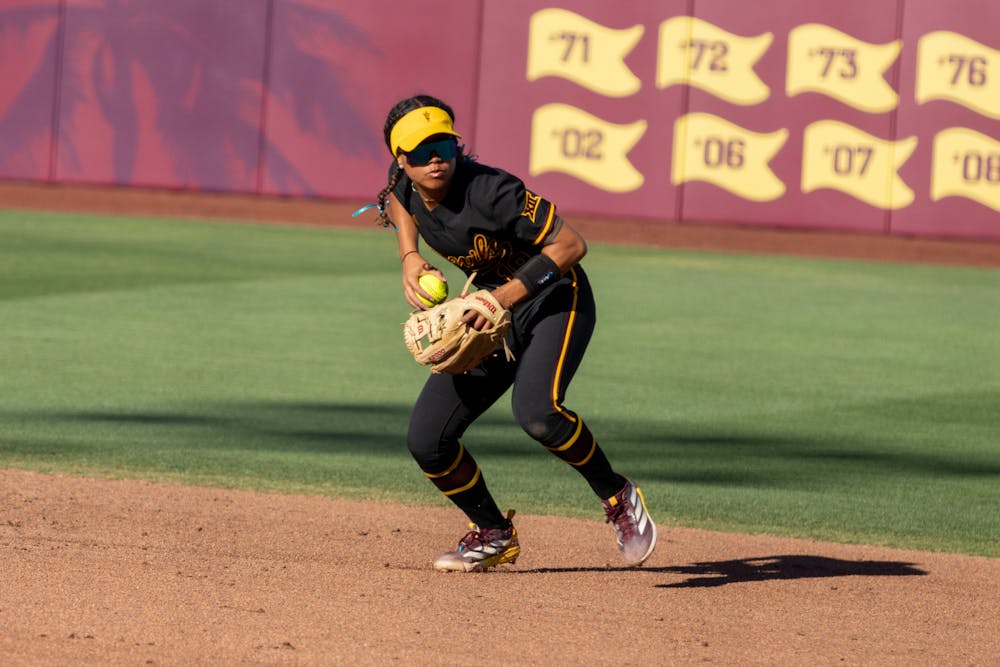
As May 1 marks the end of ASU's observation of Asian American and Pacific Islander Heritage Month, student athletes reflect on their identity and the convergence of their sports and culture.
AAPI month is often associated with celebrations of culture through language, traditional dress, dance and food. Alongside these staples, Sun Devil Athletics adds sports to this mix with a diverse array of competitors, including AAPI athletes who have found ways to celebrate their culture and find a sense of identity in their athletic communities.
Senior men's tennis player Shu Matsuoka was born and raised in Tokyo, moving to the U.S. at age 15 to train at a higher level at a tennis academy.
The language barrier created a significant challenge for Matsuoka, but he was able to utilize tennis as a form of communication and a way to bridge the gap between his Asian and American identities.
"Everybody here is expressing themselves, especially in tennis," Matsuoka said. "I had to change my personality a little bit, especially on the court, because there's so many times you have to show your existence and your presence to coaches, to teammates, to opponents."
READ MORE: Students continue to honor and celebrate Asian American Pacific Islander Heritage Month
Fijian sophomore swimmer Tolu Young experienced similar difficulties to Matsuoka upon his arrival to the U.S. in 2021, noting that he had never seen snow before his first winter in Washington state.
Even so, being able to swim at a more competitive level allowed him to connect to his upbringing in Fiji, an island nation where swimming is almost second nature.
"Growing up in Fiji, we're right next to the ocean always," Young said per ABC Pacific Sports. "Jumping in the ocean, it almost makes you want to become a better swimmer just so that you can do more with the water."
Young represented Fiji in the 2024 Paris Summer Olympics and acted as flag bearer for the country in the Trinbago 2023 Commonwealth Youth Games.
Both Matsuoka and Young see opportunities such as these, the chance to represent their home countries on an international scale, as an incredible way to pay homage to their origins while competing and growing in their sport in the U.S.
"Being able to go to an international competition like that and win a medal was very special," Young said about the Commonwealth Youth Games. "Not too many people have done that from Fiji."
For sophomore infielder Tiare Ho-Ching, celebrating her Samoan ancestry is not a matter of representing a specific country but instead engaging in teams and events that showcase the intersection of her sport and culture.
Ho-Ching was recently named to the American Samoa Softball Association's athlete pool class of 2026, with the opportunity to represent the team in the 2028 Summer Olympics. The sophomore is excited to meet more softball players who are also in the Pacific Islander community.
The infielder has also found a strong connection to her Samoan identity through the culture of ASU softball as a whole.
"Samoans and Asians, we really value family and community, and that's really important, especially here at ASU softball," Ho-Ching said.
Alongside Ho-Ching, junior offensive lineman Tana Alo-Tupuola and redshirt freshman safety Ben Alefaio-Lilii similarly celebrated their Samoan ancestry through football by competing in the Polynesian Bowl in 2024 and 2025 respectively. Sophomore tight end AJ Ia also competed in the 2025 Polynesian Bowl with Alefaio-Lilii.
Whether it be direct representation of one's country on the international stage or involvement with the cultural communities surrounding one's sport, it is clear that ASU athletics provides an opportunity for AAPI Sun Devils to honor their heritages and find their identities as multicultural athletes.
Matsuoka, Young and Ho-Ching will continue to push for greatness in tennis, swimming and softball while remembering the legacies they represent and their AAPI origins along the way.
"Looking up to girls that have played in the past, who are also Samoan or AAPI, has been really inspiring, so I'm excited to be able to play with those girls who have played before me and also share my culture," Ho-Ching said.
Edited by Niall Rosenberg, Senna James, Emilio Alvarado and Ellis Preston.
Reach the reporter at bcsmit41@asu.edu.
Like The State Press on Facebook and follow @statepress on X.
Brooklyn Smith is a reporter for the Sports desk at The State Press. She is majoring in English Literature and Economics. This is her third semester with The State Press.