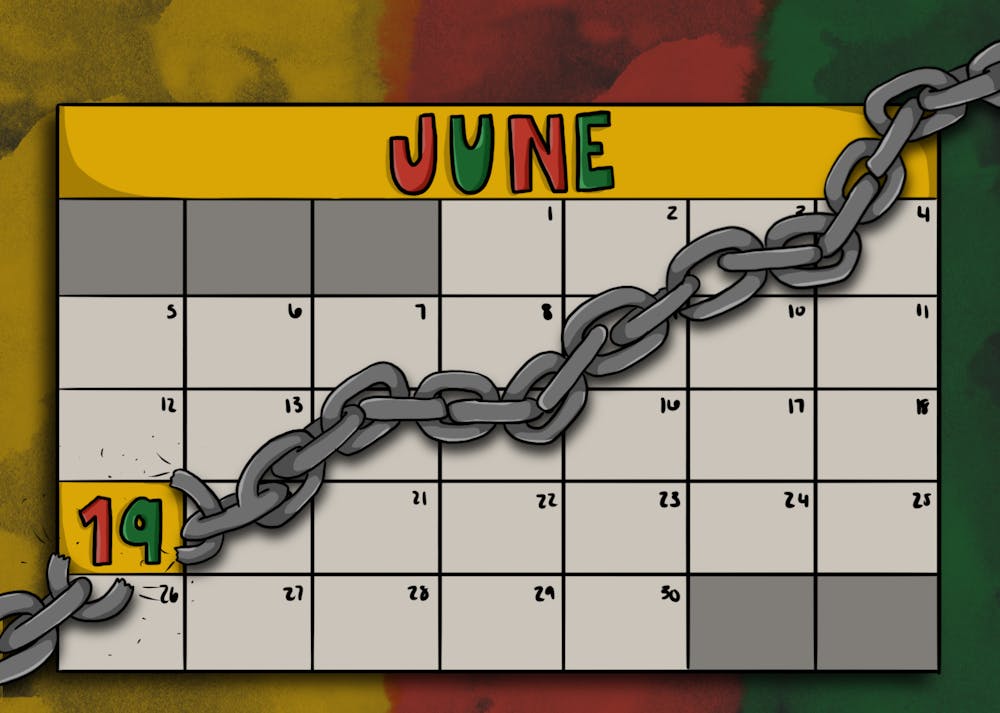
Black history continues to be recognized as Juneteenth celebrations memorialize the past.
Juneteenth commemorates the day Union Army soldiers announced the freedom of enslaved Black Americans in Galveston Bay, Texas. The name Juneteenth came from a play on words of the date when the Union arrived in Texas on June 19, 1865.
Union troops arrived in Texas, freeing over 250,000 Black Americans by executive decree under the Emancipation Proclamation, according to the National Museum of African American History and Culture.
Despite the Emancipation Proclamation taking effect in early 1863, it would take over two years for the decree to be enacted in Confederate states. June 19 marked the day that the last major concentration of enslaved Black Americans was freed.
Neal Lester, a foundation professor of English and founding director of Project Humanities, said the freedom granted to Black Americans did not always come without residuals.
"It's a time for commemorating and reflecting, but also being sober about the challenges that African Americans in the U.S. still face," Lester said.
Certain states, including Delaware and Kentucky, continued to resist efforts from the Union to abolish slavery. Slavery remained legal in these states until December of 1865, after the ratification of the Thirteenth Amendment.
Lester said that people often see the past as something that can be boxed away and set aside in a corner.
"Juneteenth is yet another opportunity to be reminded of a history that is still very much part of the present," Lester said.
Juneteenth has been celebrated within Black communities for over a century, honored as a second Independence Day for the country. Despite the commemoration's long history, Juneteenth was only recognized as an official holiday in 2021 under the Biden administration.
The Black African Coalition's co-president Maya Richman, a junior studying Spanish linguistics and psychology, said the celebration is more personal to her than just any other day off from work.
"For me, it represents how resilient we are as a community and our determination to fight and make things better for ourselves," Richman said.
Richman started participating in Juneteenth celebrations in high school after learning more about the holiday. She said attending local parades and festivals allowed her to support local Black-owned businesses and be a part of the community.
Juneteenth is a reminder that Black history is recognized year-round and not condensed into February, Richman said.
ASU has taken part in a community celebration of Juneteenth for the past five years. ASU Library's Black Collection partners with the Arizona Historical Society and the Black Family Genealogy and History Society for annual Juneteenth celebrations.
Jessica Salow, the Associate Archivist of Black Collections at the ASU Library, said the institutions came together to find a way to celebrate Juneteenth more robustly.
"We need to take that time to sit and celebrate and recognize how important it is for us to tell our stories," Salow said. "Juneteenth is just another opportunity again to have a little bit more of a spotlight on our stories."
The theme of this year's celebration was "we've come so far." Salow said the theme reflects resilience within Black communities and history.
The program included a discussion panel of Black Arizonans recognized in the community and a choreographed dance production.
The celebration not only honored Juneteenth but also the history of Arizona altogether.
"There is a lot of historical documentation, especially here in Arizona, that Black communities have been celebrating Juneteenth since the 1960's," Salow said. "It really is just bringing this back to the community so that they can have this opportunity to celebrate our history."
Edited by Alan Deutschendorf, Natalia Jarrett and Claire Bixby
Reach the reporter at dbell39@asu.edu and follow @dhemibell on X.
Like The State Press on Facebook and follow @statepress on X.
Dhemi Bell is the editor for the Community and Culture desk. This is her third semester with The State Press, working previously as a part-time Community and Culture reporter.


