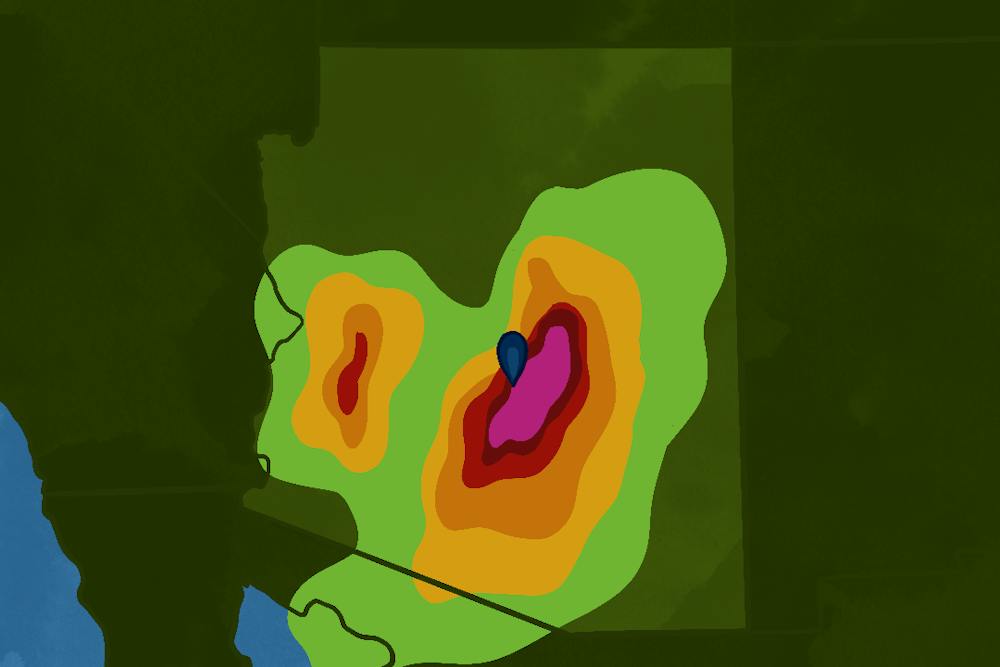
ASU researchers have spent this monsoon season ranking the Valley's dust storms on a new scale.
The Phoenix Dust Storm Scale was launched in June, the first of its kind to create a standardized measurement and ranking system for dust storms across the Phoenix area.
The scale uses factors such as particulate matter, wind speed, duration and geographic extent to classify dust storms between Category 1, minor, to Category 5, severe.
"It's impressive that you can bring all those different careers and backgrounds together and come out with a polished product that's being used by a lot of folks," said Jonny Malloy, a meteorologist for the Flood Control District of Maricopa County.
Malloy is an ASU alum who was brought in to work on the PHX-DUST Scale to provide a flood control perspective. He said the project is an important step in educating the public about dust storms — a staple of Arizona living that can be easily misunderstood, even by locals.
Dust storms, sometimes referred to as "haboobs," refer to the weather itself, while "monsoon" actually classifies the season between June and September when Arizona sees a rise in precipitation, thunderstorms and heavy wind activity.
READ MORE: Storm safety: How to prepare for monsoon season
Malloy added that people may assume a dust storm's severity based on how it looks, when sometimes air quality has a more significant impact on the storm's rating.
"Whether it's Category 1 or 5, it's best to try to practice staying indoors," Malloy said. "They're all air quality hazards in the end."
He said the PHX-DUST team has successfully ranked the storms during this year's monsoon season within 24 hours, giving the public quick access to information and a greater understanding of the weather. Rankings are posted on the PHX-DUST dashboard.
"We really wanted to emphasize that we could do a quick turnaround, even if the data is preliminary," Malloy said. "The challenge has been when these dust storms happen, say today, everyone wants to know about tomorrow."
Ryan Heintzman, a professor at the School of Geographical Sciences and Urban Planning, is one of the researchers behind the PHX-DUST Scale and the project's lead contact.
Heintzman said the idea had been "rummaging around" for many years, but the project truly started in 2020 in collaboration with scientists from 10 organizations.
Other contributors include the Arizona Department of Environmental Quality, Kitt Peak National Observatory and the National Weather Service in Phoenix.
Heintzman said the project being based in Phoenix allows researchers to look at the overall impact of monsoon season rather than just a peak concentration in a certain area.
READ MORE: Devastating dust storms, explaining the science behind the desert phenomena
"Phoenix is a good starting point because we have these (dust storms) happen every year, but we also have a robust network of the monitoring sensors, and that allows us to look at more than just what's the peak concentration at a certain point in downtown Phoenix," Heintzman said. "We can look at the entire Valley and say, 'Who was most impacted, and how long did it impact that site?'"
Malloy said the PHX-DUST Scale is currently localized to the Phoenix area but has potential to be adopted in other regions to suit their air quality, land and datasets.
Another common misconception about dust storms is that they can be linked to cases of valley fever, but some researchers believe the evidence points elsewhere.
Dave Engelthaler, the executive director of the Health Observatory at ASU, grew up in the Valley and said the belief that dust storms spread valley fever "absolutely was part of the story" then and now.
"I don't want to say it's a myth," Engelthaler said. "I want to say it's part of the mythology."
Arizona reports roughly 10,000 to 15,000 valley fever cases a year, but the number of actual infections is likely around 200,000, Engelthaler said. Many people are never tested, and patients visit a doctor multiple times before they are.
Because of those delays, most case data can't show whether dust storms cause spikes in the illness. To circumvent this, Engelthaler's team tests samples from air filters around the Valley.
When comparing the days before, during and after haboobs, "there's no statistical difference whatsoever," Engelthaler said.
The fungus that causes valley fever is associated with infected small mammals that die underground, and the risk of spreading the infection is greater where construction takes over virgin desert soil or old farm fields, Engelthaler said.
Engelthaler said he does not want to point fingers at development and construction but wants to come up with new solutions to lower the risks.
The storms also expose people to other pollutants that cause harm when inhaled — issues the PHX-DUST Scale can address, Malloy said.
"Going forward, it's bringing awareness to the monsoon season and its hazards," Malloy said. "Now that we can actually quantify dust storms specifically, I hope there's more of an interest on these dust storms."
Edited by Mia Sweador, Carsten Oyer and Alan Deutschendorf III.
Reach the reporter at lycifuen@asu.edu and ajanusee@asu.edu and follow @lexijanusee on X.
Like The State Press on Facebook and follow @statepress on X.
Lidia Cifuentes Santander is a Sci-Tech reporter for The State Press. She is a physics doctoral student at ASU. This is her first semester with The State Press.
Lexi Janusee is a senior reporter at The State Press. She is a sophomore studying Journalism with a minor in Theatre. This is her third semester with The State Press, working previously as a full-time Echo reporter.