Key points
- ASU maintains the presence of Flock cameras on campus despite community concerns.
- Tempe ended its contract with Flock and will be removing the cameras installed around the city — but not on ASU, where the cameras are separately owned.
- Mayor Corey Woods and City Council member Bobby Nichols both said they value the privacy of city residents and understand Flock cameras' threat to Fourth Amendment protections.
While the presence of Flock cameras emerges as a political issue in Arizona and nationwide, ASU is continuing to use the controversial devices.
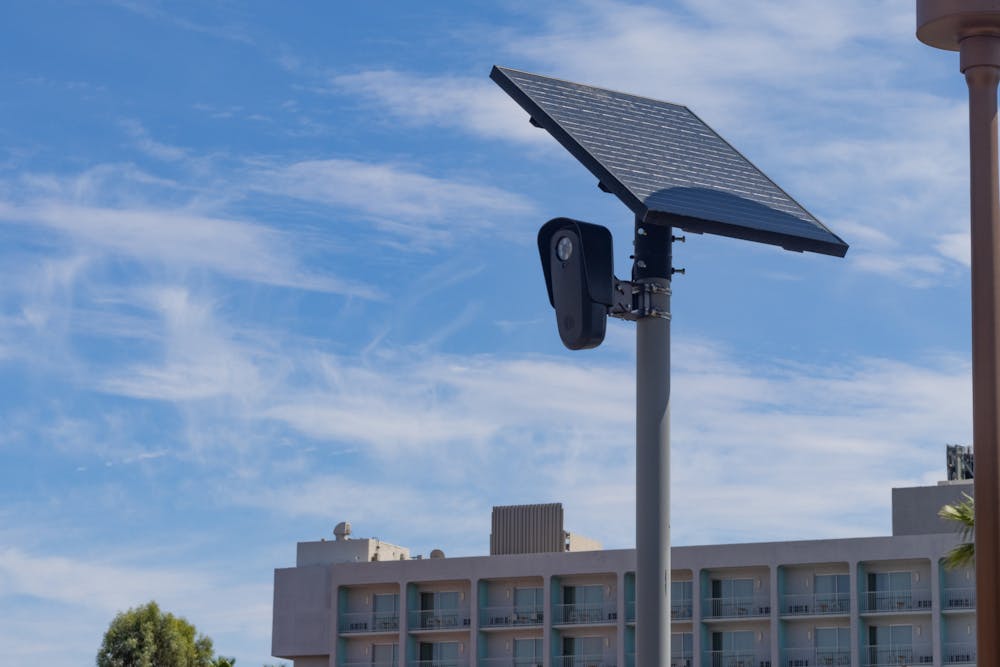
The cameras are created by the private company Flock Safety. They aim to help law enforcement reduce crime by creating a platform with tools that allow users to detect incidents, search evidence and coordinate responses, though they've come under fire over privacy and surveillance concerns.
There are 20 Flock cameras on the ASU Tempe campus, an ASU Police Department spokesperson said in a written statement.
The spokesperson said the information gathered by the University's Flock cameras is used by ASU PD's Real Time Analysis Center, which is a unit that analyzes footage to respond to crime on campus, "only as part of investigations and is considered alongside other evidence"
"Like ASU's other security cameras, the Flock cameras monitor only areas accessible to the public," the spokesperson said. "The Flock cameras are pointed at roadways only. Any other cameras you see on campus are standard security cameras."
READ MORE: ASU innovation spreads to campus safety, security amid concerns from students
The city of Tempe used Flock cameras starting in 2022, but it ended its contract with Flock and announced Wednesday it will have all the cameras removed.
On Aug. 11, the city announced in a press release that it was stopping all data sharing from Flock automated licence plate readers and were searching for a replacement vendor.
As of 8 a.m. Wednesday, though, the 33 Flock cameras in Tempe are offline and not collecting any more data. The city announced in a subsequent press release that it will not renew its contract with Flock or seek out another ALPR to replace it.
Tempe Mayor Corey Woods said at a press conference Wednesday that while monthly audits found zero cases of Flock camera misuse in Tempe, the decision was influenced by reports of irregularities at other Arizona agencies and the nation as a whole.
"Given a lot of the information that's come out over the last few weeks and also a few months, we made the decision that despite the fact that these have been helpful for the Tempe Police Department when it comes to closing cases and solving crimes and things of that nature, the concern was just the ability or the risk of misuse was frankly too great," Woods said.
Despite initially attempting to seek another ALPR vendor, Woods said he is confident the Tempe Police Department can complete their duties without the use of the cameras.
Tempe Councilmember Bobby Nichols said at the press conference that the City Council noticed a difference between the benefits of standard speed cameras at red lights and Flock cameras.
"The manual basic speed cameras ... have a traceable, statistical benefit in terms of saving lives by preventing fatal side-on collisions," Nichols said. "That is different than what we saw with Flock cameras."
Nichols said he has been against the use of Flock cameras, seeing them as a risk to Fourth Amendment rights.
In a written statement, a Flock Safety spokesperson said the company’s cameras are the "most accountable" tool in police technology.
"We respect the city of Tempe's decision, even though Tempe has acknowledged that Flock helped officers do their jobs and found no improper use by its own police department," the spokesperson said. "We believe Tempe could have preserved the system's value in helping solve serious crimes while still respecting privacy, and taking that tool away does not make a community safer."
The spokesperson said the Flock technology gives communities control over how their systems are used and are specifically designed to catch misuse with strong access and auditing polices.
According to a recent survey of 1,627 registered voters in Arizona by NextGen Polling, nearly 63% opposed ALPR camera use, and 82% were concerned about misuse of the devices.
Backlash to the cameras has emerged across the U.S., with cities nationwide pressured to end their contracts with Flock Safety, according to NPR.
On campus, students also voiced worries about privacy and the cameras' effectiveness.
Shrey Gautam, a junior studying mathematics and public policy, said he believes Flock cameras are a "grave privacy violation."
"If you believe that it is needed to prevent crime, it shouldn't be something that you depend on like a private company to have the control of the data for," Gautam said.
Alexander Zhao, a junior studying political science and economics, said the cons outweigh the pros.
"There's plenty of other ways to monitor crime on campus," Zhao said.
READ MORE: ASU Police Department hopes drone program will take off by end of semester
ASU PD released a new FAQ on its website addressing the issue.
The webpage states the cameras have been utilized in solving crimes, including assaults, burglaries and a shooting. Although other communities have stopped using Flock cameras, ASU PD will continue to use them to support public safety and criminal investigations.
The data is only shared with municipal, county and state law enforcement agencies for criminal justice purposes and investigations, according to the page.
A spokesperson for the city of Tempe said it is not capturing or receiving data from ASU's Flock cameras.
Nichols is aware of privacy concerns ASU community members have regarding the Flock cameras, he said. However, the city of Tempe does not have the authority to tell the University to remove the cameras, which are owned and contracted independently of the city.
The mayor echoed Nichols' point.
"The decision we made was a city of Tempe decision alone," Woods said. "At the end of the day, Arizona State University will make decisions about what they think is in the best interest of their students and their faculty and employees."
Edited by Andi Ruiz, Carsten Oyer, Senna James and Kate Gore.
Reach the reporter at swang496@asu.edu.
Like The State Press on Facebook and follow @statepress on X.
Quinn is currently a first-year Barrett student studying Business Data Analytics & Supply Chain Management with a minor in fashion. She is the Professional Development Intern for ASU's DECA Chapter and a part of Phi Alpha Delta in addition to being a politics reporter at the State Press.