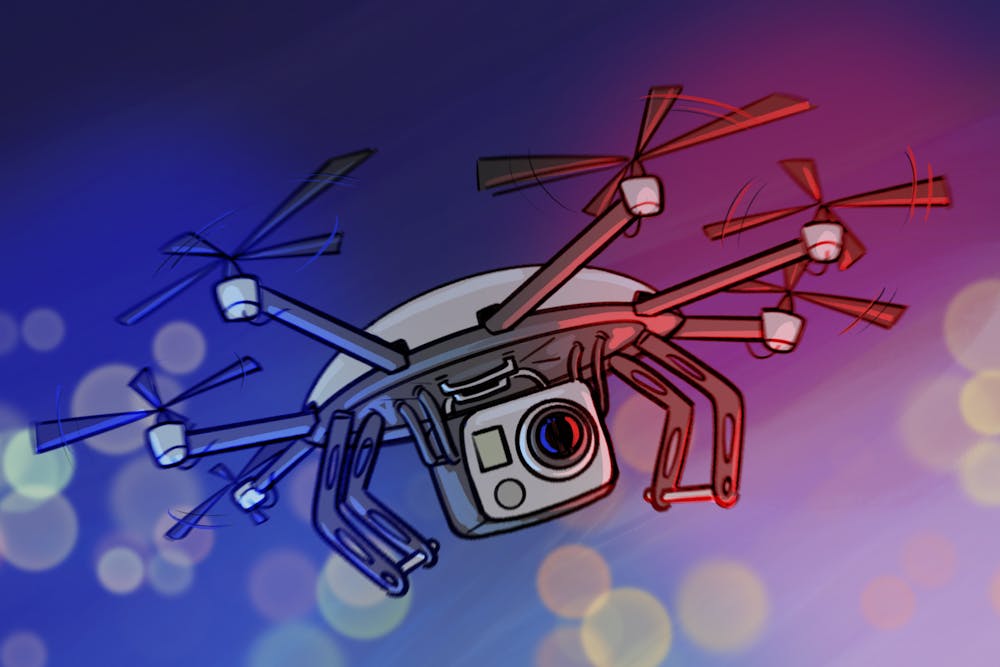
The ASU Police Department has developed plans for a drone program that would assist police officers with campus visibility and student safety.
Chris Hopkins, the manager of the ASU PD Real Time Analysis Center, said he is hoping the drones will take flight by the end of the semester.
He said these drones will be used as first responders for certain calls, such as in-progress thefts, physical altercations and car accidents. Their purpose is to "get eyes" on the scene faster and begin gathering information as officers are in transit to the call.
"This program is a pilot program, so we think that it's going to be very beneficial beyond what we can currently do," Hopkins said.
ASU PD currently has drones, but they are only used for events, Hopkins said.
The drone program was presented at a student forum with President Michael Crow in December 2025. ASU Chief of Police John Thompson said the drones would be used to rapidly assess crimes on campus and improve officer response.
READ MORE: Farming, drones, will.i.am: new ideas take forefront at Downtown Phoenix Crow forum
In cases where officers are unable to get through traffic efficiently, the drones can take off, fly over campus in a matter of seconds and provide officers with better information before reaching the scene, Hopkins said.
Hopkins said this program will be an additional tool for the community and help the department handle more situations without asking for additional support from other agencies.
The Mesa Police Department began its own drone program in 2018 to respond to traffic collisions and later expanded drone use in its special operations unit, said Stephanie Derivan, a commander for Mesa PD. From then on, it has created its own drone first responder program to respond to calls and patrol around the city.
Derivan said the benefits of drones in policing are extensive. Beyond responding to crime reports, they can help officers de-escalate situations and solve missing persons cases.
"If we can get eyes overhead to give them, 'Hey, there's a suspect in the backyard,' that's invaluable from an officer safety perspective and suspect safety," Derivan said.
Being "armed with information" helps officers determine the type of response needed in specific cases, Derivan said. It helps keep everyone involved safe.
"It's very rewarding to know that I can provide a resource to officers to help them do their jobs more effectively and efficiently, as well as to the community that we serve, that we can provide them a more efficient response and with safety in mind for both sides," Derivan said.
Michael Scott, a clinical professor in the School of Criminology and Criminal Justice and director of the Center for Problem-Oriented Policing, said he has been keeping up with drones in law enforcement for the past decade. This technology will be used for a variety of purposes, he said.
Scott said police began to use drones to respond to potentially violent disputes, but they are now also tools for documenting evidence.
"Police across the country are continuing to use them in that way, as kind of an advanced warning system to better prepare officers for what they might encounter when they arrive at the scene," Scott said.
He also cautioned against police forces using this new technology to unlawfully surveil the public.
"Drones can be used to combat crime, but they can also be used to commit crime," Scott said.
He added that "it's always incumbent on the police, whether it's university or otherwise," to justify and explain the adoption of new technologies to the public.
Scott said ASU PD has been good at developing creative ways to prevent crime on campus without the use of extreme measures. He said those kinds of tactics are worth encouraging.
READ MORE: ASU Police will test electric vehicles to reduce long-term costs
The drone program is currently slated to be Tempe-based, Hopkins said. Permits for other campuses may be harder to obtain because of landscape differences, such as tall buildings in downtown Phoenix.
He said he hopes this program will help ensure campus safety and allow students to focus on their education without worrying about potential dangers.
Edited by Carsten Oyer, Jack McCarthy, Sophia Braccio and Pippa Fung.
Reach the reporter at apruiz@asu.edu and follow @andiruiz2405 on X.
Like The State Press on Facebook and follow @statepress on X.
Andi Ruiz is a politics editor at The State Press. She was formerly a lead politics reporter and anchor at The Cut Network. This is her second semester at The State Press and is committed to bringing credible and accurate information to the ASU community.