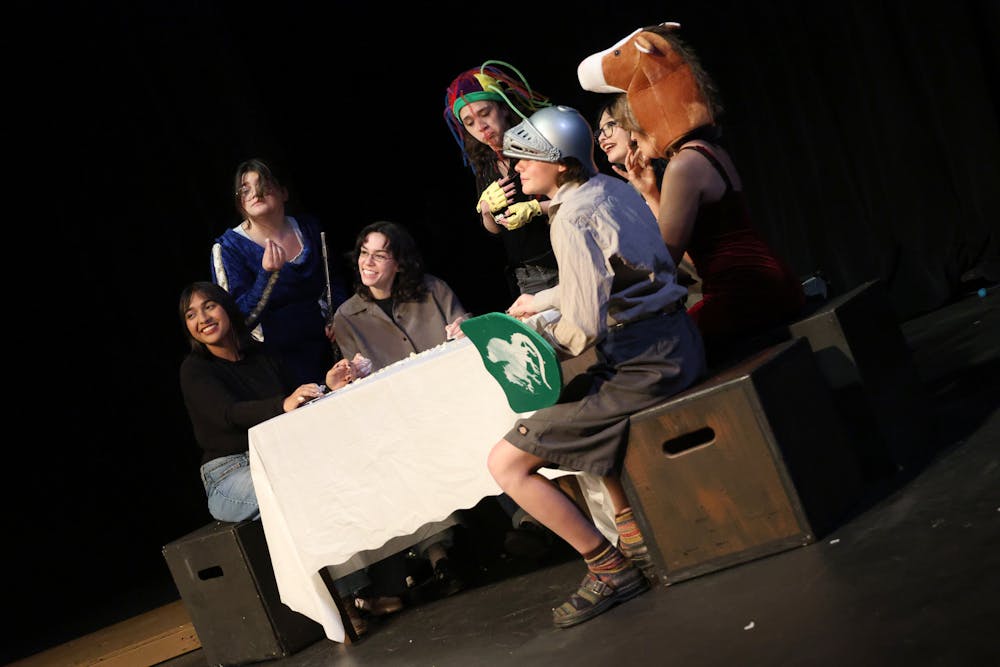
In the basement of the Memorial Union, transformed into an intimate comedy club, Governor candidates Ted Normalsville and Mr. Evil engaged in a serious debate punctuated by occasional fart noises.
The pair of politicians may have seemed like caricatures, but they represent humanity's most burning questions: How do terrible people keep getting voted into office?
The debate resulted in a landslide victory for Mr. Evil after he showed off the fearsome powers of his ray gun on Normalsville.
"You're a hero, Mr. Evil," said Gavin Pottebaum, portraying the role of moderator. "I don’t normally do this, and I don’t have authority to say this but… You win the debate!"
The sketch, titled "The Debate," was written by Pottebaum, a junior studying film and media production, and performed as a part of Farce Side Comedy Hour.
Every Friday night, Barren Mind Improv and Farce Side Comedy take the stage to perform similar sketches and improvised scenes. The two have been some of ASU's longest-standing comedy clubs and a constant for students looking for entertainment over the years.
The organizations have also grappled with larger questions regarding the field of comedy and how to create an inclusive space where every voice is taken seriously — regardless of the jokes.
Abigail Field spent a significant portion of her life in front of an audience, telling jokes and performing outrageous characters for her peers. She remembers being told that "for a girl, you're funny" and being questioned about where and how long she has been performing.
READ MORE: 'That's What She Said' helps break down gender barriers in ASU comedy scene
Field, a junior studying film, began participating in ASU comedy during her sophomore year.
She said male comedians have a reputation of being able to get away with hateful jokes, while women in comedy are under constant scrutiny.
"It is a male-dominated field for sure," Field said. "Coming from film and comedy, two very big, male-dominated spaces, I'm invalidated."
Nour Hassan, a senior studying psychology and biological sciences, is the president of TBA Comedy. She said that for the first time in TBA's history, the club's leadership is all female.
TBA performs every Monday night and, unlike ASU's other comedy clubs, members perform both sketch and improv as a group.
"There are definitely barriers to being a girl in comedy," Hassan said. "People naturally have laughed at jokes that might put women down, and that's something that we really try to avoid."
Hassan said the club is around 70% female, and members have looked for ways to make each other feel safe.
The comedy scene, even at ASU, hasn't always prioritized good taste or clean fun. Now, some students are adapting to shape the comedic landscape they hope to see in the future.
Improv-ing the scene
Before stepping on stage every Friday night, the small group of students that make up Barren Mind stand in a huddle. They take turns patting each other on the back, repeating the phrase, "I've got your back."
For comedians performing improv, this is more than just a pre-show ritual, said Ben Harwood, a sophomore studying theatre who has been part of the ASU comedy scene for the past two semesters. It builds trust and rapport between the performers.
Shea Riley, a senior studying theatre and director of Barren Mind, said improv is like a meditation for her.
"I get to jump into all of these different characters, and I get to laugh with all of my friends," Riley said. "It just feels like I'm able to disconnect from all of the hard stuff going on for a little bit."
Because Barren Mind performs in the intimate MU basement space, it has a close connection to its audience.
"We're constantly changing how we do comedy," Riley said. "What really helps is when audience members come out and they talk to us after the shows and they tell us what they liked."
Riley said the club has implemented new policies this year, such as office hours to address issues, a community agreement of acceptable behavior and a club-elected person for members to comfortably talk to about concerns.
She added that improv scenes can be less predictable to manage, because jokes aren't preplanned.
"People just use their good judgment, but a general rule is we try not to be hateful in anything we write or put out," Riley said.
If an improv scene starts to get out of hand, Riley said it is up to the performers to rein it back in. She added sometimes performers don't realize how they come across on stage, so post-show debriefs are an important part of the learning experience.
"We do evolve because of our audience," Riley said. "We want to try new things and figure out what kind of comedy works for young people and works for us as well."
A comedic spin
Harwood said a large part of what Farce Side does is satire, a type of comedy that makes fun of a person, idea or institution — such as "The Debate." Most importantly, satire is meant to make people think, not just entertain them.
"A big part of it is just making sure to not punch down," Harwood said. "When you're satirizing something or making fun of something, it's important that it's never a marginalized community or a minority or anything like that."
"Punching down" is a term used to describe when people ridicule others who hold a less powerful position than them.
READ MORE: SATIRE: Dick jokes, faux feminism and misogynistic men. Oh my!
Harwood said satire can serve two purposes: to address the world's problems in a lighthearted way and let people laugh about them.
"People in the audience will be laughing along, and then only realize later that, 'This is not only something funny that I saw on stage, but actually a deeper issue that I should pay attention to in my own life,'" Harwood said.
Many comedians will write sketches about things that they've experienced or noticed in the world around them, even if the inspiration is actually quite sad — and then put a comedic spin on it, Harwood said.
"For our mental health, we need to laugh. It's healthy to laugh," Harwood said. "We need, sometimes, an escape from the world, and I think comedy can be that."
When the jokes just don't land
Reflecting on her dozens of performances, Hassan said one of the challenging parts about being a comedian is that "you can't make everyone laugh all the time."
"The funniest thing about our team is if someone's bombing, we find it hilarious," Hassan said. "Even if no one in the audience is laughing, we're laughing."
Hassan said having a supportive community makes taking the stage less intimidating.
"Different senses of humor are what make our shows so fun to be at," Hassan said. "Just like we have different senses of humor, our audiences do too."
Field said the first time she performed stand-up comedy, she was overcome with stage fright and "blacked out" during her performance. She was sure she bombed, until she was approached by students the following day.
She said multiple people complimented her set and thought she was hilarious, which reminded Field why it's important to put yourself out there, whether that's through comedy or something else.
"That's why we need comedy, because we need to laugh at ourselves or we'll cry," Field said. "If we all take each other so seriously all the time, it's just going to weigh down, and we're not going to be able to do anything."
Edited by Carsten Oyer, Emilio Alvarado, Grace Lawrence and Kate Gore.
Reach the reporter at ajanusee@asu.edu and follow @lexijanusee on X.
Like The State Press on Facebook and follow @statepress on X.
Lexi Janusee is a senior reporter at The State Press. She is a sophomore studying Journalism with a minor in Theatre. This is her third semester with The State Press, working previously as a full-time Echo reporter.