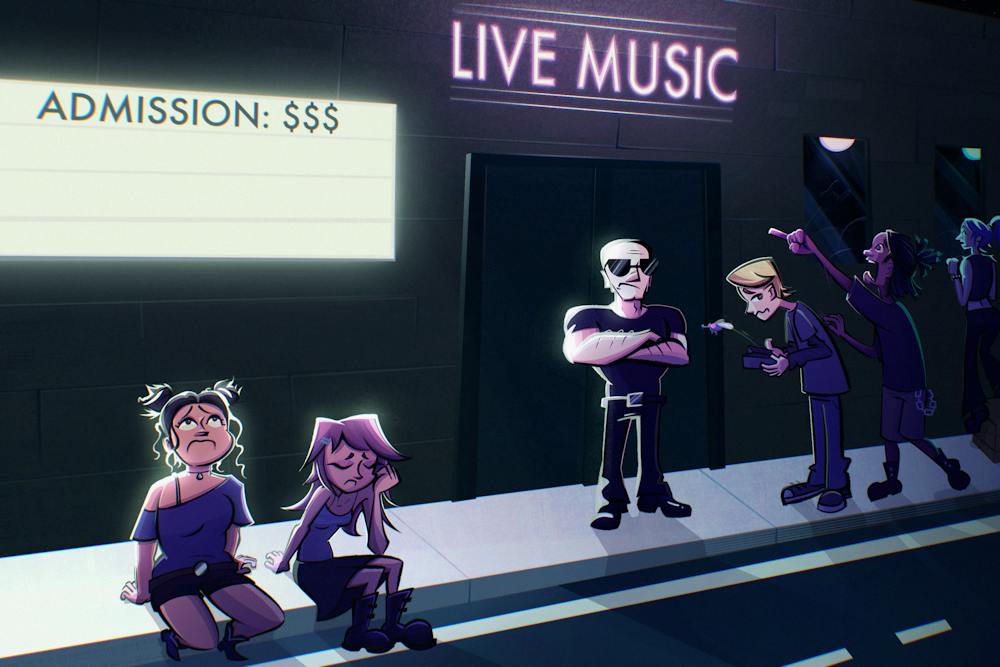
There is a difference between paying for a concert and being priced out of one.
For something that should unite people, concerts have been doing just the opposite. What was once a shared experience among fans is now defined by who can afford to be in the room.
The excitement of seeing your top-streamed artist is soon overshadowed by the question of if you can even fund the tickets alone.
A previously straightforward exchange between ticketing corporations and fans is now a test to see who's willing and able to succumb to these prices.
However, this past April, a federal jury found Live Nation and its subsidiary, ticket vendor Ticketmaster, liable for illegally operating as a monopoly, punctuating public outrage about ticket overcharging.
In spite of this verdict, ticket scalpers continue to mutilate face-value prices. Dynamic pricing and service fees have also continued to contribute to an inaccessible market for many.
Concerts are designed to feel communal, with thousands of people in the same room because they care for the same music. Everyone sings the same songs, and everyone is eagerly waiting for the act to take the stage.
READ MORE: Everyone's on tour: Here's which concerts to see this fall
This sense of togetherness begins to disappear and irony begins to present when the admission cost decides who gets to attend.
Granted, an artist deserves to make money from their work. Touring is a tiring and expensive process and there are hundreds of people involved in making it happen. Wanting live music to be accessible does not mean expecting musicians to work for free or for venues to take a loss.
The problem is that these excessive prices have become normalized. According to CouponBirds, ticket prices have risen at a rate almost five times as much as the pace of inflation since 1996.
A concert ticket costing well into the $100 range is no longer considered shocking. And depending on the artist, that's considered to be a "good" price. We're being expected to accept that seeing an artist we love in concert is an expensive privilege.
READ MORE: Money's down, but vibes are up: Examining the resurgence of recession pop
It's a strange predicament to put fans in. It's no longer a matter of if you want to go; it's a matter of if you want to spend enough to go.
You can save for months, skip other live events and convince yourself the price tag is justifiable, but it doesn't mean this needs to be the standard in live music. A night out requiring months of preparation is absurd.
Not to mention it's even more of a tormenting decision when many household-name artists tour only once every few years. If you decide to hold off on seeing them during this tour, there's no guarantee that they'll come back to your city. For many, this could be the only chance to see your favorites live.
That pressure makes the price feel heavier. You're not only paying for a few hours of live music — you're also now paying for a once-in-a-lifetime opportunity.
Live music does not have to be completely detached from profit, but it should not become so expensive that being a part of it becomes determined by someone's economic status alone.
With that being said, it's important to note that live music isn't inaccessible in the sense of never being able to afford a show; it's inaccessible in the principle of having to choose between an underground artist and a headline name.
You should be able to support local artists while also not having to eliminate the idea of a big concert because your wallet will likely feel the immense repercussions.
READ MORE: As concert ticket prices skyrocket, local artists are reaping the rewards
Live music is meant to bring people together and create a shared experience. Instead, it has become a way to exploit fans through commodifying an experience, leaving us to question who artists and venues are actually making these shows accessible for.
If concerts continue to remain luxury status, we risk losing sight of the community that brought us together in the first place.
Editor's note: The opinions presented in this column are the author's and do not imply any endorsement from The State Press or its editors.
Edited by Sam Troester, Alan Deutschendorf III, Senna James and Sophia Keeling.
Reach the reporter at evwestfa@asu.edu and follow @ellwestfall on X.
Like The State Press on Facebook and follow @statepress on X.
Ellie Westfall is a Reporter for The Echo at The State Press. This is her first semester working with The State Press, and she is in her second year at ASU with a double major in Journalism and Political Science.


